

• I’ve done a lot of thinking about the economics of that Jimmy Stewart Christmas movie, but now Lisa Clark Diller has me thinking about the economics of that other Jimmy Stewart Christmas movie.
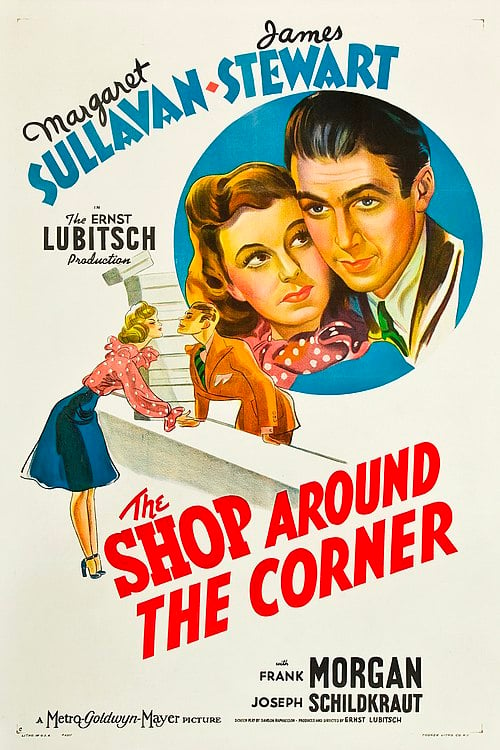 The Shop Around the Corner is a delightful comedy that belongs on all those lists of Best Christmas Movies. It’s also a terrific romantic comedy with a great set-up: Stewart and Margaret Sullavan play co-workers in a small luggage shop who don’t get along. He sees an ad in the paper inviting correspondence with a lonely woman and begins writing to her. They agree to avoid names and personal details in their letters, writing instead of their ideas, their hopes and dreams. He falls in love with this woman and she falls in love with him without either one of them realizing that, of course, she is his co-worker, Margaret Sullavan.
It’s such a great love story — with such a warm, Christmas-in-retail setting — that it’s been remade a half-dozen times, including as a Tony-award winning Broadway musical, She Loves Me, and in the modernized AOL-era computer-dating rom-com You’ve Got Mail.
That last one is my least-favorite Tom Hanks/Meg Ryan movie, partly because its re-write of Shop Around the Corner makes them not co-workers, but rivals, with Hanks as the owner of a chain bookstore company that’s killing off its competition, including the small children’s book shop run by Ryan. It would have been an absurd fantasy for the movie to end with Ryan triumphantly keeping her small business afloat after being threatened by Hanks’ corporate behemoth, so that fairytale ending doesn’t happen just because it’s Christmas.
That’s realistic, but it’s utterly unsatisfying. Happily Ever After shouldn’t just mean that Hanks and Ryan fall blissfully in love, it should also mean that her cozy little artisanal children’s book shop stays open forever, whether or not such a thing is possible.
That’s what Lisa Clark Diller is getting at in her smart post about “The Economics of Christmas Romance Movies.”
It isn’t clear how any of the arts and crafts shops featured in the films make a profit or pay the bills, and sometimes this is the heart of the problem in the story. The “evil” big business investor sees the problem and wants to fix it. Most of the time good triumphs and creative thinking or the pulling together of the whole town allows the business to stay open or change to address the latest trend.
This is wishful thinking. It is the very belief in this Christmas magic that makes it seem that such village economics is possible. It’s part of the same fiction that makes it snow on Christmas day with such regularity, or reveals that the cute carpenter down the street is actually secretly a duke or prince with lots of money. The world we live in is all too frequently shaped by 5 or 6 large corporations and those businesses that are dependent on them. All too many jobs feel meaningless. Part of the pleasure of holiday romances is the notion of agency in the workplace, jobs that are connected to the community, and where folks can see the fruits of their labor.
These movies are fantasies, but they’re fantasies that might help us to imagine living somewhere other than here in Potterville.
• This post — “Libertarianism under the false cover of formalism” — discussing the three branches of our federal government reminds me of this classic video from Lutheran Satire, discussing the three persons of the triune God:
All of trinitarian theology is speculative argle-bargle that exists, mainly, as a heresy-making machine to entrap people like poor St. Patrick in this video, forcing them to just shut up and refuse to say anything other than reciting the impenetrable mantras of the Athanasian creed in the hopes that we’ll then be allowed to get back to, like, loving God and our neighbors without constant interruption from catechical inquisitors.
But having said that, the “unitary executive” is a kind of trinitarian heresy. Is it likely to be enshrined by the corrupt justices of the current Supreme Court? Yes, probably. That cadre of partisan hacks is all about inventing new doctrines, tossing aside centuries of precedent, and ignoring the unambiguous language of the Reconstruction Amendments.
They’re eager to rewrite as much of the Constitution as we’ll let them get away with because they’re not bright enough to realize that the same body of laws and precedents they’re eliminating includes things they might one day miss.
Anybody who thinks this radical “unitary executive” nonsense, or “originalism,” or the divine right of [some] presidents, can excuse their naked, lawless power grab deserves exactly the same derisive disrespect shown by the twins in that video.
• Most Americans do not have the energy and/or surplus mental and emotional capacity to follow heady abstract debates about “unitary executive” theory or the meaning of “Chevron deference,” etc. But these things matter for their lives in concrete ways.
Here’s an example of that: “Under Former Chemical Industry Insiders, Trump EPA Nearly Doubles Amount of Formaldehyde Considered Safe to Inhale.”
Reading what brilliant lawyers like Steve Vladeck have to say about the unitary executive and the contradictions of “formalism” is important and a good use of your time if you’ve got that kind of time. But if you’re talking to co-workers about this stuff it’s better to start with, or to stick with, “Trump’s EPA doesn’t protect you, it protects chemical companies who want your kids to inhale formaldehyde.”
Headlines like this one — “SCOTUS’s GOP Justices Are About to Hand Trump Way More Power” — are also more clarifying than diving deep into the weeds of which articles of the Constitution ought to govern the operation of executive agencies created by Congress to act independently.
But it’s even more clarifying if we also say that SCOTUS’s GOP Justices Are About to Hand Trump Way More Power To Make Your Kids Breathe More Formaldehyde.
• Cheryl Rofer knows more about this stuff than most of us, so I’m inclined to trust her take on this anxiety-inducing news story: “Drone Damage to Chernobyl Confinement Structure.”
That sounds bad. And it is bad.
But Rofer says it’s probably not as bad as you might think when you hear that a Russian drone strike punched a hole in the roof of the dome covering the radioactive site at Chernobyl. Rofer writes: “The bottom line is that confinement is marginally less effective than it was before the drone strike, and that damage to the structure will increase if the hole isn’t fixed as soon as possible.”
I may borrow this language to describe my own leaking roof. It’s rain-deflecting properties are, at this point, marginally less effective. But also I worry that damage to the structure will increase if the hole isn’t fixed as soon as possible.
• On a somewhat related note, December is a fundraising month here at the blog. Here’s my PayPal link, and here’s my Venmo: @George-Clark-61. Thanks.
• Some follow-ups to our recent discussion of the litigious street-preacher industry …
In boggling over the street-preacher’s choice to attack fans of the aggressively wholesome country artist, I mentioned his sweet, emotionally healthy duet with Carly Pearce, “I Hope You’re Happy Now.” I had forgotten that Satanic Panic Inc. had previously targeted Pearce as a Satanic Jezebel herself. That was because after playing the CMA Fest, she posted a picture of herself in her artists’ parking space and wrote about how it was a dream come true for her to be performing on such a stage.
Pearce’s parking spaces were numbered and hers had the number 668. Revelation 13:8 says that the “number of the beast” will be 666. And so some good Christian folk decided that Pearce must have been using numerological codes to tell the world that it was a dream come true for her to be almost right next to Satan. Or something.
Anyway, thanks to the news alert for “Satanic” in my RSS feed, I’ve been getting an endless stream of nut-picking aggregation stories on the “Satanic imagery” in Vegas Sphere shows by the Zac Brown Band. Here’s the rare exception to that, an article that looks at the imagery from those concerts and explores the story that Brown was trying to tell by, like, citing interviews where the singer talks about it in his own words: “Breaking Down the Bizarre Conspiracy Theory That Zac Brown Band’s Sphere Shows Are ‘Satanic.'”
• Can’t say I’m a Zac Brown Band “fan,” but I do like this song of theirs, the lyrics of which supplies the title for this post:














 Ad-Free & Subscriber Log-In