

This is a good, very helpful essay from Tripp Fuller.
After some introductory talk about Bonhoeffer and the German church and “sequential complicity,” he digs in on the recent shift in white evangelical history and identity:
There’s a story white evangelicals tell about their entry into politics. It goes like this: In 1973, the Supreme Court legalized abortion in Roe v. Wade. Evangelical Christians, motivated by their deep commitment to the sanctity of life, rose up to defend the unborn. The Religious Right was born from moral conviction.
It’s a clean story. A righteous story. It’s also not quite true.
Which is to say it’s quite not true.
Fuller here is following Randall Balmer, the historian who has done more than anyone else to counter this false origin myth of the religious right and the way it has (re-)(mis-)shaped white evangelical identity, doctrine, and practice. The best short distillation of Balmer’s work on this is probably this Politico piece from 2014: “The Real Origins of the Religious Right: They’ll tell you it was abortion. Sorry, the historical record’s clear: It was segregation.”
Balmer has the receipts. This isn’t his opinion — he’s got evidence and documentation to back up what he’s saying. But it’s also strange that he’s doing this — or that he needed to do this — as a historian. Balmer was born in 1954. He lived through this and he remembers it.
I’m a bit younger than him, but I also lived through this and I remember it. Balmer was in grad school in 1980 while I was still in grade school, but 1980 isn’t ancient history. We’re not forced to resort to translating cuneiform or hieroglyphics here. We remember this all happening — the election in which Ronald Reagan defeated Jimmy Carter, the overwhelming support for Reagan among white evangelicals, and the reasons why they gave him that unquestioned, enthusiastic support. We remember when there was “a bear in the woods.” And we remember that the bear was not abortion.
I’m still amazed that so many others who also lived through this don’t seem to remember it. And that they’re so able — and eager — to “remember” something else, something that didn’t happen then. I mean, I understand how David Barton’s pseudo-history scam is able to work, because the false mythological history he’s selling involves events that did (and didn’t) happen centuries ago, before any of us were born. But why are so many people my age and older willing and able to replace their own memories with a false mythology that contradicts their own lived experience?*
For white evangelicals, God’s will was clear in the 1980 election. And God’s will — that they support Ronald Reagan –had nothing to do with abortion or with Roe v. Wade. It was mostly about Communism. White evangelicals were, at that time, Cold Warriors, not culture warriors.**
The culture war didn’t come to the forefront until the Cold War started winding down.
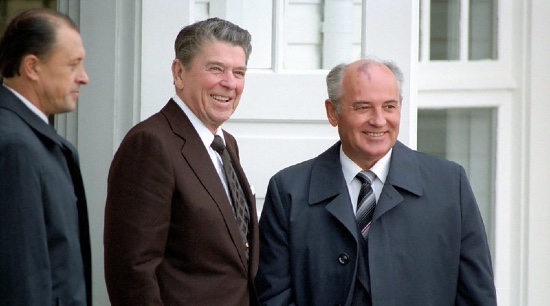
The culture war had always been there, of course, but up until Perestroika it had always expressed itself in the language of the Cold War. White evangelicals weren’t explicitly opposed to integration or to the Civil Rights Movement. They were simply opposed to Communism. And opposition to “Communism” just happened to include opposition to Brown v. the Board of Ed and to Loving v. Virginia, and to basically any other decision or legislation intended to see the 13rth, 14th, and 15th Amendments finally be supported by the force of law.
Fuller’s essay touches on this:
For decades, the one issue that maintained evangelical engagement with the public square was the specter of godless communism, viewed as a satanic threat to Christian civilization. Billy Graham emerged as a unifying figure, using his massive platform to link evangelical conversion with national identity and anti-communist patriotism.
But here’s what’s often left out of the story: during this same period, most white evangelicals remained opposed to the civil rights movement. Many used what they called the “spirituality of the church” doctrine to avoid addressing racial injustice—arguing that the church’s business was saving souls, not reforming society. The same theological move that had justified retreat from social engagement now justified silence in the face of segregation.
That understates the matter. One of the fiercest proponents of the “spirituality of the church” in the 1950s and 1960s was L. Nelson Bell, Billy Graham’s father-in-law. And for Bell, this “doctrine” did not justify silence in the face of segregation. For Bell, it demanded the unyielding defense of segregation. He regarded the Civil Rights Movement as a form of rebellion against God-ordained separation. Really — he was a “curse of Ham” guy, still, in the mid-20th century.
Bell had a name for the kind of disobedient, unbiblical, rebellious “Christians” who rejected his “curse of Ham” theology. He called them Communists.
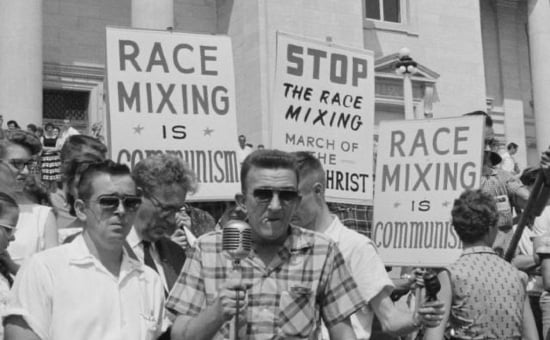
And he was an anti-Communist, that’s for sure.
Fuller then recites the same historical record that Balmer has documented. Fuller is a bit younger than me (I think), so he may not remember this personally like Dr. Balmer and I do, but again, this is all in the record. It’s not spin or opinion or something Balmer concocted. This is what happened — recently.
And then came the real catalyst—the event that actually sparked the Religious Right as we know it. It wasn’t Roe v. Wade.
In the mid-1970s, the federal government began challenging the tax-exempt status of private Christian schools that practiced racial segregation—most notably Bob Jones University. Conservative activist Paul Weyrich recognized an opportunity. He successfully mobilized evangelical leaders by characterizing the IRS actions as a secular assault on religious institutions. Here was a threat that could unite a movement: the government was coming after Christian schools.
There was just one problem. Defending segregation wasn’t a winning message for building a broad coalition. The movement needed a more respectable rallying point.
Opposition to abortion was discovered as a political tool only in the late 1970s—years after Roe—to serve precisely this purpose. The evangelical rank and file, who had shown little interest in abortion as a political issue in the immediate aftermath of the Supreme Court decision, were gradually taught to see it as the defining moral issue of the age.
Very gradually — and then all at once.
This is, as I’ve said before, “The ‘biblical’ view that’s younger than the Happy Meal.”
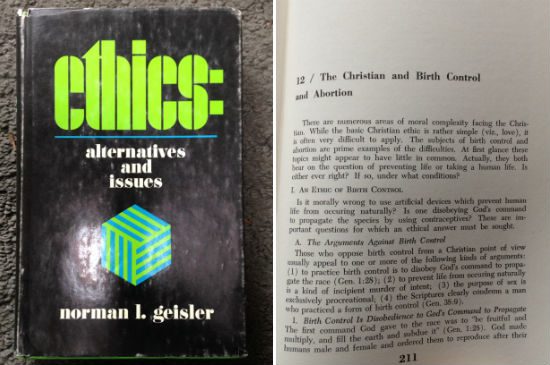
I’ve shared here many excerpts from Norman Geisler’s popular Zondervan Press book Ethics: Alternatives & Issues. That book was first published in 1971, including a chapter defending abortion as the right and proper and biblical choice for biblical Christians in many circumstances. I own a copy of the third printing of that book, from August 1975, a few years after Roe v. Wade. That edition of Geisler’s book still included the chapter endorsing abortion as a good and biblically sound choice for good and biblically sound Christians in many circumstances, still insisting that “Abortion is not murder, because the embryo is not fully human — it is an undeveloped person” and that this undeveloped person’s moral claims, while significant, must never outweigh the moral claims of the mother, who is a fully developed person.
That book was never retracted or condemned or criticized. It circulated among white evangelicals as a non-controversial primer on “biblical” Christian ethics. And then, a decade after that third edition, it was re-released with a new title and a new chapter on abortion that said the complete opposite of what the earlier editions of the same book had said.
My copy of that third edition of Geisler’s book is a tangible historical record. I can remember it, but I can also hold it in my hand. And when someone challenges my memory, or Randall Balmer’s memory, of the radically different before-and-after of white evangelical views on abortion I can smack them with Geisler’s book and point out that if this is really all just my imagination, then that shouldn’t hurt.
Fuller’s essay continues and develops well beyond his revisiting of Balmer’s history, but before we get deeper into that, I want to come back to look at another artifact of white evangelicalism — this one from 1981 — which, again, demonstrates how anti-Communism was paramount and anti-abortionism was inconsequential. That document is particularly helpful because it also does a great job of describing how anti-Communism was intended and employed to function as the defining feature of white evangelical identity, politics, and religion, and thus of the way that anti-abortionism would later be intended and employed to function.
* I’ve written about this before — see: “This Ain’t a ‘Historical Narrative,’ It’s Living Memory” and “You Must Remember This” and “An Artifact From the Before Time” and “The Change We All Lived Through But Don’t All Remember.”
** Our old friend Tim LaHaye is a good illustration of this. He started out as a John Birch Society guy. His agenda was their agenda — with his Top 10 priorities all being “anti-Communism.” Or look at his top competitor in the “Bible prophecy scholarship” market niche: Hal Lindsay, who had a lot to say about Gog and Magog, but nothing much to say about Planned Parenthood.












 Ad-Free & Subscriber Log-In