


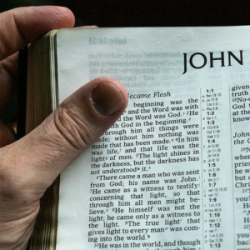
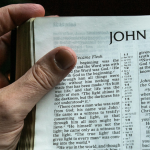
Our reading this fourth weekend of Lent is from the gospel of John, here is only beginning portion of it:
As he walked along, he saw a man blind from birth. His disciples asked him, “Rabbi, who sinned, this man or his parents, that he was born blind?” Jesus answered, “Neither this man nor his parents sinned; he was born blind so that God’s works might be revealed in him. We must work the works of him who sent me while it is day; night is coming when no one can work. As long as I am in the world, I am the light of the world.” When he had said this, he spat on the ground and made mud with the saliva and spread the mud on the man’s eyes, saying to him, “Go, wash in the pool of Siloam” (which means Sent). Then he went and washed and came back able to see. The neighbors and those who had seen him before as a beggar began to ask, “Is this not the man who used to sit and beg?” Some were saying, “It is he.” Others were saying, “No, but it is someone like him.” He kept saying, “I am the man.” But they kept asking him, “Then how were your eyes opened?” He answered, “The man called Jesus made mud, spread it on my eyes, and said to me, ‘Go to Siloam and wash.’ Then I went and washed and received my sight.” They said to him, “Where is he?” He said, “I do not know . . . ” (For full text see, John 9:1-41)
Welcome Readers! Please subscribe to Social Jesus Here.
This is Part 1 of the series Justice Lessons From Being Expelled
I don’t like when writers use people’s differences as metaphors for inferiority. Darkness as metaphor for evil has historically hurt those whose skin is darker than those with light or white skin. God is too often gendered as male and the fallen, redeemed church is gendered as female. In this week’s passage, a person’s real, lived-in disability, blindness, is used as a symbol of those opposed to Jesus and his gospel.
We can do better than this. We don’t have to throw some of our human siblings under the bus to lift up the intrinsic value and beauty of the justice ethics in the teachings of Jesus.
A translation challenge meets us in the very beginning of our reading this week. Verse 3 is one of the most debated translations in the New Testament. In many English versions, Jesus appears to say of the man born blind, “He was born blind so that God’s works might be revealed in him.” Read straightforwardly, this implies divine causation: the blindness exists for the purpose of a later miraculous display. This reading has troubled interpreters pastorally and theologically over the years, since it seems to portray God as inflicting suffering to stage a sign.
The difficulty arises from how translators handle the Greek clause that begins “hina” (“so that”). In Johannine Greek, “hina” can express purpose, and it can also introduce a result, an explanation, or function as a loose connective word rather than a strict causal marker. Greek manuscripts lacked punctuation, so translators must decide where sentences begin and end. These differences matters.
An alternative rendering breaks the assumed cause-and-effect link: “Neither this man nor his parents sinned. But that the works of God might be revealed in him, we must work the works of the one who sent me.” Here the blindness is not explained; it is simply the occasion or opportunity for divine action.
This alternate translation shifts the focus away from why the man was born blind to what God does in response to human suffering. The translation problem, then, is not merely a matter creating grammatical differences but also theological differences: whether the text teaches a God who causes disability for display or revelation or a God who confronts suffering with healing and change.
What jumps out most in this story, though, is what we’ll pick up with in Part 2.
Begin each day being inspired toward love, compassion, justice and action. Free.
Sign up at HERE.











 Ad-Free & Subscriber Log-In