


I went to Mass on the first Sunday of Advent.
That is something I can do now. I go to Mass, and this year I sit in the congregation.
For years, starting in 2021, I was just too traumatized to do that. I spent a lot of Sundays praying outside the church or staying home, because the flashbacks and panic attacks were just to bad in church. By early 2024 I was well enough to stay in the foyer for most of Sunday Mass and then leaving during the homily, in case the priest or deacon said anything that tickled my religious trauma. Now, for about a month, I’ve been sitting in the congregation. I don’t know if I’ll ever take joy in my Catholicism again, but I would still like to be near Jesus, and this is the compromise I’ve made.
It didn’t exactly feel safe, but it didn’t feel terrible.
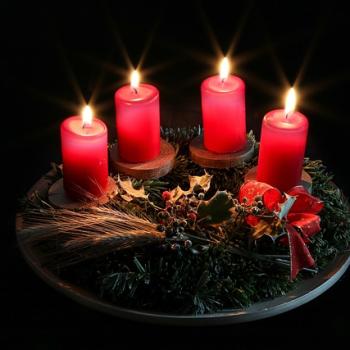
There was the Advent wreath, with a single purple candle lit and three candles dark.
What good could one candle do, in all of this darkness?
One of the last things my grandmother ever said to me was “I can’t imagine the darkness that’s come over you!”
I couldn’t imagine the darkness either, once upon a time. But this was in 2022, when I was still reeling from the horrific revelations of cult activity and sexual abuse among the Catholics in town. My grandmother knew that I was severely traumatized, both from my spiritually and emotionally abusive childhood and also from my experiences in Steubenville. She never talked honestly with me about that. She didn’t believe the Catholic Church was capable of wrong. She thought it was blasphemy to say so. If I brought up what happened to me, she’d ignore it or else get angry and tell me to pray more Rosaries. You were never allowed to say anything against the Church, because the Church was beyond reproach. That was the darkness that had come over me: I was expressing my trauma and my frustration with the Church, and that was unacceptable. After she scolded me for “the darkness,” never having once showed any empathy for what happened, I couldn’t speak with her anymore.
The darkness is still here with me, but I go to Mass now, and Adrienne comes along. Afterwards, on the way home, we talk about the music and the homily, what we liked and what we didn’t, our beliefs and our doubts. This is the opposite of the way I was raised, but it feels right.
There were the readings, all about the Parousia and the days that are coming.
As a child, these readings terrified me. I was constantly afraid of the end times. I was terrified of the three days of darkness and other dire prophecies. I had been assured, by the people in our social circle, that a great persecution was coming and our lives would be utterly ruined for the glory of the Lord. I hated that. All I ever wanted was for life to go on, without terror or chastisements or cataclysms, and to be happy.
Of course, that’s not what the readings were really about. The first reading was about the holy mountain of the Lord, where all the people will be at peace together and beat their swords into ploughshares. The second was Saint Paul exhorting the faithful to stay awake: not because something terrible was going to happen, but because something good was. The sun was about to rise, because Jesus was coming back. And the Gospel was Jesus warning the apostles that no one will be able to predict the end times. You will just be living your life, doing the things that you do– and then, one day, you won’t be.
I found that I wasn’t afraid.
I felt all kinds of things, lots of them unpleasant, but I wasn’t afraid of the end times.
That’s how I’d like to die, after all. Not in a cataclysm, but in the middle of my everyday life, doing the things that I’ve learned to be happy doing, finding ways to be good to my neighbors. I’d like to collapse one day after saying goodbye to Jimmy’s boy and sending him home with a plate of freshly baked cookies. Or for the meteorite to strike me one evening as I’ve finished up a semester of teaching after school classes at the church outreach, given the children their Christmas gifts, and started to head home to plan the next semester’s lessons. Or for the heart attack to come on while I’m covering the garden beds in compost in late October after harvesting every last tomato and squash to share with my neighbors.
I like the Christianity I find in the Gospels, so much better than the Christianity I was taught growing up.
The priest stood up to give the homily, and I cringed instinctively in case he said something terrifying. But he didn’t.
He just told a story. He said that in the old days, when a king was returning after winning a battle, the whole city would wait for him outside the gate. They’d stay awake and keep watch, so that the minute he arrived, they’d begin singing his praises and open up the gates to let him in.
And I was thrilled.
Because I’ve never, ever, ever once felt that I belonged in any kind of in-crowd, ever. I have always seen myself as an exile outside the gates of every single community I’ve tried to belong to. The closest I’ve felt to Jesus is during Holy Week, when the people of Jerusalem force a cross onto His shoulders and drag Him outside the gates to Calvary to be murdered. And here the priest had filled my mind with a story where the good subjects of the king were doing just what they ought, by waiting for him outside the gate.
The darkness is not something you’re supposed to avoid or not talk about. You are supposed to endure in the darkness, and be honest about it, and look for the little lights.
The end times are coming, but they are not terrible in the way that you think. Christ will come for you in the middle of your day-to-day life. Stay awake, not because you’re going to get in trouble, but because the sun is coming and the night will end at last.
Christianity is not a gated community where you have to belong and have good feelings about belonging. Christianity is the journey outside the gate, into exile, into uncertainty, into the mystery of day-to-day life, so that you can welcome the King.
Just for a moment I was really, truly happy.
Just for a moment, nothing hurt.
Mary Pezzulo is the author of Meditations on the Way of the Cross, The Sorrows and Joys of Mary, and Stumbling into Grace: How We Meet God in Tiny Works of Mercy.








 Ad-Free & Subscriber Log-In