

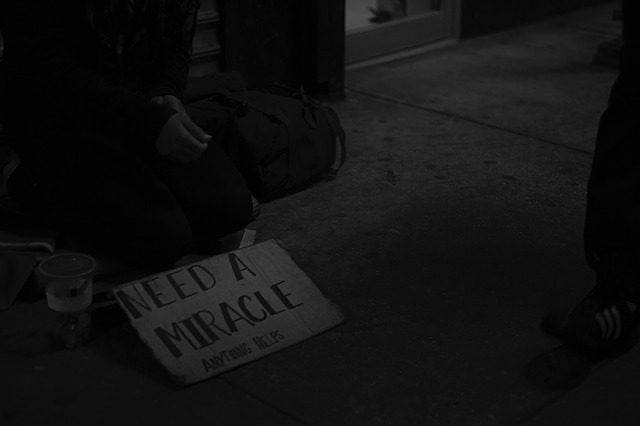
When I share stories like the one about the Cherry Boutique, or the trouble with poor neighborhoods or the mystery of free lunches at the pool, I get an outpouring of comments from my readers that they had no idea this kind of thing happened, and asking what they can do.
That’s one of the reasons I share stories about poverty up here in Northern Appalachia so often: because It needs to be seen. I’ve witnessed a lot of terrible realities that don’t seem very well known. Everybody knows that poverty exists, but they don’t often see the dark, uncomfortable details of how that can happen to people and how that really looks. We don’t get accurate representations of what the obstacles really are, and how ugly and complicated it can be in practice. We all know it’s painful, but we might not realize the was in which it hurts. I didn’t know anything about what it was to be poor before I lived here and had a taste of it myself, so I’m showing you.
As for what we can do to make poverty and homelessness stop– well, that’s a more complicated question.
Jesus did say that “the poor you will always have with you. ” I don’t believe He was declaring something He wanted to happen or stating some immutable fact about what humans are; I believe He was predicting that the sins people were committing two thousand years ago would keep on being committed. The world is broken. There are some ways in which the world can be fixed, and we should strive for those. We should look critically at our society and fight for a better one. Vote. Picket. Boycott. Write letters. Sign petitions. Perform acts of civil disobedience if you think it will make a difference. Start a foundation. Those are part of our duty, and they can help to fix certain things, and certain people will have a much easier time because of it, and that’s great. But the world will continue to be broken.
And in a broken world, people will get hurt. That’s inevitable. There are certain steps you can take to protect yourself from much of the hurt, but in the end, someone’s going to get hurt. And it won’t be the hurt person’s fault. This is one of the worst lessons to learn. We want to rebel against it with every fiber of our being. Our natural sense of justice tells us that getting hurt is bad and should never happen– or, if it happens, it ought to be a penalty. Getting hurt should be something that happens to people who do bad things to earn it. Life should be an American Chutes and Ladders board, a series of morality plays where good little boys and girls ascend to predictable rewards and bad little boys and girls slide down into just punishments. But it’s not.
We Christians should know that most of all. We venerate the cross– that most terrifying symbol that you can be a literally perfect Person and still be destroyed, but that won’t be the end. People get hurt through no fault of their own, and that’s something that is going to keep happening.
And we need to seek Christ in the people who have been destroyed.
Go back to that Gospel passage I quoted, where Jesus says “the poor you will always have with you.” It’s in the Gospel according to Matthew, chapter 26, the very next chapter after He tells the parable of the sheep and the goats– or rather, the prophecy of the sheep and the goats. In Matthew 25 He makes it very clear that that’s not just a metaphor the way the parable of the Good Samaritan or the Prodigal Son is; it’s something that really is going to happen. One day, Christ is going to come back and reveal that He was present to us in the people who needed our help, and in the ways we refused to help them, we refused to help Him. That’s the wire we’re all going to come down to; that’s the yardstick by which He will judge. After He says this, in chapter 26, Jesus is visiting friends in Bethany when a woman anoints His head with expensive perfume. The disciples are upset– Matthew doesn’t say it was only Judas who robbed the money pouch, specifically, who were mad at the woman, but “the disciples” in the plural. “Why this waste? The perfume could have been sold at a high price and the money given to the poor.”
Jesus answered them, “Why are you bothering this woman? She has done a beautiful thing to me. The poor you will always have with you, but you will not always have me. hen she poured this perfume on my body, she did it to prepare me for burial. Truly I tell you, wherever this gospel is preached throughout the world, what she has done will also be told, in memory of her.”
The disciples want to take their money and create a program to help “the poor” in the abstract, and Jesus doesn’t say they shouldn’t do that. They probably should. But they are upset at the money spent on a luxurious gift for someone and call it a waste. And that’s when Jesus tells them that actually, it’s the woman who got it right. She looked at a real Person who was there in front of her and did something really generous to honor that Person. “The poor”– that enormous abstract unwashed mass who live in the inner city or the Appalachian mountains or a third-world country– will always exist. But Christ we will not always have with us: individual encounters with Christ are fleeting. They come and go. They are before us in actual people, humans with needs who come into our lives and then disappear again. And we need to honor Christ in them by having compassion.
“The Poor” you will always have with you, and there are things we ought to be doing to improve society to help with that. Those are not optional things. But you will not always have this or that fleeting opportunity to honor Christ. You won’t always be walking down this particular street and encounter this particular panhandler. What would you do if the panhandler was Christ? You won’t always be stuck at home caring for a relative who is sick and afraid and wants to be comforted. What would you do if this relative was Christ? You won’t always have an opportunity to buy a nice Christmas present for the church gift drive for the nursing home, or to offer a poor person from your parish a ride to Mass. You won’t always have the opportunity to be especially patient with the person in front of you in line. You won’t always have the opportunity to welcome someone who’s new and looks lonely. What would you do if these people were Christ?
Because they are Christ.
I am usually very bad at noticing and honoring Christ. But when I happen to wake up and see Him, I paint an icon to show you, and to remind myself so that maybe I won’t miss Him so often.
The most important thing you can do to help is notice Him as well, and do what you can for Him when you do, and then take it from there.
(image via Pixabay)
Mary Pezzulo is the author of Meditations on the Way of the Cross.
Steel Magnificat operates almost entirely on tips. To tip the author, visit our donate page.














 Ad-Free & Subscriber Log-In