

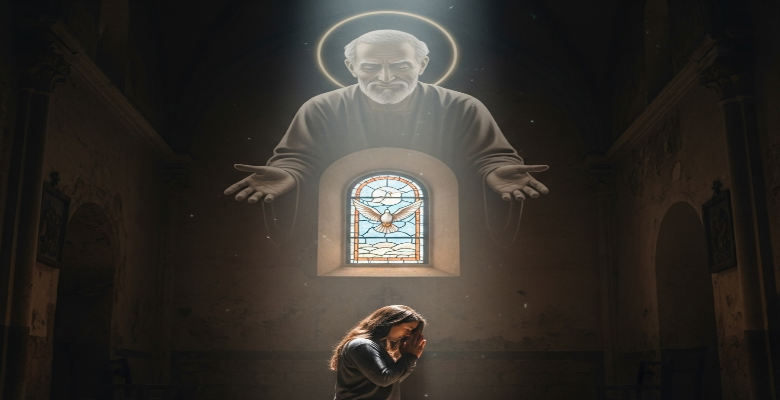
From the whisper of a Rosary to the grand liturgy of the Mass, prayer is the heartbeat of Catholic life. However, beneath this ancient practice lie two profound questions. Both questions must be asked in the light of the nature of God. First, why is prayer necessary, and second, should we persist in prayer?
Why Pray?
Before answering, it may be beneficial to define what Catholicism means by prayer.
The most artful and accurate answer is that prayer is a lifting of the heart (the emotional aspect of a person) and mind (the rational aspect of a person) to God. Prayer, as such, is an act of communication.
As indicated, this communication with God can take different forms. It can be as simple as a mental prayer or as complex as the Catholic Mass. Prayer can also take the form of reading spiritual works or engaging in lectio divina (divine reading) when reading Scripture.
A succinct answer to the question of why we should pray is that God has commanded us to do so. Catholics are told to “pray without ceasing,” and to avoid losing heart in prayer. (Luke 18:1).
These verses segue nicely into the importance of perseverance in one’s prayer life.
Two Tales Of Preservance
I want to examine two biblical passages that illustrate the significance of persevering in prayer.
The first instance comes from the Old Testament. In Genesis 18:20-32, Abraham is depicted as “negotiating” with God over the fate of Sodom and Gomorrah.
Abraham said, “Will you really sweep away the righteous with the wicked? Suppose there were fifty righteous people in the city; would you really sweep away and not spare the place for the sake of the fifty righteous people within it?… The Lord replied: ‘If I find fifty righteous people in the city of Sodom, I will spare the whole place for their sake.’ Abraham spoke up again: ‘See how I am presuming to speak to my Lord, though I am only dust and ashes! What if there are five less than fifty righteous people? Will you destroy the whole city because of those five?’ ‘I will not destroy it, he answered, if I find forty-five there.’ But Abraham persisted, saying, ‘What if only forty are found there?’ He replied: ‘I will refrain from doing it for the sake of the forty.’ Then he said, ‘Do not let my Lord be angry if I go on. What if only thirty are found there?’ He replied: ‘I will refrain from doing it if I can find thirty there.’ Abraham went on … ’What if there are no more than twenty?’ ‘I will not destroy it, he answered, for the sake of the twenty.’ But he persisted: ‘Please, do not let my Lord be angry if I speak up this last time. What if ten are found there?’ ‘For the sake of the ten, he replied, I will not destroy it.”
Unfortunately, God did not find even ten righteous people in Sodom and Gomorrah. Nevertheless, it is clear from the passage that God responded to Abraham’s persistence.
In the second example, from Matthew 7:7-8, Jesus comments on the effectiveness of persistence in prayer: “Ask and it will be given to you; seek and you will find; knock and the door will be opened to you. For everyone who asks, receives; and the one who seeks, finds; and to the one who knocks, the door will be opened.”
The practice of persevering in prayer may seem logical, but it seems to raise a theological problem.
Changing God’s Mind?
Prayer in general, and praying with perseverance specifically, presents theology with a dilemma.
In particular, prayer presents two questions. Accepting that God is omniscient, why pray at all? After all, if God knows our needs before we ask Him, why bother asking? (Matthew 6:8).
The second problem is more philosophical than religious. Because God is the uncaused cause of existence, He is said to be actus purus or pure act. God eternally lacks nothing and requires nothing. Moreover, that which exists as pure act does not change. (Hebrews 13:8). However, prayer, at least petitionary prayer, is an effort to “change God’s mind,” so to speak.
The answer to the first question is that it is human beings who need to pray. Living things seek their own happiness. This is most completely effected by the perfecting of a thing’s nature. Since humans are made in God’s image, human nature is perfected in God. As Saint Augustine observed, “Our heart is restless until it rests in you.” In this sense, true happiness lies in being in communion with God, which is precisely what prayer and worship accomplish.
The second problem involves persistence in prayer. As indicated above, God does not change, yet the intention of petitionary prayer is, it seems, to do just that; to change the mind or will of God. Why persist in praying if God is unmoved by it?
First, we must observe that while human beings pray in time, God listens in eternity. Actions, including prayer, are sequential when they occur in time. However, as God exists in eternity, every action – past, present, and future – appears to Him in the present. Owing to this, God does not change with respect to time, nor can it be said that God is changed by prayer since change is an aspect of time.
Nevertheless, this is not to imply that prayer is only valuable for perfecting human nature. Rather, prayer can also be understood as a kind of divine cause-and-effect relationship. God not only wills the effects, but He also wills the cause. For example, God wills that all men be saved (1 Timothy 3-4), and He also wills that we work out our salvation (Philippians 2:12).
In this sense, prayer becomes extremely powerful as a proximate cause (admittedly among numerous causes) that God has willed in order to establish an effect. Put another way, prayer becomes an instrument in God’s plan.
Conclusion
In essence, prayer is not about changing God, but rather about aligning oneself with God’s will through communication and petition. God’s immutability ensures that His promises and character remain steadfast, providing a solid foundation for faith and prayer.










 Ad-Free & Subscriber Log-In