


While many people associate arguments for God’s existence with faith-based reasoning, a strong tradition within philosophy argues that the case for God can, and must, be made on purely rational grounds. The reason for this is in the assumptions that philosophy and theology begin with.
In general, philosophy does not presuppose the existence of God as theology and religion do. Therefore, it is nonsensical for theology or religion to argue for a conclusion that they accept as a premise or first principle. Moreover, doing so runs the risk of arguing in a circle. Philosophy, like science, begins with our senses. It should be no surprise, therefore, that the majority of arguments for God’s existence begin with observation. The majority, but not all.
A Posteriori And A Priori
We live and learn, and the knowledge that we acquire (hopefully) builds on itself. This knowledge provides the data for propositions. The terms “a priori” and “a posteriori” are used primarily to denote the foundations upon which these propositions are known. A particular proposition is knowable a priori if it can be known independent of any experience other than knowledge of the language in which the proposition is expressed. Alternatively, a proposition that is knowable a posteriori is known based on experience.
For example, the proposition that all bachelors are unmarried is a priori. Once we understand the meanings of bachelor and marriage, we understand the truth of the statement. Conversely, the proposition that it is raining outside is a posteriori. The meanings of the terms used are insufficient to prove the truth of the statement. We must actually see the rain.
These concepts provide the basis for epistemology.
What Is Epistemology?
Within the broader field of philosophy, epistemology is the study of knowledge, and generally incorporates two aspects.
First, epistemology seeks to determine the nature of knowledge. For example, what does it mean to say that someone knows, or does not know, something? This is a matter of understanding what knowledge is, and how to distinguish between cases in which someone knows something and cases in which someone does not know something.
Second, we must determine the extent of human knowledge; that is, how much do we know, and how much can be known?
These questions about the nature and extent of knowledge have profound implications for one of the most fundamental questions of all: Is it possible for finite, fallible beings to have knowledge of an infinite and infallible God?
Can We Know God?
A thing can be said to be known in two ways. Firstly, a thing can be known essentially, as it truly is. This is to know the very essence or nature of the subject we are examining. In the second way, we can know that a thing exists without knowing its nature. We can know a thing in this manner either by observation or inference.
When the object of our knowledge is God, it is impossible for human beings to know the nature or essence of God. The reason for this is that the fallen and finite human intellect cannot comprehend the transendent and infinite.
The reason for this can be stated this way. To know the nature of something, the form of the object, that is, the nature of the thing as it is abstracted by the mind, must exist in the mind of the knower. Since the knower (humans) possesses a finite intellect, it cannot comprehend an infinite form or nature. Therefore, it is impossible for the mind (if it is unaided by supernatural grace) to understand God as He truly is.
It is possible, however, to infer the existence of God. Indeed, the majority of the arguments for God’s existence are a posteriori in nature. That is, God’s existence is inferred by observation and deduction. An excellent example of these types of arguments is Aquinas’s Five Ways.
Uniquely, Saint Augustine formulated an argument for the existence of God that utilizes a priori principles.
Augustine’s Argument
So far, the various arguments for God’s existence are, almost exclusively, a posteriori; however, there exists one notable exception to these arguments. It is called Saint Augustine’s epistemological argument, and it is predicated on reason alone. (See Saint Augustine of Hippo: On the Free Choice of the Will, On Grace and Free Choice, and Other Writings. Cambridge University Press, 2010).
Augustine argues that the presence of certain eternal and immutable truths is evidence for the existence of God. Augustine points out that truths such as the laws of logic and mathematical principles are discovered, not created, by human beings. Next, Augustine observes that these truths are universal and eternal. As such, they are true at all times and in all places. Two plus two is always four, and a thing cannot both be and not be in the same way and at the same time.
Augustine notes that for these truths to exist, there must be a mind that holds them, and this mind must be eternal to account for the eternal nature of the truths. This excludes human beings as the source of these truths.
Therefore, Augustine posits that the source of these objective and immutable truths must reside in an eternal, unchanging, and immaterial mind, which he identifies as God.
Augustine’s argument faces an obvious objection. If what has been said is true, how can a subjective and changing human mind comprehend objective and immutable truths?
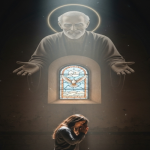
The answer, according to Saint Augustine, is that these truths are knowable to humans by virtue of divine illumination, whereby God provides the light by which humans can perceive and understand these eternal truths. Augustine does not deny the human capacity to reason or contemplate; however, he does claim that certain truths are knowable only if they are divinly illuminated. From a biblical perspective, faith precedes knowledge of the transcendent. (See Isaiah 7:9).
Nevertheless, the divine illumination aspect of Augustine’s argument comes very close to violating the special pleading fallacy (claiming an exception to a general rule without adequate justification). To some extent, Thomas Aquinas’s assertion that God’s grace perfects human nature provides a defense of Augustine’s divine illumination claim. To be human is to be rational by nature, and God’s grace builds on that rational nature by providing insights into truths human beings could not obtain otherwise.
Conclusion
Stated succinctly, Saint Augustine argues that humans have knowledge of eternal truths, which they could not have arrived at of their own accord. Therefore, these eternal truths must exist elsewhere (viz., God), and can only be comprehended by the light of divine illumination.
With his epistemological argument, Saint Augustine seeks to bridge the gap between faith and reason. How well he succeeds is an open question.













 Ad-Free & Subscriber Log-In