

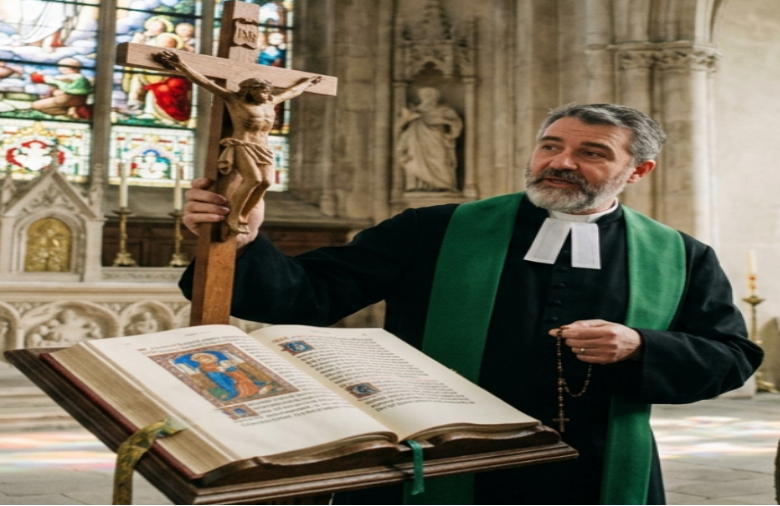
For two thousand years, the Catholic Church has been involved in an intriguing and complicated relationship with philosophy.
At the heart of this relationship is the mingling of faith and reason. Indeed, the nexus between Catholicism and Western philosophy is the belief that the God of the Bible can be known, and in fact, has made Himself known to human reason.
In this essay, I will provide brief explanations of theology and metaphysics. I will conclude by showing how the great tradition of Western philosophy has provided a framework for understanding the claims of the Catholic faith.
Before commencing, it is beneficial to define what is meant by faith. Catholic theology defines faith as “the theological virtue by which we believe in God and believe all that he has said and revealed to us, and that Holy Church proposes for our belief, because he is truth itself.” (Catechism of the Catholic Church, Paragraph 1814).
Additionally, faith entails a relational trust grounded in perceived reasons, divine revelation, and personal experience.
It is important to note that faith, as a theological virtue, is infused into the soul and perfects the intellect. This is vital because proper faith is never divorced from reason.
Catholic Theology
A succinct, though perhaps inadequate, definition of theology is the pursuit of the mind of God as revealed in Scripture.
Derived from the Greek words theos (God) and logos (word or study), theology explores questions about divine reality, sacred texts, human morality, and the meaning of existence from a faith-based perspective. As such, theology should be defined as the systematic study of the nature of God, divinity, and religious truth.
In turn, Catholic theology is categorized into several branches. Biblical theology focuses strictly on what the Bible says about God, humanity, and history.
Systematic theology organizes religious beliefs and doctrines into a coherent, comprehensive framework (e.g., the nature of the Trinity or salvation).
Historical theology examines how religious beliefs, creeds, and church structures have developed over time.
Practical theology applies theological concepts to everyday life, including pastoral care, worship, and spiritual formation.
Moral theology investigates questions of right and wrong, justice, and human behavior through the lens of faith.
Finally, philosophical theology uses reason and logic to explore metaphysical questions about God and existence.
Because philosophical theology must grapple with the ultimate nature of what exists, it necessarily relies on the older, foundational discipline of metaphysics.
Metaphysics
Metaphysics (literally, “after physics”; after the material world) is a branch of philosophy concerned with the fundamental nature of reality, existence, and the universe. The discipline is usually subdivided into ontology and cosmology.
Ontology is the study of being and existence. It investigates what it actually means for something to exist and categorizes different types of being.
Cosmology is concerned with the origin, structure, and evolution of the universe. It examines the concepts of space, time, and causality. These two branches provide the four fundamental questions that philosophy must ask.
Does an objective reality exist outside of our human perception, or is the universe just a construct of our minds?
Is time an objective dimension of the universe, or is it a subjective experience linked to human consciousness?
Are the mind and the physical brain the same thing, or are they fundamentally different?
Do we have free will, or are our lives determined by a strict chain of cause and effect?
In turn, these questions inform Catholic theological positions on topics such as the mind-body problem, the resurrection of the body, and good and evil.
Catholic metaphysics has been and continues to be heavily influenced by Aristotle and formalized by Saint Thomas Aquinas. As the official philosophical tradition of the Catholic Church, Thomistic metaphysics explores concepts like being qua being, act and potency, form and matter, and essence and existence.
As stated above, the relationship between Catholicism and metaphysics is foundational, deeply integrated, and rooted in the idea that faith and human reason are harmonious paths to truth.
Historically, Catholicism has relied on metaphysical frameworks to articulate, defend, and deeply understand its theological doctrines. To appreciate this, it is necessary to examine the relationship between Catholic theology and Western philosophy.
A Needful Association
We may reasonably ask why Catholicism uses philosophy to develop its theology. The answer lies in philosophy’s (and by extension, human reason’s) remarkable capacity to explain and support Catholic teaching. Specifically, metaphysics provides the language and framework for developing and articulating Catholic theology.
Examples of metaphysical frameworks used to describe Catholic theology can be seen in three fundamental doctrines: the Trinity, the Incarnation, and Creation.
In seeking to explain the Trinity, Catholic theology has effectively adapted and refined terms such as ousia (essence), hypostasis (the relationship among the persons of the Trinity), and person.
Essence refers to what God is. It encompasses the entirety of the divine nature, attributes, and existence. In Catholic teaching, all three Persons share this one, identical divine nature perfectly.
In this context, “person” refers to who God is. It denotes a distinct, individual reality. The Persons of the Trinity are not parts of God. Rather, each Person is fully and entirely God, possessing the whole divine essence.
In traditional metaphysics (particularly the thought of Saint Thomas Aquinas), God is metaphysically simple, meaning He has no “parts” or composition. He is pure existence itself.
Metaphysical simplicity explicitly precludes the argument that the God of the Bible is actually three gods. This is accomplished by positing that the distinctions in God are not parts, but relational distinctions. The Persons are the divine essence itself, existing in a dynamic relationship with one another.
Similarly, when Catholicism asserts that God became man, metaphysics enables theologians to explain how Christ possesses both a complete divine nature and a complete human nature in one divine person through the concept of the hypostatic union. By differentiating between Christ’s human and divine natures, metaphysics provides the framework for understanding how Christ is both God and man.
Finally, the relationship between Catholic theology and philosophy allows for the distinction between God (who exists necessarily) and creation (which exists contingently). Moreover, by expounding on this relationship, Catholic theology is able to rule out pantheism or a clockmaker god who abandons the universe (deism).
Moreover, because created things only participate in existence (they do not create or sustain their own existence), the contingent universe is sustained by a being whose very essence is existence itself.
To put this concept differently, created things are a mix of potency (the potential to be or not to be) and act (exist); God is Actus Purus (Pure Act), lacking any unrealized potential. For this reason, Catholic theology considers God to be the ipsum esse subsistens or “subsistent act of to-be”.
From what has been said thus far, it is evident that without metaphysics, fundamental Catholic dogmas become difficult to conceptualize.
Conclusion
Philosophy provides the grammar to understand Catholic theology because philosophy is ultimately about reason, and true faith can never be divorced from reason.
The Catholic Church has consistently defended the importance of metaphysics against modern skepticism, secularism, and relativism. Pope John Paul II’s encyclical Fides et Ratio (Faith and Reason) explicitly asserts that philosophy and metaphysics act as a necessary bridge to keep theology grounded in objective reality, warning against the dangers of abandoning rigorous metaphysical thought.










 Ad-Free & Subscriber Log-In