

The Historical Foundation Of Catholicism
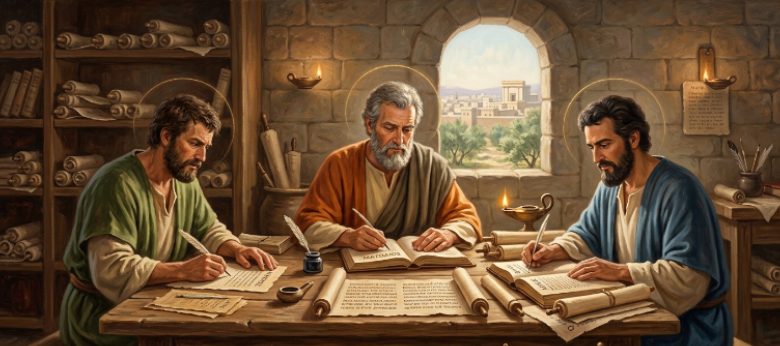
One of the most enduring attacks on Catholicism is the claim that Gospel authors had little if any direct knowledge of Christ. The line of thinking is that the Synoptic Gospels are the result of “hearsay” and innumerable editorial changes, rendering them historically unreliable and of no theological value.
In this essay, I will argue that the Gospels accurately depict Christ and the early development of Christianity. This will be done by examining the relationship with and the knowledge of Christ that the Gospel authors possessed.
Lastly, I will suggest that the independent evidence and archaeological data support the argument that the Gospel authors were authoritative in depicting Christ and in shaping the development of the early Church.
The Synoptic Gospels
The Synoptic (Greek for “seen together”) Gospels are so named because they share many similarities in what they depict. The three books are named after their authors, Matthew, Mark, and Luke, all of whom are considered apostles of Christ. Since the Synoptic Gospels provide much of the data concerning the life of Christ, it is of extreme significance to show the knowledge these three men had of Christ.
As an Evangelist, Matthew wrote his Gospel with a Jewish-Christian audience in mind, arguing that Jesus is the long-awaited Messiah who fulfilled Old Testament prophecies. Of importance to this essay is the fact that Matthew would become one of the twelve apostles. This position meant that Matthew served as an eyewitness to Jesus’s ministry, teachings, miracles, death, resurrection, and ascension.
It is true that neither Mark nor Luke was among the original twelve apostles. Mark’s knowledge of the events of Christ’s life came primarily from Saint Peter. For this reason, Mark’s Gospel focuses predominantly on Peter’s experiences.
While Peter spoke Aramaic, he did not speak Greek. This fact would have significantly hindered Peter’s ability to evangelize in the Roman Empire. For this reason, Mark acted as Peter’s interpreter, making his account of the events depicted in Mark’s Gospel highly reliable.
In addition to authoring the Gospel in his name, Saint Luke is credited with authorship of the Acts of the Apostles. Most of the data in Luke’s Gospel about Christ would have come from Saint Paul, who, in turn, encountered the risen Christ.
In addition to what has been said thus far, three additional points must be made.
First, the Synoptics (Matthew, Mark, and Luke) share substantial content, including the same or similar words and stories, as well as the general structure of Jesus’s ministry. This fact has led some theologians to posit the existence of a lost source known as the Q source.
Second, the authors portray a unified picture of Jesus as a prophet, the Messiah, the Son of God, and the Son of Man.
Finally, there is ample evidence to suggest that all three Synoptic Gospels were written relatively early, well within the time when eyewitness testimony was available, that is, within forty or fifty years of the Crucifixion.
These points support the consistency and timeliness of the Synoptic Gospels.
Historical Confirmation
There is internal data as well as historical evidence to support the position that the Synoptic Gospels were written within a reasonably short time after the Crucifixion.
The most notable of these is the failure of any of the Synoptic Gospels to mention the destruction of the Jerusalem Temple in A.D. 70. This, even though the Gospels record Jesus predicting its destruction.
An event so significant (cataclysmic for a first-Century Jew) would have certainly deserved mentioning if it had occurred within the time frame of the writing of the Gospels. The failure of any of the authors to reference the destruction of the Temple suggests that all three Synoptic Gospels were completed before A.D. 70 and within forty years of the Crucifixion.
Second, Saint Luke wrote the Acts of the Apostles after his Gospel. The Acts of the Apostles concludes with Saint Paul still alive and under house arrest in Rome (circa A.D. 62). It also fails to mention the martyrdoms of Peter and Paul (circa A.D. 64–67), which strongly implies Acts was finished before those deaths. If Acts was completed by A.D. 62, then Luke’s Gospel must have been written even earlier, likely in the late 50s.
There is also ample external evidence to support the veracity of the Synoptic Gospels. An example of this is called the Augustinian Hypothesis.
The Augustinian Hypothesis is part of early Christian thought that holds that Saint Matthew wrote his Gospel first, followed by Saint Mark and Saint Luke. Some traditionalist scholars argue that Matthew could have been written as early as A.D. 42. (France, R. T. Matthew. Wipf and Stock Publishers, 2004).
Accepting Markan priority (that is, the Gospel of Mark was the first Gospel written), and if Luke and Matthew used Mark as a source and were themselves written before A.D. 70, Mark must be dated even earlier, possibly to the 50s or even 40s. The significance being that Mark’s Gospel would have been completed within a generation or two of the Crucifixion.
Whether one adopts the Augustinian view of Matthean priority or the contemporary scholarly consensus of Markan priority, the chronological result converges on the same point: the foundational records of the life of Christ were established by living eyewitnesses.
Making The Case
Ultimately, the question that must be answered is whether the Synoptic Gospels accurately depict the events of the life and death of Jesus of Nazareth. This is to say nothing of the theological import that Catholicism attaches to the Gospels.
The fact that the Synoptic Gospels are grounded in history strengthens the case for their veracity. Examples include depictions of the Roman taxation system and historical figures such as Herod the Great and Herod Antipas.
Additional evidence is provided by archaeological finds, such as the Pool of Bethesda and the Pilate Stone, both of which are mentioned in the Gospels and confirm the Synoptic Gospels’ authors’ precise knowledge of 1st-century Judean geography and politics.
Some skeptics have suggested that the Synoptic Gospels were either written many years after the events they depict or that the authors were not privy to the life and death of Christ. As shown above, this is not the case. Moreover, these documents stand out as far more reliable than other ancient texts.
For example, the biographies of Alexander the Great and Siddhartha Gautama (the Buddha) are roughly 400 years removed from the events they record. The six sources for the life of Caesar Augustus range from ninety to 200 years after the events they record. As shown, the Synoptic Gospels were likely written within fifty years at most of the events they describe.
In addition, unlike many accepted historical texts, the Synoptic Gospels were written by eyewitnesses or by associates of eyewitnesses to the events they report.
Lastly, there is no reason to doubt the authorship of the Gospels or any significant post-publication editing of the Synoptic Gospels. Biblical scholar Dr. Brant Pitre has shown that all ancient manuscripts bear the traditional names ascribed to them (Pitre, Brant. The Case for Jesus. 2016).
Conclusion
Unlike the various myths of the ancient world, Catholicism is a historical religion. Indeed, the central claim of the faith is the Incarnation – God becoming human – an event occurring within history. Nevertheless, skeptics have sought to discredit the biblical texts, suggesting that the data within them is suspect.
In this essay, I have endeavored to show that the evidence supporting the central claims of Catholicism is verifiable historically and that the Synoptic Gospels faithfully render the life and death of Jesus of Nazareth.












 Ad-Free & Subscriber Log-In