


Many Catholics today—some knowingly, others not—import Marxist categories such as oppressor versus oppressed, systemic harm, historicism, equity, and lived experience into the faith as if they were virtues. The Church does address these topics in various documents, so the problem is not the categories themselves. The problem is the Marxist coloring applied to them, which distorts their meaning and turns them into ideological tools rather than theological insights.
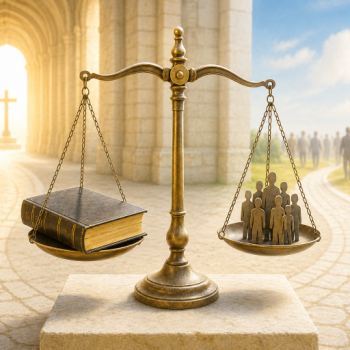
Marxism and Catholicism cannot coexist at a foundational level. Marxism functions on a horizontal, bottom-up vision of reality, while Catholicism operates on a vertical, top-down one. These frameworks begin with fundamentally different understandings of the human person, truth, authority, sin, and salvation. The most visible attempt to fuse these incompatible systems appeared in Latin America in the movement known as Liberation Theology.
Those who import Marxist elements into Catholicism effectively recast the faith as nothing more than a set of “real-world” or hand-to-mouth concerns—a program of social justice detached from transcendence. But Catholicism has always sought a balance: meeting physical needs and addressing the spiritual hunger that only Christ can satisfy.
A Materialist View of the Human Person
Marxism begins by reducing the human person to material and economic forces. Class, economics, race, and power function as the primary determinants of a person’s life. In this framework, every human being falls somewhere within the spectrum of “oppressed” and “oppressor.” All systems of power supposedly exist to maintain this dynamic and perpetuate harm. Religion—especially moral and spiritual claims—is dismissed as a tool the oppressor class uses to control the oppressed. As a result, religion becomes merely an ideological instrument, stripped of transcendence and reduced to a socio-political function. “Salvation,” in Marxist terms, amounts to material uplift and the achievement of an earthly utopia.
Catholicism teaches the opposite. Humans are made in the image of God and possess a rational intellect and free will. As image-bearers, we can make real and morally significant choices. Sin, grace, and personal responsibility—not social conditions—define the deepest human struggle. Salvation is not material rearrangement but the redemption and transformation of the person through God’s grace and Christ’s sacrifice.
For this reason, Marxism’s reduction of human beings to material forces and social determinants is fundamentally incompatible with the Catholic vision of the human person, which affirms spiritual dignity, moral freedom, and a destiny that transcends the merely material.
Liberation Theology: The Failed Attempt to Smuggle Marxism into Catholicism
Despite the glaring incompatibilities between Marxism and the Catholic faith, some within the Church have still attempted to mix oil and water. The most prominent example emerged in Latin America during the 1960s with Liberation Theology. This movement sought to interpret the Gospel through the lens of the oppressed—in other words, to reinterpret Christianity through Marxist class struggle. Christ, traditionally understood as the Savior who redeems humanity from sin, was recast as a political liberator sent to free the poor from socio-economic oppression. Even more troubling, “the poor” were given a quasi-sacramental status that granted them a special authority simply by virtue of their condition.
Liberation Theology imported Marxist themes into Catholicism by:
- using class struggle as the primary hermeneutic;
- treating the Church’s hierarchical structure as part of the oppressor class;
- replacing personal sin with “structural” or collective sin;
- elevating revolutionary praxis over conversion and repentance;
- redefining salvation as social and material liberation rather than union with God.
Unsurprisingly, the Magisterium decisively rejected this Marxist reinterpretation of Christianity. The Congregation for the Doctrine of the Faith condemned the errors of Liberation Theology in the 1984 Instruction on Certain Aspects of the “Theology of Liberation,” and clarified authentic Christian liberation in the 1986 Instruction on Christian Freedom and Liberation. Joseph Cardinal Ratzinger (later Pope Benedict XVI), who authored both documents, issued a stark warning to anyone attempting to baptize Marxist concepts as Christian virtues:
One needs to be on guard against the politicization of existence which, misunderstanding the entire meaning of the Kingdom of God and the transcendence of the person, begins to sacralize politics and betray the religion of the people in favor of the projects of the revolution. [emphasis added]
Perfectly stated.
Marxist Categories Reappear in Progressive Catholicism
The theologically observant have long predicted a renewed Marxist influence within the Catholic Church. Drawing heavily from the assumptions of Liberation Theology, progressive Catholicism often derives moral authority not from truth, but from victimhood. It elevates “lived experience” over doctrine and treats subjective narratives as more decisive than the Magisterium.
In debates over sexual ethics, nature—and the Natural Law that flows from it—frequently gets reframed through power dynamics and appeals to secular science. Added to this is the steady reliance on “pastoral language,” sociology, psychology, and political science as tools to override authoritative Catholic teaching. The mechanics of this influence are everywhere. One need only open the pages of National Catholic Reporter (NCR) or America Magazine to find examples.
A case in point comes from NCR’s Meredith McKay during Advent 2021:
There are no easy answers for dismantling the unjust systems still so present today, but faith and allyship as a white Catholic requires an ongoing willingness to engage with the discomfort of not knowing while maintaining disciplined hope that change is possible.
In one sentence, McKay strikes nearly every Marxist note: class, race, collective guilt, privilege, and a call to revolution (“dismantling unjust systems”). And if one reads NCR regularly, these themes repeat themselves with remarkable consistency.
Final Thought: Why Catholicism and Marxism Cannot Mix
In the end, the incompatibility between Catholicism and Marxism does not arise from a mere clash of political preferences. It rises from two fundamentally different visions of reality. Catholicism proclaims a God who enters history to transform the human heart; Marxism imagines that human hearts change only when history does. She preaches forgiveness; Marxism preaches struggle. She calls the poor blessed; Marxism uses the poor as a lens of accusation. Finally, Catholicism insists on the dignity of every person, including the oppressor, Marxism divides humanity into permanent camps of the righteous and the damned.
This is why the Church has consistently rejected Marxist categories as theological foundations. They do not elevate the Gospel—they obscure it. They do not clarify the mission of the Church—they distort it. And they cannot be grafted onto the faith without hollowing it out from the inside.
For this reason, whenever Marxist categories are smuggled into Catholic thought—whether boldly or subtly—the result is always the same: the Gospel is reduced, grace is sidelined, and the faith loses its soul. And for that reason, Catholics who love the Church must insist, with clarity and charity, that the Cross cannot be replaced with the hammer and sickle—no matter how noble the intent or compassionate the rhetoric.
Thank you!
Read The Latin Right’s other writing here.
Please visit my Facebook page and IM your questions (and follow my page) or topics for articles you would like covered.










 Ad-Free & Subscriber Log-In