

Guest writer: Pilgrim
Introduction
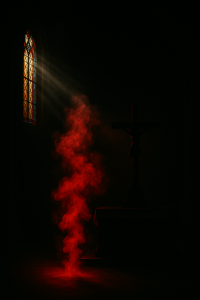
In 1972, while home from university, my father told me Pope Paul VI had said something striking: “From some fissure the smoke of Satan has entered the Church.”
Paul VI, a shepherd of Vatican II, believed in renewal but saw something going wrong, not from outside enemies, but from within: a spirit of doubt and a fading sense of the sacred.
I remember that conversation, though at the time I was distant from the Church.
Today, I understand his warning, and tracing the past sixty years reveals how errors became the atmosphere shaping an entire generation.
Part I: A Parish in 1968
At sixteen, a new priest arrived in our Essex parish: young, charismatic, a former merchant seaman who rode a motorcycle. He preached that Humanae Vitae was a matter of personal conscience, replaced the high altar with plywood, removed statues and rails, and held modern youth Masses. Quietly, to young people, he also suggested that doubts about the virgin birth or resurrection need not be literal, framing them as symbols, spiritual truths wrapped in ancient language.
Here’s what made it confusing: some changes were uplifting. I was raised in Belfast; now there were ecumenical services with Protestants, people we’d been taught were heretics. My father was a convert from Judaism, and now we were talking about Jewish people differently.
Certain weights were lifted.
But when this same openness suggested the resurrection might be metaphorical, or that conscience trumped the Pope on contraception, how could we know there was poison mixed with incense? I remember the disorientation, liberated yet unmoored, as if the walls had vanished and the floor with them.
The wider culture pulled us as well: Woodstock, the Pill, decriminalization of abortion and homosexuality, anti-war marches, all promising freedom without consequences. Church “openness” just seemed like catching up.
It was all swirling together: refreshing reforms and toxic ones, authentic development and doctrinal evacuation. As word of the priest’s teachings spread to older parishioners, they were unsure why the foundations of their faith now seemed negotiable, and they quietly left for a parish across town. The older folks felt exiled, and we, young people, got guitars and permission to doubt. And the priest presided over the fracturing of what he’d been sent to shepherd.
Part 2: Where the Smoke Came From
The Dutch Catechism: Suggestive Ambiguity
Every age has its errors. In 1966, following Vatican II, the Dutch Catechism emerged as a fresh attempt to teach the faith. It used narrative, contemporary science, and modern psychology instead of scholastic density. It was fresh and accessible. Its subtle danger lay not in denying doctrine but in offering alternatives, phrased suggestively, leaving interpretive gaps wide enough for readers to drift into error. In 1968, a Commission of Cardinals identified ten doctrinal pressure points.
Original sin, once taught as transmitted by propagation, became a moral defect acquired by imitation. The soul’s immediate creation was replaced by language suggesting emergence from matter. Angels became poetic metaphors; the virgin birth, symbolic; Christ’s redemptive death, an inspiring example. Sacraments followed: the Mass, a communal meal rather than Christ’s sacrifice; transubstantiation blurred; the priesthood reduced to functional ministry. Conscience, once guided by Church authority, was cast as autonomous.
These were not stylistic tweaks, and when I read it years later, I understood Pope Paul VI. They were doctrinal load-bearing walls. Remove one, and the structure trembles. Remove several, and it collapses. If original sin is only learned behaviour, why baptise infants? If the Mass is a meal rather than a sacrifice, what becomes of the Real Presence? And if conscience stands in judgment over the magisterium, where does authority finally rest? The Catechism didn’t cause the crisis, but it reflected and amplified a wider theological restlessness, giving that unrest a form that shaped formation for decades.
This was not fringe dissent. The bishops who commissioned and approved it had taken the Oath Against Modernism, rejecting the reduction of dogma to symbol and the elevation of private conscience above Church teaching. The irony seems not to have registered. Corrections from Rome came only after controversy; by then, the Catechism had circulated internationally, with Cardinal corrections appended rather than integrated.
Vatican II had taught none of the errors that followed. In the confusion of implementation, the “Spirit of Vatican II” became a license to claim what the Council never said. The texts on religious liberty, collegiality, and conscience carried real tensions, not from carelessness but from trying to meet the modern world while preserving continuity. Sometimes the language was broad to achieve consensus with ambiguities that left room for interpretation. The question was whether that space would be used faithfully or exploited.
Nevertheless, the difference between interpretive tension within legitimate bounds and outright doctrinal revision was real, even if difficult to discern.
The Intellectual Climate: Küng and Curran
The tone of crafted ambiguity of the Dutch bishops didn’t emerge in isolation. It echoed a wider theological climate.
Hans Küng questioned papal infallibility not bluntly, but through seemingly reasonable inquiries. The effect: settled doctrines appeared provisional, open to negotiation. The magisterium’s voice, once concrete, seemed one opinion among many. Rome withdrew Küng’s teaching licence in 1979.
Charles Curran took a similar path in moral theology. After Humanae Vitae, he argued Catholics could choose contraception in good conscience. When moral truth depends on individual discernment rather than Church formation, doctrine may be affirmed in theory but neutralised in practice. Curran’s teaching licence was revoked in 1986.
Both men were intellectually gifted and engaged with the modern world, but brilliance and empathy cannot substitute for fidelity. Their theological method was unanchored from the Church’s doctrinal inheritance and began to shift.
The pattern appeared elsewhere. The 1968 Winnipeg Statement affirmed Humanae Vitae while allowing Catholics to dissent in conscience “without blame.” The bishops who issued the Winnipeg Statement believed they were holding fidelity and compassion together. They affirmed Humanae Vitae while making room for troubled consciences. Whether such space inevitably becomes dissent, or could have been held in tension, is still debated. In practice, the allowance became permission, and then became expectation.
Dutch bishops, Küng, Curran, and the Winnipeg Statement shared a grammar of ambiguity with core doctrines reframed, teaching relativised, and setting conscience adrift from doctrine.
A decade after Vatican II, the Church existed in an atmosphere where everything seemed negotiable.
Paul VI Recognizes the Smell
Paul VI sensed trouble long before most would admit it. His 1972 reference to the “Smoke of Satan” was a pastoral observation. He noted a change in the air, a corrosive spirit entering the Church. The signs were visible: doubts about core dogma, secular assumptions seeping in, trust in personal experience over revelation, and a desire to soften doctrine in pastoral improvisation.
The Dutch National Pastoral Council (1966–1970) tested these ideas, proposing optional celibacy, expanded lay governance, questions on women’s ordination, and relaxed sexual ethics, all framed as modernisation.
Beneath all this lay a deeper question: how to distinguish between genuine development and displacement? Newman provided the answer: true development maintains ‘the same dogma, the same sense, the same import,’ only clarifying and deepening what was already present. What was happening wasn’t development; it was revision and replacement.
Part 3: Attempts to Clear the Air
Pope John Paul II acted decisively. He convened the 1980 Special Synod for the Netherlands, reaffirming priestly celibacy, catechetical fidelity, and sacramental discipline, correcting heterodox tendencies.
His pontificate systematically confronted the crisis Paul VI had foreseen. Encyclicals like Veritatis Splendor and Familiaris Consortio reasserted moral truth, Magisterial authority, and the integral link between freedom and truth. His Theology of the Body offered a personalist anthropological foundation: the body reveals meaning, we’re called to live faithfully. In 1992, he introduced the Catechism of the Catholic Church, a comprehensive guide to perennial Church teaching.
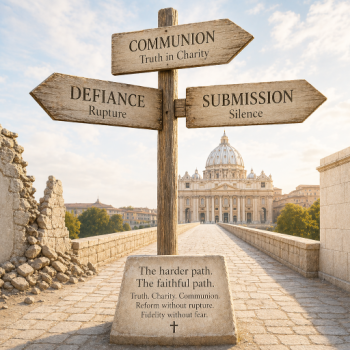
Pope Benedict XVI added more theoretical clarity. In 2005, he distinguished between the “hermeneutic of discontinuity and rupture” and the “hermeneutic of reform in continuity.” Authentic renewal, he insisted, respects doctrinal inheritance and safeguards sacramental and moral teaching. Vatican II was not a rupture but an organic development that deepened the Church’s self-understanding while maintaining fidelity to revelation.
For many Catholics, this clarity brought relief. Now a husband and father, on the edge of returning to the Church, I recall reading Veritatis Splendor in 1993 and feeling for the first time in years that perhaps the floor had stopped moving beneath us.
Part 4: The Smoke Persists
Even with John Paul II and Benedict XVI’s teachings, the ambiguity seeded in the late 1960s had taken root and continued shaping Catholic formation. Despite Rome’s corrections, underlying patterns persisted. Many priests and teachers formed during that era continued to catechise with the same assumptions: vague sacramental theology, expansive conscience, ambivalence toward doctrine, and preference for pastoral “flexibility” over clarity.
You could still feel this in parish life and see it in shrugs where certainty used to be. Local practice often overshadowed universal teaching. By the time Amoris Laetitia (2016) and Fiducia Supplicans (2023) appeared, the interpretive habits formed and embedded in earlier decades resurfaced in a new key.
New generations absorbed these errors from childhood; they became normalized, internalized, and reproduced. A recent survey of American religious belief reveals the damage, and Catholics, with each passing decade, increasingly mirror the confusion of the broader culture.
What the Surveys Reveal
The results of the 2025 Theological Survey reveal that among Americans, faith contradictions are stark: 66% say people are good by nature, 74% say we’re born innocent before God, yet 56% maintain that God counts a person righteous only through faith in Christ. If we’re born good and innocent, why do we need a saviour? 49% say Jesus is not God, while 58% insist only Jesus can save. The functional Christology suggested in 1968, Jesus saves, but we don’t need to affirm the Nicene doctrine, is a mainstream belief.
A brief methodological caveat: the 2025 survey was conducted by evangelical Protestant organisations; its questions and framing are from a Reformed Protestant perspective; and it reflects general American religious belief rather than specifically Catholic data. This was not a poll designed to measure Catholic catechetical formation per se, but rather broader theological confusion that included Catholics.
That said, what makes this survey data so revealing is not just that Catholics hold contradictory beliefs. The statistics don’t just show confusion; they trace the long arc of catechetical drift that began with the Dutch Catechism, the dissent of Küng and Curran, and episcopal equivocations like the Winnipeg Statement. The ambiguities of 1968 have become the default assumptions of many ordinary Catholics.
On human nature and sin: The Dutch Catechism’s treatment of original sin as learned imitation rather than transmitted condition has become the dominant American view, and Catholics have absorbed it.
On the sacraments and authority: Among Catholics specifically, 67% agree that worshipping alone or with family is a valid replacement for regularly attending Mass. Only 54% think every Christian has an obligation to join a local church. The Mass as a community gathering rather than Christ’s sacrifice, suggested decades ago, is now shaping practice.
On conscience and moral teaching: 62% of Catholics agree that Christians should not allow their religious beliefs to influence their political decisions. Conscience is seen as an autonomous judge, separate from Church formation, precisely what the Cardinals corrected in 1968, is now the majority Catholic position.
On the body and human nature: 71% of Catholics affirm that God created marriage to be between one man and one woman, yet 38% affirm that people should be able to choose their gender regardless of biological sex.
These shifts are sometimes invoked as evidence of the sensus fidelium, the “sense of the faithful,” that supernatural instinct by which the People of God recognize truth. Authentic sensus fidelium exists, the faithful’s instinct for the Real Presence, and devotion to Mary, but this requires formation, fidelity, and communion with the Church; it cannot be discerned from opinion polls. When formation is compromised, popular opinion cannot be trusted to judge truth; dissent dressed up as consensus misleads more than it illuminates.
Behind these statistics are real people: parents uncertain how to teach their children, couples confused about contraception, and young adults who’ve never heard clear explanations. Many Catholics have spent their entire formation in doctrinal confusion and don’t recognize error because it’s all they’ve known.
The priest who tells divorced-and-remarried couples they can receive Communion believes he’s being merciful. The theologian who argues for female ordination believes he’s advancing justice. The bishop who blesses same-sex unions believes he’s accompanying the marginalized. They’re being pastoral, compassionate, and faithful.
This is what sixty years of confusion and ambiguity produce.
The German Synodal Path
The German Synodal Path (2019–2023) shows how accumulated errors reach critical mass. Its proposals for optional celibacy, same-sex blessings, ordaining female deacons, and open Communion for remarried Catholics and their non-Catholic partners mirror the Dutch Pastoral Council fifty years earlier. Participants would dispute this; they see themselves responding to new pastoral realities and lived experience. But the method is unmistakable: elevating local discernment over universal teaching, casting doctrine as pastoral rigidity, and treating conscience as self-interpreting rather than formed by revelation.
The striking fact is the repetition, not the novelty, showing ambiguities Rome corrected in 1968 have persisted and returned, this time now clothed in the language of local synodality, lived experience, and listening to lived experiences.
Part 5: Pope Leo XIV—Early Signals
This damage is not invincible. When Pope Paul VI spoke of confusion, he named an unease many Catholics felt but could not articulate. Pope Leo XIV faces similar concerns today, approaching them with measured, steady, and distinctly pastoral care.
Before considering Leo XIV’s signals, it’s worth saying what renewal actually looks like. True reform deepens understanding without breaking continuity; makes truth accessible without making it optional; shows mercy that leads toward truth, not away from it; and respects both conscience and the authority that forms it. This is what John Paul II and Benedict XVI modelled, and what Leo XIV appears to be continuing.
In November 2025, addressing the Roman Rota, he cautioned against “false mercy” in annulment cases. His concern was not to tighten procedures arbitrarily, but to show that compassion loses integrity when divorced from truth. His theme was that pastoral care must help people without misleading them.
The address emphasizes three points. First, Church judicial authority serves truth, not convenience, requiring both competence and integrity. Second, mercy and justice are interdependent: true mercy respects truth, and justice expresses mercy. Third, marriage is “a reality with its own precise consistency,” not a private arrangement for negotiation.
Leo is not undoing his predecessor’s reforms. He praised Francis’s innovations in making processes “accessible and expeditious, but never at the expense of truth.” He is recalibrating the balance: accessibility must serve truth, not replace it.
Though focused on annulments, the address articulates principles: truth before accommodation, formation over improvisation, coherence within mercy. This may signal a broader pastoral vision. Observers note his emphasis on clarity without harshness, his insistence on honest answers, and a willingness to name problems directly.
Leo seems focused less on revisiting past conflicts than on helping Catholics now regain their footing, with a steadiness that reassures them they need not choose between compassion and fidelity to the Gospel. His emphasis on truth-in-mercy offers a firmer framework. Bishops too, must play their role in correcting errors, distinguishing authentic renewal from doctrinal drift, and identifying harmful ambiguity. The faithful need what they’ve lacked for two generations: clear teaching.
The Church has survived worse and will survive this, but it requires vigilance, faithful shepherds, and laypeople willing to demand pure air.
Conclusion: Breathing Pure Air
I think back to that fractured parish in 1968, the older generation crossing town, we young people inhaling poison and thinking it was freedom, our priest presiding over the quiet suffocation of a community. I sometimes wonder what might have happened if someone had stood up and named what was happening, distinguishing the fresh air of ecumenism from the toxic particles of doctrinal erosion?
The trajectory from 1968 to today was not straightforward. Secularisation, the collapse of Catholic subcultures, educational upheaval, digital fragmentation, and the clergy abuse scandals and institutional failures in responding to them all contributed their own damage. Yet recognising these complicating factors doesn’t eliminate the original problem: that doctrinal ambiguity in a critical decade created vulnerabilities that subsequent crises exploited and deepened.
Perhaps we’re finally learning to distinguish incense from the “Smoke of Satan.” But it requires something most of us find difficult: the willingness to admit we’ve been breathing poison, the humility to seek pure air, the courage to help others find it too.
The errors can be named. The air can be filtered and cleared. The faithful can breathe freely again.
It begins with recognizing that the “Smoke of Satan” entered the Church and still lingers. And only when we acknowledge this can the patient, painful work of clearing the atmosphere begin so that future generations might breathe the truth.
What does pure air feel like?
It feels like ecumenism without amnesia, mercy without pretending error is truth, accompaniment that actually leads somewhere. It feels like a Church confident enough to proclaim the Gospel plainly and humble enough to admit when pastoral strategies fail. Not a return to 1950, but a recovery of coherence that lets us move forward.
It’s clarity without cruelty. Knowing what the Church teaches and why, with pastors who can say both “This is true” and “I’ll walk with you.”
References
Paul VI. “Homily for the Solemnity of Saints Peter and Paul.” 29 June 1972.
Commission of Cardinals. “Observations on the New Catechism.” 1968.
Hans Küng. Infallible? An Inquiry. 1971. (No official free version; publisher’s page)
Charles E. Curran. Faithful Dissent. 1986. (Publisher listing)
Canadian Conference of Catholic Bishops. “The Winnipeg Statement.” 27 September 1968.
John Paul II. Veritatis Splendor. Encyclical Letter, 6 August 1993.
John Paul II. Familiaris Consortio. Apostolic Exhortation, 22 November 1981.
John Paul II. Theology of the Body (Wednesday Audiences, 1979–1984). (Full text compilation)
Benedict XVI. “Address to the Roman Curia.” 22 December 2005.
Ligonier Ministries & Lifeway Research. The 2025 State of American Theology Study. November 2025.
Catechism of the Catholic Church (1992)
Dicastery for the Doctrine of the Faith. Fiducia Supplicans. Declaration, 18 December 2023.
Pope Francis. Amoris Laetitia. Post-Synodal Apostolic Exhortation, 19 March 2016.
Thank you!
Read The Latin Right’s other writing here.
Please visit my Facebook page and IM your questions (and follow my page) or topics for articles you would like covered.








 Ad-Free & Subscriber Log-In