


I recently read a passage that captures the disconnect many of my readers feel when they encounter the Catholic way of thinking. In The Church and the Middle Ages (1000–1378): Cathedrals, Crusades, and the Papacy in Exile, Steve Weidenkopf makes this observation:
Those who are quick to view the past from a position of supposed superiority come to erroneous conclusions… Today, people often struggle to comprehend the Middle Ages, not only because of false narratives perpetuated by the media (nearly every movie set in the Middle Ages portrays life as brutish, dirty, and depressing), but also because the medieval worldview is vastly different from—even incompatible with—our modern or postmodern perspective. This is most clearly seen in the two principles on which medieval society was centered: hierarchy and faith.
Weidenkopf’s point explains far more than historical misunderstanding. It explains why medieval thinking—Catholic thinking—so often clashes with postmodern thought. The two worldviews don’t merely differ; they collide. Catholicism assumes an ordered universe, intrinsic purpose, sacramentality, and revealed truth as the structure of reality. Postmodernity assumes autonomy, self-construction, and the relativizing of meaning—effectively denying that meaning exists outside the self.
These systems don’t disagree around the edges. They oppose each other at the level of anthropology.
Catholic thinking is anathema to postmodern minds because it contradicts the mental framework postmodernity forms. Only a conversion of worldview—not a dilution of doctrine—can make Catholic truth intelligible.
Teleological Catholicism vs. Postmodern Anthropology
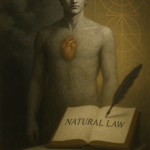
Catholic thinking begins with the conviction that God created the universe with order and purpose. Catholics hold that nature has an inherent end, the human body carries real meaning, truth exists independently of us, and human nature shapes moral reality. In short, Catholicism embraces a teleological view of the world and the human person. This worldview grows out of the Jewish roots of Christianity, the teachings of the New Testament, and centuries of reflection in the Natural Law tradition. You can see this clearly in Aquinas’s Summa Theologiae and in John Paul II’s Veritatis Splendor and Theology of the Body.
Postmodern anthropology denies all of this. In the postmodern frame, the Self constructs its own reality. Nature has no purpose, and the body serves as raw material for psychological desire. Whatever meaning life holds begins and ends with the autonomous individual. “Truth” becomes nothing more than a personal preference—an assertion of my truth over yours.
These assumptions come directly from the architects of postmodern thought. Nietzsche dismissed objective meaning and framed identity as self-assertion. Sartre denied any built-in human purpose and claimed individuals must invent their own essence. Foucault treated truth claims as power plays. Judith Butler stripped the body of inherent significance and recast gender as psychological performance. Richard Rorty collapsed truth into whatever a community finds useful. Their ideas now saturate the modern imagination, shaping how people talk about “authenticity,” “identity,” and “lived experience.” As a result, many instinctively resist any appeal to objective nature, purpose, or revelation.
Moreover, a worldview built on autonomy cannot recognize objective purpose as anything but an attack. Catholic teaching sounds oppressive or cruel because it challenges the self-constructed identity at the heart of postmodern thought. Teleology feels like violence against personal freedom. When people lose any reference point beyond themselves, conversations inevitably collapse into emotional appeals, accusations of harm, and personal attacks. The conflict leaves the realm of logic and enters the battleground of two competing and incompatible anthropologies.
Sacramental Realism vs. Therapeutic Individualism
Catholicism begins with the conviction that God works through the physical world. In the Catholic worldview, matter mediates divine grace. Matter matters. The sacraments do not merely symbolize grace; they cause what they signify because Christ Himself is the ultimate Sacrament—the visible sign who makes the invisible God present.
Catholicism also sees the body as essential to identity, not as a blank canvas for self-expression. We live as body–soul unities, and we will rise the same way. At death, the soul separates from the body only temporarily. At the final resurrection, God reunites them: the just will enter eternal life in glorified bodies, and the unjust will endure eternal separation from God in their bodies. We experience life as embodied souls; we will experience eternity the same way.
Postmodern thought reverses every one of these convictions. In the postmodern frame, the Self becomes sacred, not the body and not the created order. Emotional comfort replaces objective moral truth. “Authenticity” and psychological well-being set the boundaries for right and wrong. Christianity—when it appears at all—serves as a therapeutic tool for self-affirmation, not a source of revelation.
A postmodern mind interprets any Catholic teaching that fails to validate the Self as emotional harm. Truth becomes “meanness.” Encouraging virtue, discipline, or prudence gets recast as an attack on psychological safety. Catholic categories—sacrifice, conversion, repentance, obedience—set off therapeutic alarms because they expose the limits of self-construction. The clash, once again, isn’t about logic but about rival visions of the human person.
Revelation vs. Self-Constructed Meaning
Catholics believe that God revealed Himself in history—first through angels and prophets, and ultimately by taking on flesh in Jesus of Nazareth. Jesus founded a Church to continue His mission, and He equipped that Church with the Holy Spirit so it could guard and teach the truth faithfully. As the Church confronted errors and answered new questions, her doctrines developed organically under the Spirit’s guidance. Throughout this process, the Church did not invent truth; she received it and proclaimed it with authority.
Postmodern thought flips this vision upside down. Religion becomes a human construction, shaped to meet emotional or social needs. Authority is automatically suspect. Personal “authenticity” outweighs any claim that God has spoken. In this worldview, the individual decides what has meaning and which parts of religion—if any—feel useful.
A postmodern mind struggles to accept a world where meaning comes from God rather than from the Self. Revelation threatens the autonomy that anchors postmodern identity, so people instinctively reinterpret revelation as a power-play. When someone has learned to see all authority as coercive, “God reveals” sounds like “God (or the Church) controls.” The problem is not the evidence for revelation but the worldview that refuses to let revelation be possible.
Deprogramming the Postmodern Mind
Catholicism and postmodernity clash at the roots. A postmodern mind cannot absorb Catholic truth because it filters every Catholic category through its own assumptions. Catholicism sounds irrational, harmful, or oppressive only because postmodernity reshapes the imagination before any argument begins.
Evangelization today therefore demands deprogramming—the renewal of the mind St. Paul commands (Rom 12:2). Paul VI and John Paul II taught the same truth: conversion transforms the foundations of thinking. Catholicism invites people to see reality differently, not merely behave differently.
- Expose the Postmodern Operating System
Most people never examine the worldview they absorbed. They treat autonomy as sacred, the body as pliable, authority as coercive, and truth as subjective. When you name these assumptions, you break their spell and open space for real thought.
- Show the Failure of the Therapeutic Promise
Postmodern autonomy promises freedom but produces anxiety, fragility, and identity confusion. A self that invents itself cannot sustain meaning. When people confront the fruit of therapeutic individualism, they begin to search for something deeper.
- Translate Catholic Truth Without Diluting It
Bridge Catholic teaching to modern questions without compromising doctrine:
- Authenticity flows from identity received from God.
- Dignity arises from creation, not emotion.
- Justice depends on truth, not subjective harm.
- Love wills the true good, not mere affirmation.
This approach clarifies Catholicism instead of softening it.
Final Thought: Catholic Thinking Is Incomprehensible Without a New Mind
Catholic and postmodern thought cannot coexist because they rest on opposite assumptions. The postmodern mind treats Catholic thinking as anathema because it cannot process a worldview built on nature, purpose, sacrament, and revelation. This conflict has nothing to do with taste or preference; it grows out of metaphysical reality and competing visions of the human person.
The Church must evangelize postmodernity rather than accommodate it. Compromise cannot bridge incompatible worldviews. Only conversion can do that. Catholicism becomes intelligible only when the mind abandons postmodern categories and learns to see reality as the Church proclaims it.
A renewed mind can finally understand Catholic truth. A postmodern mind never will. Catholicism makes sense only after a conversion of worldview—not after a dilution of doctrine.
Thank you!
Read The Latin Right’s other writing here.
Please visit my Facebook page and IM your questions (and follow my page) or topics for articles you would like covered.









 Ad-Free & Subscriber Log-In