


By Theo Pastoral
I think the time has come for progressive Catholics to be totally honest about a few things.
When I read progressive Catholic blogs and comment sections, I see fellow progressives constantly trying to play both sides—invoking nuance, appealing to “development,” and speaking in carefully padded language in order to remain in the good graces of Church authority. Frankly, I find this posture cowardly. Jesus taught us to let our “yes” be yes and our “no” be no.
So, allow me, at last, to be honest with the readers of The Latin Right.
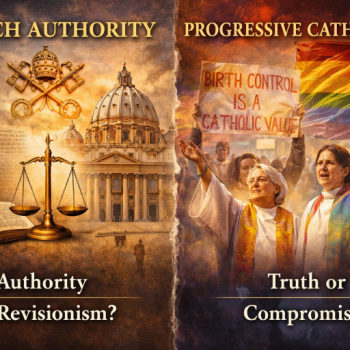
Church Authority
If progressives were totally honest, we would admit that our deepest conflict is not with particular teachings, but with the Church’s continued claim to authority over the body—especially over sexual expression.
The real problem is not what the Church teaches about sex, but that it still believes it has standing to teach about it at all.
Given everything modern science now affirms, most progressive Catholics do not actually regard the Church as competent in this domain. That is why our arguments almost never remain within the framework of doctrine, metaphysics, or moral theology. We instinctively reframe them into the language of accompaniment, dialogue, listening, and lived experience.
Sex is where this conflict becomes unavoidable, because sex is where the modern self is most invested. Here, the Church’s claim to interpret the body feels less like guidance and more like intrusion. And so we soften, contextualize, and psychologize—not to develop teaching, but to escape its jurisdiction.
Science
If progressives were totally honest, we would admit that arguments from Church authority about sex die on the vine, because pre-modern theology cannot compete with modern psychology, biology, medicine, and social science.
For us, the language of health, outcomes, identity, and studies has replaced the language of ends, nature, and moral object. We no longer ask what a sexual act is ordered toward. We ask how it is experienced. We no longer reason from creation. We reason from consensus.
Expert institutions now function as our real magisterium. Peer-reviewed journals carry more authority than councils. Therapists more than theologians. And yes—expert consensus more than celibate men transmitting what we privately regard as antiquated cosmologies.
When the Church echoes the conclusions of contemporary science, we tolerate it. When it resists them, we pathologize it. Disagreement is reframed not as theological dissent, but as ignorance, repression, or harm.
If we were honest, we would say plainly: science has not informed our sexual ethics. It has replaced them.
Abortion and the Environment
If progressives were totally honest, we would admit that we do not really care about abortion as a moral issue in itself. We care about it politically.
We see abortion primarily as a tool used by conservatives to mobilize voters and police private life. We believe reproductive choice is fundamentally personal, and therefore not properly subject to ecclesial or political authority at all. That is why we instinctively file abortion under “culture war.” It allows us to portray conservatives as obsessed with bedrooms and bodies rather than concerned with what we consider real moral issues.
And what do we consider real moral issues?
Systems. Climate. Healthcare. Economics. Structures.
If progressive Catholics were honest, we would admit that environmentalism—not abortion—has become our primary moral horizon. The destruction of ecosystems, climate instability, and planetary vulnerability strike us as more authentically “pro-life” concerns than the regulation of individual acts.
Human Nature
If progressive Catholics were totally honest, we would admit that what troubles us most about the Church’s language of “nature” is its unwillingness to listen and adapt to modern science.
When the Church speaks of nature, it often does so as though the matter were already settled—as though centuries-old categories could continue to govern human sexuality without serious interrogation from contemporary knowledge. But we no longer inhabit the intellectual world in which those categories were formed. We live in a world shaped by neuroscience, developmental psychology, evolutionary biology, and the social sciences. These disciplines do not merely add color to the discussion; they fundamentally reshape it.
From a progressive perspective, this posture increasingly read as closed mindedness.
Conclusion
If progressive Catholics were totally honest, we would stop describing these tensions as disagreements about emphasis, tone, or pastoral style.
What is actually underway is a transfer of trust.
We no longer trust the Church to define the body.
We no longer trust theology to interpret desire.
We no longer trust nature to carry moral meaning.
We trust science. We trust secular institutions. We trust therapeutic frameworks. We trust evolving consensus. And we trust the individual to know themselves.
The Church is not a teacher who speaks from a received account of reality. It is a tool—tasked with softening, spiritualizing, and religiously validating conclusions reached elsewhere.
Sex is simply where this becomes impossible to disguise, because sex is where claims about truth, authority, identity, and power converge. And when those claims collide, progressive Catholicism has already made its choice.
If the Church wishes to remain relevant, it will change.
If it will not change, it will fade—into increasing irrelevance.
Thank you!
Read The Latin Right’s other writing here.
Please visit my Facebook page and IM your questions (and follow my page) or topics for articles you would like covered.













 Ad-Free & Subscriber Log-In