

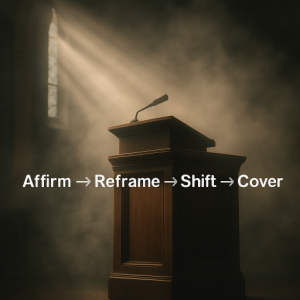
I often write about my frustration with progressive Catholicism. At times, progressive Catholicism feels like an ever-moving target. I see this most clearly in my exchanges with progressive Catholics in my comment section, especially with fellow blogger Todd Flowerday. After a recent dialogue with Todd, I had an epiphany: the source of my frustration lies in what I call “pastoral” deniability (PD)—a tactic that follows four steps: Affirm, Reframe, Shift, and Cover.
- Affirm — Acknowledge Church teaching.
- Reframe — Present Church teaching as optional or an unfair “imposition.”
- Shift — Treat information outside Church teaching (such as human desires) as morally neutral and potentially God-given.
- Cover — Portray fidelity as inhospitable and accuse it of driving people away.
The net effect? Progressive Catholicism uses “pastoral” deniability to appear faithful while eroding doctrine. Anyone well-read can see this tactic repeated in the writings of Fr. James Martin, S.J., the National Catholic Reporter, America Magazine (which Fr. Martin oversees), and others.
Case Study 1: Todd’s Employment of “PD”
In a recent comment on my last article, Todd responded to another Catholic about LGBTQ issues and disordered desires. He wrote:
What it boils down to is a very difficult discernment. God has also created human beings with a drive for intimacy, companionship, and a generativity beyond just procreation. Which is primary: gender of companionship? I know you, Peter, and Dennis see the more outward manifestations of our humanity as primary, and the Church recognizes this also. I remain skeptical that celibacy, which the Church also discerns as a charism and a calling is to be imposed on people who may not have the gift. I’m also doubtful that it helps to frame this in terms of human desires as if this were something to avoid in total, or to see if it is simply part of who we are and how we were made.
It would be a far more difficult question than that for me if I were gay. It would be interesting to hear from LGBTQ people in these discussions. But of course, Dennis isn’t going to attract such people here and is far more likely to chase people away. Likewise, the institutional Church. So it becomes preaching to the choir, focusing on the sins of others rather than other sins of our own. Rather neat, isn’t it?
Affirm:
I remain skeptical that celibacy, which the Church also discerns as a charism and a calling …
Todd borrows Church language on charism to sound faithful.
Reframe:
… is to be imposed on people who may not have the gift.
He redefines chastity as an optional “talent” rather than a universal obligation.
Shift:
God has also created human beings with a drive for intimacy, companionship, and a generativity beyond just procreation … doubtful it helps to frame this in terms of human desires as if this were something to avoid in total …
He shifts the focus from integrating desire under reason to treating desire itself as morally neutral.
Cover:
Dennis isn’t going to attract such people here and is far more likely to chase people away. Likewise, the institutional Church.
Todd reframes truth as uncharitable and fidelity as inhospitable.
Case Study 2: Fr. James Martin’s Use of “PD”
This example draws from multiple statements by Fr. Martin.
Affirm: In a 2018 America Magazine article, Fr. Martin quotes the Catechism:
Homosexual persons are called to chastity … by the virtues of self-mastery that teach them inner freedom.
And elsewhere in the same piece:
As a Catholic priest, I have also never challenged those teachings, nor will I.
Here, he formally acknowledges the Catechism’s teaching.
Reframe: In Building a Bridge (2017), Fr. Martin introduces reception theology:
Theologically speaking, you could argue that this teaching has not been ‘received’ by the LGBT Catholic community, to whom it was primarily directed.
This reframes a binding moral norm as non-authoritative if those it applies to reject it.
Shift: On social media, Fr. Martin declared:
Homosexuality is not an ‘abnormal lifestyle choice.’ It is the way that God created a part of the human race.
This shifts the focus away from chastity and toward acceptance of homosexuality as possessing a divine origin. If God created people this way, can we call their behavior sinful?
Cover: Fr. Martin often shields himself from charges of dissent by blending pastoral concern with doctrinal ambiguity. After calling homosexuality “the way that God created a part of the human race,” he continued:
LGBTQ people are beloved children of God who are, in many places, at risk of violence. As with all marginalized people, God is by their side, even if the Texas GOP isn’t.
Here, fidelity to Catholic teaching is quietly subordinated to protecting the marginalized. This pastoral appeal functions as cover: Fr. Martin can deny ever “challenging the Catechism,” while creating the impression that doctrinal clarity itself is inhospitable.
Why “Pastoral” Deniability Matters
Both Todd and Fr. Martin follow the same formula: Affirm → Reframe → Shift → Cover.
The result is a pastoral gray zone where doctrines appear affirmed in principle but undermined in practice. Rhetorical sensitivity and inclusion blur the truth.
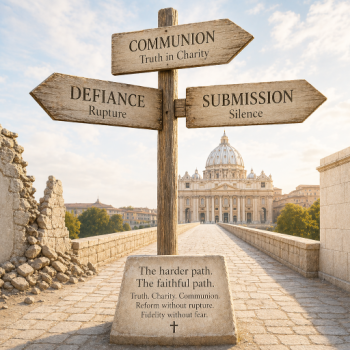
Yet true Catholic fidelity proclaims truth in love. As Pope Benedict XVI wrote in Caritas in Veritate:
Truth needs to be sought, found and expressed within the ‘economy’ of charity, but charity in its turn needs to be understood, confirmed and practiced in the light of truth…This is a matter of no small account today, in a social and cultural context which relativizes truth, often paying little heed to it and showing increasing reluctance to acknowledge its existence.
Final Thoughts
Progressive tactics rarely deny doctrine outright. Instead, they affirm, reframe, shift, and cover. Todd and Fr. Martin exemplify this tactic. Their use of “pastoral” deniability lets them present themselves as faithful sons of the Church while cloaking ambiguity in the language of pastoral care.
This approach does not evangelize; it anesthetizes. Instead of leading souls to conversion, it leaves them lost in a fog of half-truths. Authentic pastoral care proclaims the whole truth with love, because only the truth saves.
Thank you!
If you liked this article, please leave your comments below. I am very interested in your opinion on this topic.
Read The Latin Right’s other writing here.
Please visit my Facebook page and IM your questions (and follow my page) or topics for articles you would like covered.













 Ad-Free & Subscriber Log-In