

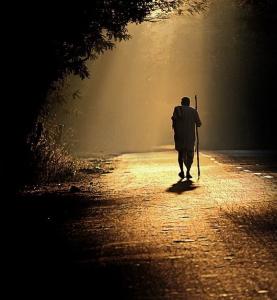
 Guest writer: Pilgrim
More thoughts from an old man witnessing a culture lose its way
Opening Thoughts
Where there is no vision, the people perish. (Proverbs 29:18)
Vanity of vanities, says the Preacher, vanity of vanities! All is vanity. (Ecclesiastes 1:2)
I keep returning in my prayers to two voices from Scripture that speak directly to our time. The wise man in Proverbs warns that “where there is no vision, the people perish.” The Preacher in Ecclesiastes laments that “all is vanity;” our projects, our achievements, our carefully constructed meanings dissolve like vapor.
These words of wisdom speak to me as I watch our culture flail about, desperately seeking something to believe in now that the Christian vision has been largely abandoned. We are a people starving for a truth that can give meaning, yet everything we grasp turns to dust in our hands.
The Restless Substitutes
I’ve watched secular society try to fill the God-shaped hole – the deep ache for the infinite – with various substitutes. Each promise what only the Gospel can deliver: lasting meaning, unshakeable hope, a reason to carry on amidst life’s inevitable disappointments.
Politics as Religion. I’ve seen politics become the new salvation. People invest their deepest hopes in electoral outcomes, treat policy disagreements as battles between good and evil, and speak of politicians as either messiahs or demons. The intensity is religious, but the foundation is sand.
Every election cycle, I watch good people convince themselves that the right candidate, the right policies, will finally set things right. Then disappointment sets in. The promised transformation doesn’t come. The “other side” wins sometimes. Even when “our side” wins, human nature remains unchanged. Politics, it turns out, cannot bear the weight of ultimate meaning.
Progress as Gospel. For decades, I watched people place their faith in inevitable progress. Science would fix what was broken. Education would erase ignorance. Medicine would conquer sickness. Technology would bind us and heal division.
Instead, our devices have left us lonelier. Our knowledge has made us more certain of our own righteousness and less willing to listen. Medicine has prolonged life, but cannot remove fear. Technology has multiplied our connections, yet thinned our communion. The gospel of progress has delivered speed without rest, information without wisdom, and connection without love.
Identity as Creed. More recently, I’ve been seeing identity become the new creed. Who you are, your race, your sexuality, your gender, your tribe, demand allegiance with religious intensity. Questioning the new orthodoxy brings swift excommunication from communities.
Identity without transcendence, like politics and progress when misused, becomes a prison. It reduces the human person to categories. It makes every interaction a power struggle. It turns difference into a threat rather than a gift.
Augustine saw this clearly centuries ago in his City of God. When the earthly city tries to take the place of God, it cannot help but fall short of the devotion it demands. The same dynamic plays out in contemporary politics. Communities that promise ultimate meaning but deliver only fleeting power, leaving their adherents restless and disillusioned.
The Substitutes Fail
The tragedy isn’t that these pursuits are evil. Politics, progress, and identity all contain genuine goods. The tragedy is that alone, they cannot carry the weight we place on them.
I think of the Preacher’s words: “I have seen everything that is done under the sun, and behold, all is vanity and a striving after wind.” He’s not saying these things are worthless, but that they are not ultimate. When we treat them as ultimate, we set ourselves up for heartbreak.
This helps me understand why our cultural debates feel so intense, so personal, so apocalyptic. When politics becomes religion, policy disagreements feel like battles for the soul of humanity. When progress becomes gospel, setbacks feel like cosmic failures. When identity becomes creed, critique feels like an existential attack.
The Restless Heart
I see this restlessness everywhere. In the endless scroll of social media, in the frantic pace of our culture, in the way we consume relationships and experiences with the same appetite we bring to products. Always hoping the next thing will finally satisfy.
Augustine understood this: “You have made us for yourself, O Lord, and our hearts are restless until they rest in you.” Every substitute for God stirs this restlessness. They cannot provide what the human heart is called to seek.
Lessons About Vision
At my age, I’ve had time to watch several grand visions rise and fall. I’ve seen utopian promises collapse and idealistic movements turn bitter. I’ve witnessed the gap between human aspiration and human achievement play out across the decades. Now I’m watching the crumbling of the West’s secular faith – the sacralization of liberal-pluralistic democracy and its institutions.
But I’ve also seen something else, too. The quiet persistence of people who have found their vision in something beyond the human. They face the same disappointments, the same failures, the same mortality we all face. But they don’t collapse when their earthly projects fail because their hope is anchored elsewhere.
They understand what the Preacher meant when he concluded: “Fear God and keep his commandments, for this is the whole duty of man.” Not a system to master, but a relationship to cherish. Not a problem to solve, but a mystery to live within.
The Opportunity in Crisis
This creates an extraordinary opportunity for the Church, though it’s not the opportunity many Catholics think it is.
Our culture’s exhaustion with failed substitutes doesn’t mean people are ready to return to institutional Christianity. The Church’s reputation has been damaged by its grave moral failures, its cozy relationships with worldly power, and its own tendency to treat politics as religion.
But it does mean people are increasingly open to authentic witness. They’re hungry for communities that offer genuine transcendence rather than better politics. They’re searching for meaning that can survive disappointment, hope that can endure suffering, and love that can embrace enemies.
The early Church conquered no empire nor controlled a government. It lived the Gospel until others couldn’t ignore it. Christians cared for plague victims when others fled. They included the excluded. They forgave the unforgivable. Their vision was so compelling, so different from the tempests of politics, the illusions of progress, and the idols of identity. Its strength lay not in seeking power, but in love and fidelity – enduring, patient, and rooted in the eternal.
In a world chasing meaning through earthly structures, the Church offered a witness that endured, a hope that outlasted human ambition, and a love that reflected the eternal.
Living Between Vision and Vanity
I find myself these days living consciously between the vision of Proverbs and the vanity of Ecclesiastes. I still work for good things – justice, beauty, truth, human flourishing. But I hold them lightly, knowing they are not ultimate.
It’s not cynicism, but freedom. When we know that only God’s kingdom endures, we can work for penultimate goods without being crushed when they fail. You can engage in politics without making it your religion. You can appreciate progress without making it your gospel. You can acknowledge identity without making it your creed.
This is what I think the Church can offer our restless age. A vision that doesn’t promise what it cannot deliver, and a hope that survives when earthly hopes collapse.
Closing Reflection
Sometimes I imagine what our culture might look like if Christians lived this vision consistently. Not perfectly, we’re still fallen creatures. But authentically. What if we were known for our peace in anxious times, our generosity to enemies, our refusal to treat politics as final?
What if we built communities where people could find the belonging they seek without tribal warfare? Where they grapple with meaning without having to choose between naive faith and cynical despair.
The Preacher was right. Everything under the sun is vanity. But he was also a man of faith, and faith opens us to what is above the sun: the eternal love that gives meaning to our temporary struggles, the kingdom that does not fade, the vision that truly sustains a people.
We are pilgrims, and our task is not to build the perfect society under the sun, but to point toward the Eternal City beyond it. Not to solve the restlessness of the human heart, but to witness to the One who can satisfy it.
That may be enough. In fact, it may be everything.
And so I turn, as pilgrims always have, to the wisdom of those who walked before us, to see how the Church has wrestled with these same questions.
Theological Postscript: The Wisdom of the Ages
This reflection draws from a long tradition of Catholic wisdom on human nature and society.
Scriptural Foundation: Jesus understood that his followers would live in tension with the surrounding culture. He called them to be “salt of the earth,” the “light of the world,” and a “city on a hill.” (Matthew 5:13-16), preserving goodness and providing illumination and guidance through presence. He also warned: “If the world hates you, keep in mind that it hated me first” (John 15:18). Christians are called to engage the world while holding different priorities.
Saint Paul instructed believers: “Do not be conformed to this world, but be transformed by the renewing of your mind” (Romans 12:2). And the result should be visible: “the fruit of the Spirit”- love, joy, peace, and patience (Galatians 5:22-23).
Augustine’s Restless Heart: Saint Augustine understood something fundamental about humanity [1]. In his Confessions, he observed that “You have made us for yourself, O Lord, and our hearts are restless until they rest in you.” This isn’t just beautiful poetry; it’s anthropology. Human beings are built for transcendence. Trying to satisfy that longing with politics, progress, or identity ends in disappointment.
Augustine recognized in The City of God that earthly cities become idolatrous when they seek ultimate meaning outside the Heavenly City [2]. Political communities can try to provide transcendent meaning, but prove too fragile.
Vatican II’s Framework: Gaudium et Spes insists that “without the Creator the creature vanishes;” that human dignity finds its full meaning only “in the mystery of the incarnate Word.” The Council wasn’t rejecting modern achievements but showing where they fit within a larger picture – as good things that point beyond themselves to something greater [3].
Recent Papal Teaching has applied these insights to contemporary challenges:
John Paul II diagnosed the spiritual emptiness he saw in both communist and consumer societies. In Centesimus Annus, he argued that authentic human development requires recognizing the transcendent dimension of every person [4]. His Fides et Ratio showed how human reason itself points us toward transcendent truth [5].
Benedict XVI deepened this analysis, focusing on the relationship between earthly and eternal hope. In Spe Salvi, he warned that earthly projects become destructive when we give them a final significance. They only find their proper meaning when understood as expressions of a deeper longing [6]. Caritas in Veritate demonstrated how authentic development requires both truth and love, neither of which can be grounded in secular frameworks [7].
Pope Francis emphasized witness and invitation. In Evangelii Gaudium, he wrote that “The Church is called to be the house of the Father, with doors always wide open.” An evangelization that trusts in the Gospel’s own attractiveness rather than cultural dominance or political force [8].
Pope Leo XIV’s recent words capture: “The promotion of ‘values,’ however evangelical they may be, but emptied of Christ, is incapable of changing the world” [9]. Political engagement without Christ-centered formation produces ideology; interior spirituality without public courage abandons society to secular forces.
A Final Word
Our age’s crisis of meaning isn’t sociological; it’s theological. We’re witnessing what happens when human communities try to build on foundations that cannot bear the weight of human longing for the infinite.
Catholic tradition affirms both the wisdom of Proverbs and the realism of Ecclesiastes. Without divine vision, spiritual and moral chaos follow. Only in Christ do we find a truth that endures and a hope that embraces human limitation and human destiny.
And so I return to the pilgrim’s task. Not to build the perfect order under the sun, but to point beyond it. Not to banish restlessness, but to witness to its source and cure. The Church must neither withdraw nor be triumphalist. It must be an authentic sign of that Eternal City which alone endures.
For me, these voices confirm what I have learned in my own faltering way. And so I walk on as a pilgrim, between vision and vanity, trusting that this restless heart finds its home in the One who alone gives rest.
O God, you are my God, earnestly I seek you;
my soul thirsts for you, my flesh faints for you,
as in a dry and weary land where there is no water
(Psalm 63:1).
Footnotes
- Augustine, Confessions, Bk. I. I.
- Augustine, The City of God, Bk.19. 24.
- Second Vatican Council, Gaudium et Spes (Pastoral Constitution on the Church in the Modern World), (1965), 22.
- John Paul II, Centesimus Annus (The Hundredth Year), (1991), 24.
- John Paul II, Fides et Ratio (On the Relationship between Faith and Reason), (1998), 1.
- Benedict XVI, Spe Salvi (On Christian Hope), (2007), 22–25
- Benedict XVI, Caritas in Veritate (Charity in Truth), (2009), 1.
- Francis, Evangelii Gaudium (The Joy of the Gospel), (2013), 47.
Thank you!
Read The Latin Right’s other writing here.
Please visit my Facebook page and IM your questions (and follow my page) or topics for articles you would like covered.













 Ad-Free & Subscriber Log-In