


In reading many progressive writers, one theme appears again and again: power. Power to restructure society. Power to regulate behavior. And power to remake the world. The promised end is always some version of a progressive utopia—where everyone recycles, healthcare and education are universally guaranteed (including unlimited access to abortion), and even the human footprint itself has been engineered into harmlessness. In this vision, power exists to master reality. It exists to control outcomes. It exists to bring the world to heel.
Whenever I encounter this way of thinking, I am struck by how radically it departs from the Catholic understanding of power—an understanding rooted not in mastery, but in theodicy. Christian theodicy begins with a confession modern thought resist: power does not belong to us. Power belongs to God. And because it belongs to God, transformation does not begin with control, but with surrender.
Now, some immediately object that Christians themselves often ally with power. The point to Christian nationalism, integralism, or darker chapters of Christendom. But that objection quietly concedes the Christian point. Christianity does not deny the temptation to dominate. In fact, Christianity builds its entire moral vision around restraining it. When Christians grasp for power, they do not fulfill Christian theodicy; they violate it. The Gospel never promised that baptism ends the influence of sin. It promised that Christ would judge, expose, and crucify even our lust for control.
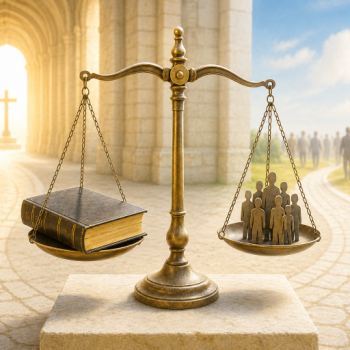
From here, two irreconcilable visions of power confront us:
- Is power something human beings must seize, concentrate, and deploy to fix the world?
- Or is power something that must first be submitted to God, such that renewal comes only through obedience, repentance, and participation in His will?
Everything follows from how we answer these questions.
For progressive utopianism is, at its core, a theology of control.
Christian theodicy is a theology of surrender.
Progressive Utopianism: Power as Mastery
With the removal of God from the center of reality, the human desire for power rushes in to fill the void. We see this in the progressive tendency to replace providence with process, grace with governance, conversion with control, and sanctification with systems. In this paradigm, power means control: control of outcomes, prevention of designated risks, authority to redefine “harm,” and possession of the means to accelerate history toward a desired utopia.
This framework also explains why progressives fixate on particular levers of control: regulation, speech management, therapeutic enforcement, bureaucratic moralism, and elitism in the form of reliance on expert classes. Denying any meaningful doctrine of fallen human nature, progressive utopianism treats evil as primarily environmental. As a result, power over environments becomes salvific, and the mechanisms built to manage them become paramount.
Christian Theodicy: Power as Belonging to God
Conversely, theodicy answers the question every worldview must face: who holds power over evil? Christianity answers without qualification: God does. And because God holds power, the human task is not to abolish tragedy by force, but to enter it through repentance, obedience, and hope.
Long before modern progress narratives, St. Augustine of Hippo framed Christian theodicy around divine sovereignty rather than human control: “God judged it better to bring good out of evil than not to permit any evil to exist.” The point is not that evil is useful, but that only God has the power to redeem what man can only manipulate.
God alone sees the whole, judges justly, redeems without corruption, and brings life out of death. He alone transforms the human heart. He alone recreates what sin has disordered. Through grace, the Christian does not seize power but relinquishes it—dying to self and embracing the Cross, as Christ did.
In Christian theodicy, true power does not rest in mastery, but in surrender to the only true Power: God.
A Progressive Christian Example: “Blood and Power”
A recent article by fellow Patheos writer Henry Karlson, titled “Blood and Power: The Dangerous Game of Climate Politics,” illustrates this contrast with particular clarity. In the article, Karlson appeals to the fear of environmental catastrophe to press Christians toward progressive political solutions, framing resistance as a path toward inevitable extinction. He invokes real suffering, climate anxiety, and ecological instability as moral leverage, then converts that leverage into political necessity in order to justify progressive power plays.
In short, Karlson’s piece exposes what happens when human beings convince themselves they must control the future to save it. The “climate crisis” becomes not a call to stewardship under God, but a warrant for technocratic dominance, militarized resource control, and moralized coercion. What emerges is progressive utopian logic in real time: a movement from care for creation under God to mastery over creation in the name of survival. That shift is no accident.
Final Thought… Who Submits and Who Demands Submission?
Every worldview must answer the same question: who holds power over evil? Progressive utopianism entrusts that power to human hands—hands that regulate, engineer, coerce, and reconstruct the world to save it. Christian theodicy places that power where it belongs: in God’s hands. And because that power rests with God, the human response turns away from mastery and toward repentance, obedience, and hope.
This divide runs deeper than politics. It cuts to theology itself. One vision seeks to stabilize goodness and prevent tragedy. The other understands that we cannot bypass suffering, only redeem it through the cross. One promises a future secured by power. The other offers a kingdom received through surrender.
For this reason, progressive Christianity recoils from judgment, sacrifice, and limits. These doctrines dethrone human control. They confess that force cannot fix the world or heal the heart. Only God possesses the ability to redeem and save.
Christianity offers something far more unsettling (and far more hopeful). It proclaims a God who does not manage suffering from a distance but enters into it. A God who does not redeem the world by mastering it, but by taking on humanity and dying for it. A God who conquers evil not through domination, but through love.
We never escape submission to power. We only choose whose.
Thank you!
Read The Latin Right’s other writing here.
Please visit my Facebook page and IM your questions (and follow my page) or topics for articles you would like covered.









 Ad-Free & Subscriber Log-In