

 Who Am I to Judge (God)?
Many today treat a non-judgmental attitude as a virtue. “Who am I to judge?” gets tossed around to cover a multitude of sins—or at least to grant leeway for excusing one’s own. Yet people rarely extend this restraint to God. In fact, many people judge God’s actions, especially in the Old Testament, and then use those judgments to justify atheism, agnosticism, or skepticism.
Christians—particularly those who affirm Scriptural inerrancy—regularly hear objections like:
“I could never believe in a God who would…”
“That contradicts my conscience.”
“That sounds cruel.”
These complaints assume that God must pass human moral evaluation before He deserves honor or worship.
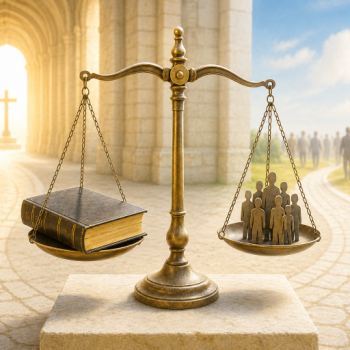
But this line of criticism relies more on emotional reaction than on theological reasoning. Saying “I don’t like this” does not make it false. This discussion does not turn on emotion; it turns on whether we understand the Creator–creature distinction. The problem begins when man steps into the judge’s seat and places God on trial.
The harsh passages in the Old Testament remind us of our place as creatures. In short, God is God, and we are not.
The Creator–Creature Distinction
God stands infinitely above His works: “You have set your glory above the heavens.” His greatness remains unsearchable. Yet as the free and sovereign Creator—the first cause of all that exists—God remains intimately present to His creatures’ inmost being: “In him we live and move and have our being.” As St. Augustine writes, God is “higher than my highest and more inward than my innermost self.” He upholds and sustains all creation (Catechism of the Catholic Church, 300).
God is Creator, not a moral peer. Man, contingent and dependent, receives existence itself from God. The One who gives being also gives order and purpose to what He creates. A contingent creature cannot stand in judgment over the source of its own existence.
As St. Paul asks:
Who are you, O man, to answer back to God? (Rom 9:20).
God therefore does not submit to the moral order; He grounds it.
The Modern Inversion
Confusion about the Creator–creature distinction has produced a theological inversion. In this inversion, ideas such as judgment—whether temporal or eternal (Hell)—appear unloving or even morally repulsive. Many people soften or dismiss judgment language as nothing more than humans projecting bad behavior onto God. As a result, sentiment filters Scripture, and subjective moral standards become the final interpretive authority.
This approach conflicts with the Church’s understanding of Scripture and its interpretation. As Dei Verbum teaches, Sacred Scripture and Sacred Tradition “form one sacred deposit of the word of God,” which the Church, with the help of the Holy Spirit, faithfully interprets for “the salvation of souls.” This sacred deposit judges the individual; the individual does not judge the sacred deposit.
When sentiment governs interpretation, God speaks only what we already agree with.
The Biblical Witness: God as Judge
Scripture, both Old and New, presents God as the ultimate judge of humanity. God judges Adam and Eve for their sin by banishing them from the Garden (Gen 3:23–24). He judges the earth in the time of Noah, sparing only Noah’s family (Gen 6:9–22). He later commands judgment against the Amalekites (1 Sam 15).
Christ likewise claims authority to judge (John 5:22). His actions reflect that authority in the cursing of the fig tree (Mark 11:12–25) and in His teaching about the separation of the righteous and the unrighteous at His return (Matt 25:31–46).
Yet Christ did not come primarily to condemn but to save. As the Catechism explains, Christ “did not come to judge, but to save and to give the life he has in himself” (CCC 679). At the same time, the same passage warns that by rejecting grace, a person can “even condemn oneself for all eternity by rejecting the Spirit of love.”
Scripture therefore presents the merciful Christ as the righteous Judge.
Addressing the Objection: “Cruelty Attributed to God”
Many readers bristle at Old Testament passages because they perceive God’s actions as cruel by ordinary human moral standards. Some raise the same objection to the doctrine of Hell and eternal judgment (Rev 20:11–15).
We must, however, distinguish between human cruelty and divine judgment. Human cruelty arises from abuse of power, ignorance, or malice. Divine judgment proceeds from perfect justice and the Creator’s rightful authority over His creation. Human beings judge with limited knowledge; God judges with complete knowledge. Christian belief, by definition, affirms God’s omniscience.
This same all-knowing God took on flesh, suffered death, and rose again for our salvation. That truth provides the Christological anchor for understanding judgment: the Judge is Christ crucified. Judgment and love meet at the Cross (CCC 604).
Final Thoughts: The Lost Virtue: Humility
At the center of this discussion stands a simple but demanding truth: creatures must accept their place in the created order. Much of our modern discomfort with divine judgment does not arise from careful theology, but from a reluctance to kneel before a wisdom greater than our own.
Humility restores clarity. It reminds us that we do not sustain the universe, define justice, or redeem the world. God does. When we forget this, we do not elevate human dignity—we burden ourselves with a role we were never meant to carry.
The Christian faith does not ask us to silence our questions, but it does ask us to trust the character of the One who reveals Himself. The God who judges is the same God who creates, sustains, and saves. He is not arbitrary, and He is not cruel. He is just, merciful, and wise beyond our comprehension.
In the end, peace begins when we step down from the judge’s bench and take our place in the created order. God is God, and we are not—and that is not a threat, but good news.
Thank you!
Read The Latin Right’s other writing here.
Please visit my Facebook page and IM your questions (and follow my page) or topics for articles you would like covered.











 Ad-Free & Subscriber Log-In