

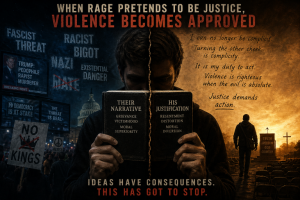
Here we go again. Another act of violence targets political conservatives—this time at the White House Correspondents’ Dinner. For Donald Trump, this marks a third attempt.
Witnesses watched the aftermath unfold in real time. Scared and heartbroken, Erica Kirk—the widow of a previous victim of leftist political violence—left the event sobbing, “I just want to go home.” The Secret Service stopped the attacker before he could carry out his plan. One agent suffered injuries but is expected to recover. Authorities took the alleged shooter into custody alive.
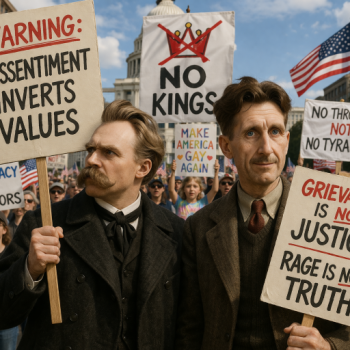
I write now to repeat a warning I have already made in Nietzsche, Orwell, Modern Grievance Politics & “No Kings” and The Danger of Enraged Imprudence: the current rhetoric on the Left places real people in real danger.
The alleged shooter’s manifesto does not obscure this reality—it confirms it.
Grievance-driven rhetoric and moral recklessness create an approval structure for political violence. When political leaders and journalists constantly describe conservatives as existential, fascistic threats—while labeling the president a pedophile, murderer, and rapist—they do more than criticize. They shape perception. They frame the stakes as absolute.
And when the stakes become absolute, some will act accordingly.
Is it any wonder that people take these claims at face value?
This has got to stop.
The Manifesto: Moral and Religious Language as Justification for Violence
So why did the alleged shooter do it? He tells us in a manifesto he sent to his family just before the attack.
What stands out is not chaos, but moral clarity—at least in his own mind. His motivations take on an explicitly moral and religious character.
First, he frames violence as a duty. He writes:
I am no longer willing to permit a pedophile, rapist, and traitor to coat my hands with his crimes.
After listing his intended targets, he anticipates objections to his actions. He even addresses Christ’s command to “turn the other cheek.” But he does not reject it outright—he redefines it. In his view, only the “oppressed” must turn the other cheek, not those who act on their behalf. In fact, he argues that refusing to act violently makes one complicit “in the oppressor’s crime.”
Note the inversion:
- Mercy becomes complicity.
- Restraint becomes cowardice.
- Violence becomes righteousness.
In short, this is Friedrich Nietzsche’s concept of ressentiment fully matured:
- Grievance becomes moral superiority—and moral superiority becomes justification for destruction.
Nietzsche Was Right—But Not in the Way They Think
As I argued in my No Kings article, ressentiment thrives on perceived injustice and powerlessness. It also rebrands weakness as moral authority.
Applied to the alleged shooter, the pattern becomes clear. He viewed himself as morally pure, saw his opponent as irredeemably evil, and concluded that violence was not merely permitted—but required.
What else, in his mind, should a moral person do when confronted with absolute evil?
Orwell Was Right Too: Language as Conditioning
Viewed through the lens of 1984 by George Orwell, this situation reveals how political rhetoric conditions the mind. It reshapes how people define justice, tolerance, and righteousness, flattens moral categories, and normalizes hostility.
In the immediate aftermath of the attack, conspiracy theories spread online claiming the incident was “staged.” As in Orwell’s novel, reality itself becomes contested.
When language detaches from truth, violence often fills the vacuum.
The Failure of Prudence
As I argued in The Danger of Enraged Imprudence, prudence applies right reason to action and guides moral judgment by reality, not emotion. Enraged imprudence does the opposite. It assumes certainty, escalates action, and collapses the distinction between justice and vengeance.
Apply that framework to this attack. We see someone who believes he possesses perfect moral clarity, acts without restraint, and bypasses every mediating structure—law, the Church, and reason itself.
The alleged shooter’s actions fit the definition of enraged imprudence.
Not Just “One Lone Actor”
Some may read this and conclude, “This was a lone actor, not the product of anything more sinister.” But that explanation falls short.
The alleged shooter drew from widely circulating moral narratives. He adopted familiar rhetorical frames and relied on a shared ideological language of grievance.
His actions reflect a concerning cultural pattern—not an isolated incident.
For context, please see the clip below showing the consistent rhetorical narrative that reflects similar language used by the alleged shooter.
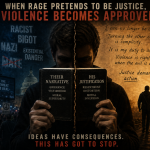
Final Thoughts: When Rage Pretends to Be Justice
This recent assassination attempt makes one thing clear: hatred is not neutral. Hatred deforms the soul. It clouds judgment, distorts reality, and hardens the heart against both truth and restraint.
A culture that normalizes contempt for its opponents will not remain content with words. It will escalate. It will justify. And eventually, it will act.
That is how an approval structure for violence takes shape—not through a single argument or a single voice, but through repetition. Through constant moral escalation. Through language that frames political opponents not as wrong, but as evil—irredeemable, dangerous, and beyond the reach of ordinary moral limits.
Once that framework takes hold, the rest follows with disturbing consistency. If the enemy is absolute evil, then resistance becomes absolute. If the stakes are ultimate, then restraint looks like betrayal. And if violence appears necessary, someone, somewhere, will decide to carry it out.
We cannot pretend this dynamic does not exist. We cannot dismiss it as an isolated breakdown. Ideas have consequences, and moral language—especially when untethered from truth—can justify almost anything.
If we want to prevent the next act of violence, we must confront the conditions that make it seem righteous.
This has got to stop.
Thank you!
Read The Latin Right’s other writing here.
Please visit my Facebook page and IM your questions (and follow my page) or topics for articles you would like covered.











 Ad-Free & Subscriber Log-In