

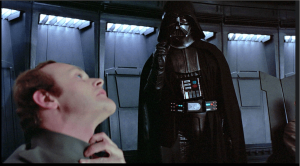
One of the most memorable scenes in the Star Wars mythology occurs between Admiral Motti (Richard LeParmentier) and Darth Vader (David Prowse) in a Death Star conference room in Episode IV: A New Hope. The scene introduces us to both the power of the Death Star and of the Dark Side of the Force. This unfolds in the argument between Motti and Vader, where Motti accuses Vader of incompetence, suggesting that Vader’s “sorcerers ways” are outdated and that his devotion to an ancient religion “sad” in comparison to the power of the Death Star. Vader, in turn, famously responds saying that he finds Motti’s “lack of faith disturbing,” and then demonstrates what real power is like with his infamous force choke.
In the scene, writer and director, George Lucas, drawing from various mythologies, and the work of mentor, Joseph Campbell, incisively captures a common motif throughout religious history. The theme is the relationship of the spiritual and the technological, or the magical and mechanical. The Death Star can destroy massive amounts of physical matter–entire planets and all their inhabitants. The Dark Side, however, can destroy the soul–transforming good men into cruel despots. The two are, in one sense, in conflict over what is the best means to rule the world: is it through the body, or through the spirit?
Yet, on the other hand, the two operate in union. They both have the same goal in mind: domination and control. Moreover, because myths are real, this interplay between the supernatural and the scientific– the technological and the occult– has played out repeatedly in history, and not just in a galaxy “far, far away.” We find it both in the Bible, and in more recent historical times and places. Spiritual power and mechanical power often interlock in an unholy alliance as man attempts to secure dominance over God’s world and its creatures without recourse to God.
Pro- and Anti-Occultism in The Nazi Third Reich
In a fascinating study on the supernatural beliefs of the Nazi Party, Hitler’s Monsters, Eric Kurlander carefully documents the mystical doctrines and supernatural beliefs of many top leaders of the Nazi party. Hitler, Hess, Goebbels, and Himmler, and other influential Nazi politicians, military leaders and propagandists, sought to combine the occult musings of the infamous Madam Blavatsky, a 19th-century Russian mystic who developed the theory of “root races”– which lead to the Nazi doctrine of “Ariosophy,” or “Arianism”– the esoteric beliefs of the Thule Society, and the neopagan revivalism of men like Guido von List, to fashion a spiritual-political ideology aimed at revitalizing a demoralized German people in the wake of WWI.
Kurlander builds a convincing case that it was this combination of revived germanic (“Edda”) paganism, eastern-inspired occultism, and Blavatsky’s theories on race that synthesized into the overall ideology that drove the Nazi war machine. According to Kurlander:
No mass political movement drew as consciously or consistently as the Nazis on what I call the ‘supernatural imaginary’ – occultism and ‘border science’, pagan, New Age, and Eastern religions, folklore, mythology, and many other supernatural doctrines – in order to attract a generation of German men and women seeking new forms of spirituality and novel explanations of the world that stood somewhere between scientific verifiability and the shopworn truths of traditional religion. Certainly no mass party made a similar effort, once in power, to police or parse, much less appropriate and institutionalize such doctrines, whether in the realm of science and religion, culture and social policy, or the drive toward war, empire, and ethnic cleansing. Without understanding this relationship between Nazism and the supernatural, one cannot fully understand the history of the Third Reich.
Kurlander goes on to note that this supernatural occultism was an integral part of Hitler’s personal beliefs. When the 101st ABN division of the United States Army discovered the Führer’s personal library at Berchtesgaden, it
Included almost no works on political theory or philosophy. But Hitler did own many books ‘on popular medicine, miraculous healing, cooking, vegetarianism and special diets’ and dozens ‘about Wotan and the gods of German mythology . . . magic symbols and the occult’. Among these volumes were Ernst Schertel’s Magic and Lanz von Liebenfels’ The Book of German Psalms: The Prayerbook of Ariosophic-Racial Mystics and Anti-Semities.
However, in spite of the explicit spiritual and occult beliefs and practices of not only top Nazi leadership, but many Germans at the time, there also developed a reaction to occultism and magic within the Nazi party. Some Nazi leaders saw the embrace of occult and magic as unscientific and deceptive. Between 1937 and 1939 there was a push to curb occultism, rein in popular belief in astrology and magic practice, and police charlatanry among the Volk. While this push against occultism and the mystical was never fully realized, it clearly had its advocates. This lead to a inner tension among Nazi leaders, like Hess and Himmler, who personally subscribed to occultism, and others, like the noted chemist, Albert Stadthagen, and Police Commissioner, Carl Pelz, who were tasked to combat occultism or, at least, popular occultism and magical chicanery.
Kurlander notes, however, how deeply seated occult belief and magical thinking was in the popular mindset, a fact that many of the more “scientific,” anti-occult commentators lamented:
According to one frustrated anti-occultist, writing in the pages of the Racial Observer in 1937, ‘it is regrettable that the proclivity for superstition and mysticism has been systematically fomented’ in the Third Reich. After four years in power ‘nearly 80 per cent of Germans are still in some form susceptible to this nonsense’. Far from inaugurating a ‘war on the occult’, the years 1933–7 had witnessed an efflorescence of occult and supernatural thinking. For sceptics and debunkers, both inside and outside the NSDAP, the situation was untenable.
Nevertheless, in spite of the inner conflicts over either the reality, or usefulness, of the supernatural, magical and occult among Nazi leaders, none of the conflict seems to have hindered the ultimate goal of both pro- and anti-occultists: the prosecution of the war, the elimination of lesser races, most notably the Jews, the marginalization of Christian religion, and the restoration of the Arian people as the “Great Race” among men. In these aims there was astounding unity among those of a more scientific bent, and those of a more spiritual orientation.
Of Magical and Mechanical Power
It is a well-known fact of the Star Wars mythology that George Lucas patterned much of the “Galactic Empire” off of Hitler’s Germany:
There’s nothing subtle about this historical allusion in Star Wars. After all, the elite assault forces fanatically devoted to the Galactic Empire share a common name with the paramilitary fighters who defended the Nazi Party—stormtroopers. The Imperial officers’ uniforms and even Darth Vader’s helmet resemble those worn by German Army members in World War II, and the gradual rise of Palpatine from chancellor to emperor mirrored Adolf Hitler’s similar political ascent from the chancellor to dictator.
https://www.history.com/articles/the-real-history-that-inspired-star-wars
It is curious then, and perhaps to Lucas’ credit, that in the scene between Admiral Motti and Darth Vader the same dynamic tension between the scientific–or mechanical– power monger, and the supernatural–or magical–power monger is depicted; not unlike how it played out in the real history of the Third Reich. The line here between art imitating life and life imitating art is, indeed, quite blurry. Especially when one understands the various sources that contributed to the Nazi ideology.
Kurlander’s book is recent, a 2017 publication, but the material he is working with would have been available to Lucas at the time. One wonders if Lucas did some digging of his own into the supernatural and esoteric beliefs of the Nazis, and the conflict between pro and anti-occultists. If he did, kudos to him for capturing something of great historical value in an otherwise commercial film. It is, of course, aspects of the early films like this one that lent to their tremendous appeal. There is something deeply true, metaphysically and morally, being depicted in the Star Wars universe…at least in the first three films.
However, even if Lucas had not done the historical research needed to latch on to the dynamic laid out above, the theme of magical and mechanical power operating together toward an evil end, and, at times, coming into conflict with one another in spite of that end, is a ubiquitous one–both in real history (or Historie), as in Hitler’s Germany, and in mythological history (or Geschichte), as in Star Wars, or other popular mythologies, like Lord of the Rings. Because we see the interplay of the spiritual and the physical all around us, at every time and every place, regardless of culture, we intuitively understand the argument between Motti and Vader. Moreover, we also aren’t too surprised to learn that the real Nazis argued over the same dynamic.
Technology and the Fall of Man
Jacques Ellul, in his classic treatment on the powers and principalities, The Meaning of the City, provides theological insight into these two faces of evil. All of human techne, or technology, is a response to a spiritual state: the state of being separated from God, the Creator. This spiritual separation, this curse (Gen 4:11-12), results in spiritual isolation and insecurity. Technology becomes the means by which man attempts to reestablish the primordial harmony, and feel safe in his soul.
Reflecting on the story of Cain, the first murderer and builder of a city, Ellul comments on Cain’s spiritual state after his fall into sin:
Cain is completely dissatisfied with the security granted to him by God [Gen 4:15-16], and so he searches out his own security. However, the search is no different from his first desire for God’s presence, and his security can only be found in God [Gen 4:2b-5]. It is only when he believes in God that he will be able to believe that the mark placed on him…is an effectual guarantee, because it is an integral part of God’s word (pledge). But of course, Cain doe not understand it the way God does. And as for his security, he will find another way to procure it.
Ellul, Meaning of the City, 4-5
God’s promises to care for his creatures, even after they sin, are continually rejected by his creatures: first by Adam and Eve (Gen 3:6-10), then by Cain, then Lamech (Gen 4:19-24) , the builders of Babel (Gen 11:1-9), and ultimately all humanity (John 1:9-11). And so, instead, Cain, like us, will procure his own security without recourse to God. It is through technology, here embodied in the building of the first city, that power will be restored:
He will try to take care of his own needs in these areas [security and immortality]…He will satisfy his desire for eternity by producing children, and he will satisfy his desire for security by creating a place belonging to him, a city.
Ellul, 5
The biblical story shows mankind’s distancing himself from both God and God’s word. Instead of trusting God, man turns toward his own creative powers to secure his destiny and determine his fate. When confronted by the curse of separation from his creative source, the Creator Himself, man says:
‘I’ll take care of my problems alone.’ He puts everything to work to become powerful, to keep the curse from having its effects. He creates the arts and the sciences, he raises an army, he constructs chariots, he builds cities. The spirit of might is a response to the divine curse, and one could almost say that such a spirt would never have existed if there had been no curse in the first place.
Ellul, 11.
In sum, the spiritual and the technologic are intimately related. Much, if not all of human history, is predicted in the early stories of Genesis. Man, spiritually wounded, seeks to create his own source of spiritual power: technology. Ironically, he undergoes this project by employing the God-given capacity of his own creativity: fearing death, he tries to dominate life.
Conclusion: The Spiritual-Mechanical Symbiosis
The spiritual and mechanical are not only in conflict, however. They eventually merge into one unit or being, brought together under the auspices of a malevolent will. In the movie, both Vader himself, and the Death Star, represent symbioses of the spiritual and mechanical. Vader is “more machine than man,” as we find out in a later episode, and the Death Star is not just a weapon, but an actual city: a living machine. The Nazi terror was also a symbiosis of the spiritual and the technical. Whatever supernatural power the Nazi leaders had embraced, whatever magical and occult practices they performed, it lead to a military-industrial build up of incredible strength (a “hideous strength” to paraphrase Lewis). That was a power that unleashed more physical destruction than anything to date.
This dynamic, which we encounter both in the mytho-poetical and in the real historical, is something that needs to give us serious pause. As our technologies increase far beyond our ken, in the realization of powerful Artificial Intelligence or in bio-technical innovations once thought possible only in the realm of “science fiction–” in the world of myth–we cannot remain ignorant of the deep truth about the magical and the mechanical, and how they relate and cooperate toward evil ends. As Christians, especially, we must remember that our strength lies not in horses or chariots, but in the name of our God, in the name of Jesus!












 Ad-Free & Subscriber Log-In