

Introducing my new devotional art for the Modern Witchcraft champion of women’s bodily autonomy, sexual freedom, equality & untamed feminine power!
There are few figures in myth and mysticism as arresting and misunderstood as Lilith. Long dismissed in patriarchal traditions as a demon or night-spirit, modern devotees increasingly reclaim her as a primordial Dark Goddess of women’s empowerment, sexual sovereignty, and resistance — a figure who refuses domination and embodies the peak wildness of the night.

Sumerian Lilitu?
In ancient Near Eastern mythology, the name Lilith is connected to the Sumerian and Akkadian lilītu — female night or wind spirits associated with wildness and perceived peril. In these traditions, night spirits were often visualized with wings or bird-like features, reflecting their liminal and untamed nature. Later Jewish folklore and mystical texts portray Lilith as a night demon figure — sometimes described as a dangerous spirit in Talmudic and amulet literature. In medieval Kabbalistic sources she becomes a feminine consort to the angel Samael. Samael is associated in these texts with demonic progeny. These features contributed to her later reputation as a “mother of demons.” These layers were shaped by a patriarchal framework that cast autonomous feminine power as threatening or demonic.
The Burney Relief?
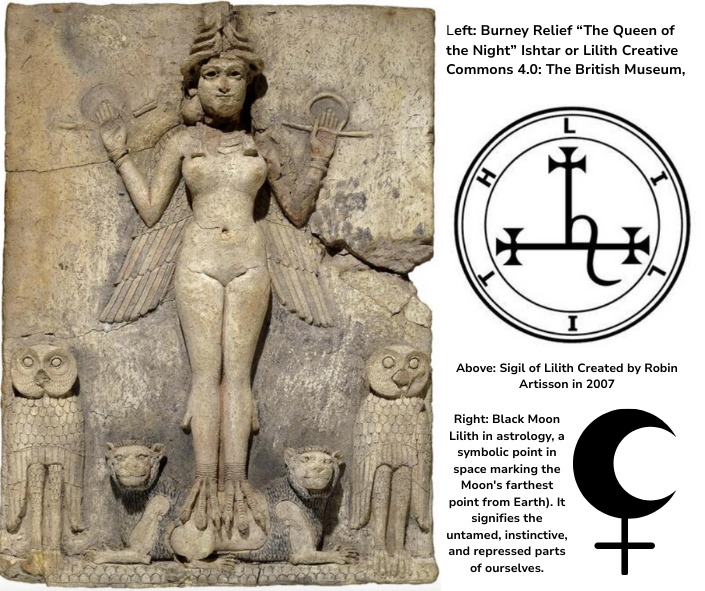
In the Burney Relief, an 18th-to-19th-century BCE terracotta plaque from Mesopotamia, a beautiful nude female figure with wings and bird-like feet stands over reclining lions. This is most often the image that pops up when searching for information about Lilith. She is flanked by owls, and holding rod and ring symbols of Sumerian royalty. Many scholars suggest the relief most likely evokes a Sumerian Goddess or some other ancient night spirit whose mythic memory contributed to later conceptions of Lilith. (see image below)
Adam’s First Wife?
Later Jewish folklore — particularly rabbinic sources and medieval adaptations of the story found in texts like the Alphabet of Ben Sira — reframed Lilith as Adam’s first wife, created from the same earth as Adam, and therefore refusing sexual subordination. In that narrative, she asserts equality (“We were both created from the earth”) and chooses exile over domination, a motif that resonates powerfully with contemporary women reclaiming their embodied autonomy under the patriarchy of this Dominator culture.
As is typical for most ancient Goddesses, Lilith’s history is not a linear evolution from goddess to demon. The Mesopotamian world did not conceive her solely as a demon; many scholars see her iconography and associations aligning more closely with complex feminine deities such as Ishtar or Ereshkigal, who embody passion, threshold forces, and chthonic, underworld sovereignty.
It was these earlier archetypes of night, wilderness, and unbound power that inspired my visual portrayal of Lilith for this candle wrap. In my image, she is nude yet not intentionally erotic. I intended her strong, unashamed body as an emblem of sovereign empowerment, rather than objectification. Her dark, feathered wings and talon-like feet invoke the ancient imagery of the lilitu and the Burney figure; her horned headdress and broad necklace of labradorite echo Mesopotamian regalia, with an added detail of dark moon energy. The rod and ring of royalty in her right hand represent power purposefully reclaimed.
Blood Moon Eclipse?
The blood moon eclipse of the backdrop fuses lunar feminine symbolism with earthly solidarity — a moment when all lunar phases are alchemically present at once, honoring both her Dark Moon associations and her peak of wild potency at fullness. To my eyes, this eclipse becomes a statement: sovereignty does not require denial of any part of one’s self. I blogged more about this here: https://www.patheos.com/blogs/witchonfire/2019/01/witchy-physics-blood-moons-lunar-eclipses/
Why all the Serpents?
I drew the serpent in her left hand as both a nod to her role in the Jewish narrative of Eden — where serpent wisdom catalyzes consciousness — and as a kundalini-like emblem of rising sexual power and divine ecstasy. The owls and lions that flank her mirror the Burney composition and enrich her guardianship over both nocturnal wisdom and regal sovereignty. However, I rendered both a male lion and a lioness, as the ideal restoration of sexual equality that Lilith represents.
The choice of deep red roses and moonflowers in the foreground are intentional offerings: roses for blood, passion, and the thorns of oaths kept; moonflowers for the night’s quiet potency and the feminine mystery of the psyche.
Sigil of Lilith, Astrological Glyph?
On her breast-plate necklace and the border, I also incorporate the 2007 Robin Artisson Sigil of Lilith— a modern symbol embraced by modern devotees. This is contemporary feminist focal point for collective intention and reclamation. My hope is that the egregore of power will grow as more witches use it as a tool of connection to her.
On her horned moon crown and in the border corners, I also incorporated the astrological glyph of Black Moon Lilith: In astrology, Black Moon Lilith is a symbolic point in space marking the Moon’s farthest point from Earth (apogee). This glyph of a waning crescent moon signifies the untamed, instinctive, and repressed parts of ourselves. The energy of rebellion, wildness, shamelessness, and fierce independence that challenge societal norms are all linked to the mythical figure of Lilith through this glyph.
In embracing Lilith today, witches like myself are purposefully de-emphasizing the objectified seductive, demonized, vampiric, satanic or “mother of demons” aspects attributed to Lilith by the Patriarchy. Instead, we awaken consciousness of her as an icon for female wholeness, consent culture, freedom and gender equality. She embodies the rebellious, sexual sovereignty of modern witchcraft. Lilith challenges witches to honor our human depths, our darkness, to pay heed to our instincts, and to guard the sacred thresholds between the worlds.
Hail and Welcome, Goddess Lilith!
For more information check out this resource from Northern Arizona University:
To purchase and download a printable version of this article, with a high resolution color file of this candle-wrap art ready to print and affix to a glass 7-day candle, visit my author website : https://www.heronmichelle.com/shop/p/lilith












 Ad-Free & Subscriber Log-In