Magical Green Elephants: Pagan Finance


It seems like pagans only talk about money when someone is attempting to raise funds and, quite frankly, that isn’t enough. Many pagans are on low incomes, one income, or no regular income, but still need to find ways to build assets, achieve some form of financial security, and, with time, create something they can pass on to their children.

Please bear in mind, I am not a finance professional. I’m just a chick with a love of finance and markets who started seriously looking at where her money was going on $24k a year. I had bills to pay and was, often, barely able to put gas in my car, but I had to nail down sound financial habits fast. I got the thumbs up from a friend on Google+; should I write blog posts about basic finance aimed at the pagan community, he would read them.

This one’s for you love.


First things first, if you do not have a savings account stop reading right now and open one. I have one with ING Direct, but there are a couple of great banks that offer passable interest rates on savings and allow you to automatically debit savings from your checking account.

ING Direct

Ally Bank

These are just two examples of online-only banks that provide FDIC insured savings accounts. ING often has some kind of deal where, if you open an account with $50, they will deposit $50. That’s a 100% match y’all and it’s free money. It’s also not a sham. I did, in fact, receive my $50 bonus for both my savings and Sharebuilder accounts with them. (A total of $100)

If you want to do your own investigation (and you should) to find an online bank, or local one, that will best meet your needs check out Bank Rate for objective comparisons of what banks have to offer. If you’re interested in joining a credit union, A Smarter Choice can help locate a union you qualify for.

If you’re like me and sometimes can’t resist the urge to buy that one little thing just because you have the funds, a savings account with an online only bank may be a good set up, especially since it can take upwards of 3 days to get your money back into your checking account. (Which gives me plenty of pause to wonder if the transfer is actually WORTH dipping into my savings.)

Even if you only have $5 in your account, to your name, put $1 in savings and pay yourself first. My Wells Fargo Way to Save account puts a dollar into savings every time I swipe my debit card. Not only is this relatively easy, but it quickly adds up; especially if you’re one to do a lot of swiping.

The next step I had to take was the nasty B-word. Budget. This is an ever changing process, so once I started budgeting I became very aware of when I let my budget slip…a little. In my opinion, one of the things that dooms many people is the desire to over budget, every penny, of every waking moment and this just isn’t realistic. Give yourself wiggle room and be honest about your expenses. The best way to do this may be a spending diary. For me, it was keeping receipts. One little stop at Barnes and Noble, another at Game Stop, a third at Microcenter and next thing you know I have a purse full of receipts that I have to look at and plug into software when I get to my desk.

This is, often, easier to overlook when purchasing online, but printing your orders and accounting for them may divulge impulsive spending habits, emotional spending, or just plain bad money management.

A few of my favorite, personal, finance websites are Budgets Are Sexy, Money Ning, and Get Rich Slowly. The posts are informative and written in lay person; so no calculations are necessary when reading. Don’t get me wrong, I like math, but I don’t like math that much.

Money Ning, and many other sites, offer free budgeting templates for most software platforms, so there really is no reason to not get a handle on one of the main things we consumers tend to have an issue with; our spending. Finally, planning for the future, emergencies, and even retirement is not just the privilege of the upper middle class. Putting away for a rainy day could, ultimately, be the difference between a small bump and a major pothole should an emergency arise.

Now I’m sure someone is looking at this post and saying “What the hell does this have to do with paganism, or the pagan community.” and I’ll say “everything.” It’s the giant elephant in the room we so often sweep under the rug. It isn’t until a scandal comes about that the discussion of pagans, and our attitudes towards money and financial involvement, are brought up for conversation. It’s amazing how much money will be put into a community center, but mention a pagan credit union and you can hear the crickets chirping half way from Omaha; despite there being a Christian credit union in my immediate area.

Imagine the advantage members of that union have. Not only are they linked economically, but they are personally vested in insuring members of their religious community are able to obtain affordable lending, etc.

And what if we are not making good use of our resources? Why not form a network of pagan finance, mortgage, savings and loans professionals; who could become known for their ethics, understanding of social-economic diversity, and even socially responsible investing? Why not help real people evaluate real issues involving a world they live in which is becoming, increasingly, complex with each new regulation, term, or form of investment?

So this is just the first in a series of posts I’ll probably do, sharing my experiences, showing my screw ups, and hopefully, showing other pagans that there is nothing wrong with talking about money and how an individual can benefit from it while helping to sustain a religious, local, and global economy.


*I was in no way compensated for any of my blurbs. For in depth savings and loans information please contact a finance professional. This post is based, purely, off of anecdotal evidence. All recommendations are personal and for entertainment purposes only. Insert more legalese here.


An American Love Story: In Black and White

An American Love Story in Black and White


We sat across from one another; peach to cinnamon, brown to green, brown to black and in our eyes were love and misunderstandings. We would never fully see things from the other’s point of view. Sure, we could listen and create the kind of dialogue not fit for polite company, but there would always be that barrier, the diverging narratives of paths we never got to choose.

Like fate our hands were dealt and it was fate that led us to hold each others’, too warm, palms across that polished table in a Silver Diner some 2 years ago. He told me about his youth, claustrophobic muggy summers in the suburbs of Philadelphia. He used “ghetto” and meant it in the proper sense. A tight nit community of Polish Jews, his grandmother lived across the street from him as a child. I told him about my younger days spent in areas where I was, often, the source of the much maligned diversity being forced on a good neighborhood in a good part of town; of being pulled over in my own complex. Aparently, we weren’t supposed to be in that area.

The wrenching feeling of truly being alone, isolated from extended family where I was “too white” and “too weird” and viewed with suspicion by the family of friends as “too other” and “potentially dangerous.”

I told him my mistrust is of what he is and not who he is. He didn’t understand and asked painful questions. We argued.

I pried open, with sandalwood scented fingers, the womb of his privilege. Like a newborn, he blinked bleary and cautious, now aware of a world that was not his own. A world that existed out of the corner of his eye, but was never ‘real’ in a tangible sense. “Entitlement” became a part of his vocabulary just as “White people as people” became a part of mine. I saw how my wariness and weariness had turned into anger, and that anger, into hate. I apologized.

We wouldn’t always agree, but from our relationship as friends, lovers, and finally, husband and wife, we gained more of an understanding of where the other came from.

The tidal forces of a shame culture, meeting a guilt culture, sometimes creates blockages in communication. It wasn’t always out of ignorance; sometimes we just don’t speak the same language.

As we became serious and we realized our religions also played major roles in our lives, we both took the time to learn from each other and, slowly, a household altar came together bedecked in offering dishes and candles holders for Shabbat. Our representation of the agathos daimon is tucked in neatly with his favorite menorah.

He knows how special an offering should for Hekate’s Deipnon, just as I know how to make a semi-passable challah for Chanukah and sing one song. (Not well mind you, my Hebrew is shite, but it gets me through.)

Our relationship is FAR from perfect, but it does bring me a little hope that, eventually, the kind of dialogues we share will become ones we can have with others. At some point the discomfort will have to go and we’ll all have to look each other in the face, remove the masks, and be honest about where we stand as a pagan community, as a nation, and as human beings.

The melding of two opposites has created the seeds of birth in our home. We’re the cool “kid-free” place to go where hospitality and laughter flows. We provide stimulating conversation and a hand of Lord of the Rings the Card Game if you are so inclined.

No, we aren’t perfect, but maybe we’ve proven that uncomfortable conversations about race, gender, and religion can be a rewarding experience when you have the right kind of company. Our dialogue has ranged from snarky, to patronizing, to hilarious, and everything in between; but that brutal honesty and expression helped turn us into more than just husband and wife; but allies.


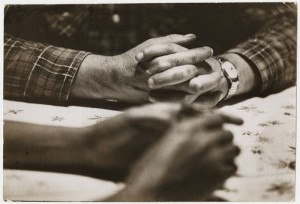
*The above photo is a shot of Mildred and Richard Loving, who were arrested for being in an interracial marriage before miscegenation laws were struck down. You can see more pictures of the Lovings here.


Have You Seen Me?


I remember the first time I picked up Faerie Magazine ™. “I like faeries!” I chirped, excitement bubbling through as I thumbed the glossy pages. My husband rolled his eyes and walked away, unwilling to share in, what I thought, was a great find. But as one page turned into another, I felt that sinking pit in my stomach. You would not find me there. Every picture, every drawing, every cultural nuance announced boldly

This magazine is Eurocentric.

I put the magazine back and went elsewhere, probably to the science section, where the faces of Neil De Grasse Tyson and Claudia Alexander would greet me with their astronomical delights.

It is no surprise that the modern pagan movement is heavily Eurocentric, and very fond of cultural appropriation for the sake of the ‘exotic’ or ‘ancient’. Plastic Shamans hawk ‘ancient native rituals’ about as ancient as the first tablet PC and Hoodoo and Vodun becomes the latest craze amongst those seeking the spirits of the ‘noble savages’ they’d be too frightened to speak to in real life.

With this in mind I’ve grown use to the European faces staring up at me from pagan magazines. Sometimes in Renn-garb, they smile secure in their history, their place, within this grand religious spectrum; Celts, Gaels, Visigoths, Normans, Saxons, and Jutes- proud warriors and spiritual women all, with eyes the shades of their ancestors. I am not a part of this, nor do I wish to be, but there is the constant reminder, the hint, the faint odor beneath the perfumed veneer; this is what paganism looks like.

And it is consistently reinforced in the imagery our community puts out for mass consumption. Despite there existing goddesses, faeries, mermaids, sea peoples, shadows and shades, in every continent and culture, the black appearance is consistently ignored, or shown as a token to diversity, instead of a reality within our community. According to most pagan magazines I’ve seen we’re the writer of the Voodoo/Hoodoo section or the mammy-esque wise-woman, none too threatening in her sexuality while being meek and comforting to their target audience.

The absence of black faces, especially black female faces, is one of the reasons, I believe, Daughters of Eve is so necessary. As we dive into subjects surrounding black culture, our interactions with society, and our journey within paganism; we provide an outlet and voice for those, often unintentionally, ignored by the pagan community at large.  We get to display our fire, our various philosophies, and just as significant, our faces to other pagans, perhaps even younger women who never knew they had a choice when it came to their spiritual/religious beliefs.

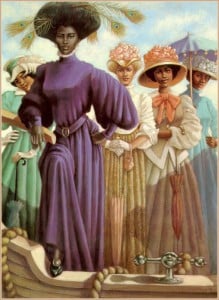
Illustrators: Leo and Diane Dillon

Every reader of Daughters of Eve has seen me and, in a small way, knows me; knows I exist and is well aware that my paganism runs just as true through my veins despite there not being a lick of Irish within me to account for it. This tangible reality, my skin the color of sandalwood, and hair like lamb’s wool are an affirmation of the biological diversity of our planet, our cities, and our pagan community.

Many more black Americans will be coming to this community, with their own fears and misconceptions and what better way to welcome them than to prove to them that we are here? Have been here and will be here for years to come?


The Open-Minded Fallacy


This blog-post comes straight from my gut and is the subject of a recent discussion I got to have with the wonderful Brett Hillman during a, too brief, Skype conversation a few nights ago. It’s a subject near, and dear, to my heart only in that it makes me chuckle whenever I see someone proudly bandy the concept about.

So here goes; No one should have to say how open-minded they are.

I’m probably alone in this belief or at least part of a very unpopular minority. Open-mindedness means a willingness to learn, observe, empathize, and listen; four actions that are evident in ones ability to ask questions, show intellectual and emotional vulnerability, take risks, and accept the likely occurrence of being wrong.

It is apparent in the way one speaks to others, one’s ability to engage in dialogue with those who may disagree, and how one may frame their arguments. It’s a rare trait shared by the likes of Sagan, Jung, or Einstein. Open-mindedness is knowledge, tempered with wisdom, and a splash of good old fashioned skepticism towards one’s self perceptions as well as the perceptions of others. A well-rounded appreciation of human infallibility.

It’s not a natural stat one can roll for. No religion , political party, social class, race, or sexual orientation gets a +5 to their open-mindedness upon character creation. No one group has a “tag” on being anymore open-minded than any other. I’ve met devout Catholics and staunch Republicans who deserved the banner more than some liberal band-wagoners who trumpet the term as if it’s the only redeeming quality in their arsenal of personal achievement.

In the end open-mindedness is an asset but it’s not an end all be all and it’s not something that is attained by simply saying one has the trait. It is cultivated, nurtured, curb-stomped a few times, put in the dryer, and pulled out two sizes too small. It’s then restitched, reassessed, and trudged out again, this time with less filler and more natural material.

This state of receptivity is merely a jumping off point leading towards inquiry, experimentation, research, and analysis. Open-Mindedness does not mean a lack of critical thinking skills or the current new age predilection for claiming all things have ‘validity’ when many things do not. There is a big difference between curiosity and plain social/intellectual lying.

Finally, like “honorable” or “priest/ess” this trait is not self-assignable. It is a subjective observation that can, at best, be given by an outsider looking in. With this in mind, out of all of the adjectives available to note the great thinkers, philosophers, and scientists, “open-minded” is rarely ever used.

In short, it’s modern usage has become little more than the shallow territory of the intellectual showman; very loud, but with very little to say.

So the next time you hear someone use this phrase-du-jour, perk your ears, squint your eyes, and really pay attention. Often, the dross you’ll end up with will be nothing like the treasures the individual will claim to possess.