
 Fare Forward
When one thinks of art and its relation to ethics, one of the first things to come to mind is Plato’s treatment of poets and painters in the Republic. Neither group is beloved of the philosopher: the poets do too much to lead the passions astray and create false notions of divinity and the afterlife; the painters create objects which form the lowest rung on the Platonic chain of being. For Plato, immaterial forms are the untainted essences of things, while material instantiations of those forms are imperfect representations of them. Paintings of material things are imperfect representations of imperfect representations of the forms. Since the human being’s highest perfection is an unmediated contemplation of the forms, to view a painting is, in effect, to debase one’s intellect.
This view of artistic representation is difficult for non-platonists to stomach. Especially in the modern era, individuals who have been raised to appreciate the fine arts look to classic works by men like Van Gogh, Michelangelo or Vermeer for a privileged disclosure of the truth in things. Rather than offering a mere debasement of material forms, we expect painters, photographers, sculptors, filmmakers, etc. to express the unity of being and subtlety of character in their subjects in a way that acts as a kind of light to illuminate the world. Thus the artist is, by virtue of his oft-mentioned “genius”, an unusual sort of educator: one who works through intuitions and simulated experiences to convey truths which might otherwise be unreachable through dialectics. There is a special dignity to the artist when seen in this way.
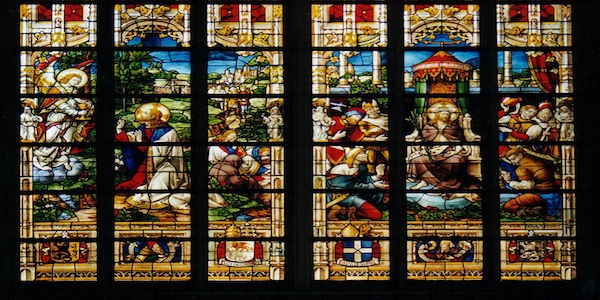
Take for example the main chapel at the Dominican House of Studies. In the windows and paintings which cover the left and right walls of the chapel, there are at least a dozen scenes from the life of St. Dominic. The images represent key moments in his career, in the foundation of the Order of Preachers, and in his priestly work mediating the grace of Jesus Christ through the sacraments, miraculous works and the proclamation of the gospel. These images together form a perfect visual representation of the life of blessed Dominic, whose life itself forms an excellent image of the life of Jesus Christ, who himself, as the eternal Word, is the image of the invisible God. The walls of the chapel thus form a testament to the life of the Blessed Trinity, and are a kind of preaching by which the properly disposed viewer is capable of drawing close to God. In other words, the artists who made this collection of paintings and windows have disclosed for us the essence of a life, which itself enables those who follow to draw closer to the Truth, and to receive life from the Eternal Life, who is with the Father and was manifested to us. And this is what all preaching is: a way of exercising the grace of understanding given in faith to make Christ manifest to others in their present lives. And preaching is the most excellent kind of teaching, since by helping another to see Christ, we offer the path to Truth itself, and it is by receiving truth that the mind is perfected and formed.
Under this mode, then — as a kind of pedagogy — the work of the fine arts can offer viewers and listeners a chance to see the otherwise fixed and familiar world through a purer or more focused gaze. If the artist is graced with the ability to illuminate his subjects in this way, and the viewer is disposed to learn from him, the relationship they strike up can become the highest sort of friendship: one constituted by a mutual desire for virtue and shared pursuit of the last end. Even if artist and viewer never meet, they can still express a kind of friendship through the work: the artist wishes the viewer well and demonstrates it by his labors, and the viewer receives in gratitude what the artist has given and wishes him well in his good work. If the exchange in question concerned anything less than a vision of the Truth, the friendship would decay into one of utility or enjoyment. But where the object of the artist’s work is the illumination of being and the elevation of the mind, the work stands open to viewers as an invitation to join in the consideration of something which trasncends canvas, film or print. And, staring through the artistic medium to ipsum esse per se subsistens, artist and viewer enter a kind of unearthly communion of contemplation.














 Ad-Free & Subscriber Log-In