Dear Black Women Giving Me Hair Advice about My African Daughter: Please Stop

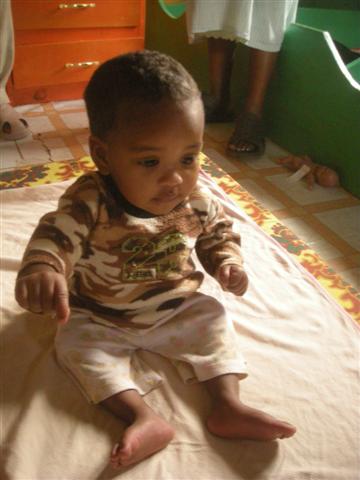
When we adopted Naomi from Africa, the orphanage had shaved her head. At two and a half, she was practically bald and more like a baby than a a toddler, weighing a mere 14 pounds.

Since then, I’ve learned much about my new daughter — she has a contagious laugh, she’s physically incapable of taking a bath without splashing the water on the floor, and her love of shoes would put Imelda Marcos to shame.  What took me a little longer to figure out was hair. At first, she rocked out her Patrick Stewart bald look.  Sometimes, I’d stick a bow on her head.  Everyone oohed and ahhed and our new addition.  But then, her hair grew, and things got more complicated:

Within months, I started getting stares from other black women in public.  If they were brave — and many  were – they’d casually mention good hair stylists I could use, tell me which websites had good information, and suggest effective products I should buy.  One lady at the store,  actually walked me to the hair style aisle and showed me exactly what I should do.  Another very kind woman sent product to school and left them in my older kids locker to help me learn how to care more effectively for her hair.  And these were not isolated incidents.  Far from it.

A very bold black cashier at the mall asked, “Why do white people go to Africa, pick up kids, throw a headband on them, and think that’s okay?”

I took a look at my cute little baby, with her little fro and her pink bow.

“I fixed it,” I said.

“No, that’s not a style,” she said.  “She’ll never know how to fix her hair if you don’t.”

Another cashier took one look at Naomi and asked, “Who’s doing her hair for you?”  Her look of contempt told me that I needed to get someone to do her hair for me.  I wasn’t having a good day, and I almost burst into tears.  When she saw my face, she said, “I mean, you’re doing an okay job, you just might want to fix it.”

This never stopped.  It got to the point that I’d try to scoot through public places in order to avoid letting other people see Naomi, for fear that I wouldn’t respond to their criticism in a Christ-like manner.  (It’s not their fault. They, after all, didn’t realize they were the sixth person to come up to me at the grocery store.)

That’s when I found Chocolate Hair Vanilla Care, a fantastic website for white moms who need to learn about their black daughters’ hair.  An invaluable resource, I followed the website’s instruction to the letter.  I bought exotic lotions and oils.  I learned how to care for it.  That’s when I learned how to do things like these braids
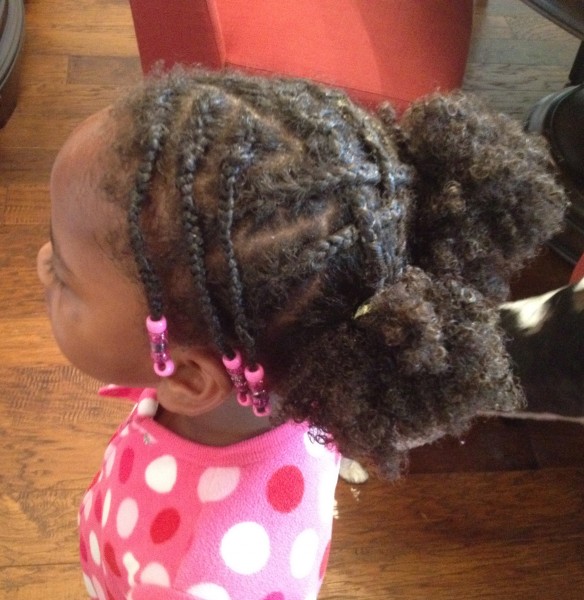
and beads
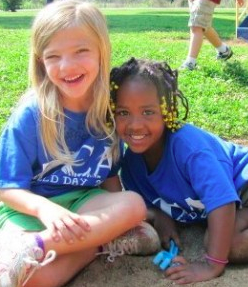
and I got better, and even experimented with larger, wooden beads:
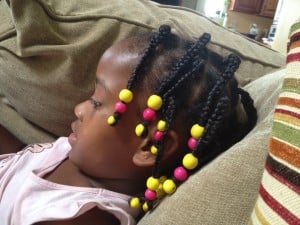
The lady at the mall was right.  One day, Naomi will be a beautiful black woman, and I want her to have pride in her hair and feel comfortable in various styles.  And if that’s going to happen, it means I have to learn a great deal about her hair… and fast!  I’ve done so many experiments on Naomi’s hair — some hits and some misses — that it’s a part of our weekly routine.  (I compare it to breastfeeding. I wasn’t able to nurse Naomi, since I missed out on her infancy.  But there’s something special about the hours time spent doing  hair — it’s our bonding time, the thing we do together that no one else in our family can do….  though her older sister Camille is getting really good at braids!) Sometimes, between hair styles, her hair looks this like this:
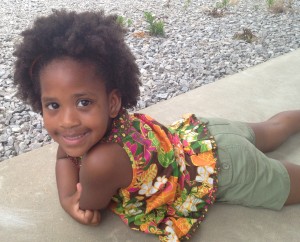
And this is where the problems occur.  See, there’s a difference between what white women like on black children and what black women like on black children.  White women like this hairstyle very much.  But when black women see Naomi in public with an afro, they really disapprove.  No matter how many braids I’ve done, I get approached if I dare take them out and walk around in public with her.

When I tell people about how much free advice we get from African American women, white people are incredulous. After all, little girls on advertisements and on television have their hair in afros.  What’s the big deal?  Well, as far as I can tell, there’s a lot going on, socially, politically, and culturally.  On Chocolate Hair, Vanilla Care website, there’s a great article called, “The Politics of Free Hair” which is well worth a read.  Rory writes about how many people give her unsolicited advice when she takes her daughter out in public with an afro.   You really wouldn’t believe how frequently it happens.  Rory says it happens every single time she takes her daughter out in public when her hair is natural.  I’d agree — sometimes several different people in one shopping excursion.

Yesterday, I was at Target in Spring Hill, Tennessee, and I braced myself.  I was in a week of “natural hair” because I was trying to avoid “part fatigue.”  The following conversation actually happened:

Cashier: What’s you name, sweet little girl?

Naomi: Naomi

Cashier: You sure are pretty.

Cashier, to me: Have you ever thought of fixing her hair?

Me: Yes, I learned how to braid and I take care of it, but it’s been braided for so long I wanted to let the parts rest a bit and give her hair a chance to be natural.

Cashier: Well, I have been looking at it, and I can tell you don’t know what you are doing.  (Then, she proceeds to give me directions to a braid shop in my hometown.)

Cashier, to Naomi: How does your mom fix your hair normally?

Naomi: in twists, in beads, in braids, in an afro….

Cashier: Well, you sure are pretty, but you’d be even prettier if your mom took you to a braid shop.

If this happens every time I go out with Naomi when her hair is in an afro, it’s obvious: hair is complicated.  This was also very clear when Gabby Douglas was the first African American gymnast to win the All Around at the Olympics,  all anyone could talk about was the fact that her hair was “ugly.”  (“She lives with a white host family and they don’t know anything about taking care of her hair,” her mother explained.)

And that public outcry over a black child’s hair is not isolated.  Angelina Jolie, who adopted little Zahara from Ethiopia, was criticized in Newsweek for the way she did — or didn’t do — her child’s hair.  Read this condescending article from writer Allison Samuels:

Up until recently, Angelina Jolie seemed to be doing a pretty decent job with Zahara Jolie Pitt—providing essential and expensive medical care, purchasing land in Zahara’s native Ethiopia with the plan to build a health center, providing a life of adventure and opportunity… In recent pictures it’s clear Angelina Jolie hasn’t taken the time to learn or understand the long and painful history of African-American women and hair. If she had I can’t imagine she would continue to allow Zahara to look like she has in the past few months. Photos of  Zahara show the 4-year-old girl sporting hair that is wild and unstyled, uncombed and dry. Basically: a “hot mess.’’

I don’t know Allison Samuels.  She might be a fine person.  However, imagine if I turned this around and wrote, “Allison Samuels knows a lot about moisturizing cornrows, but how many children has she saved from poverty?  How much medical care has she given to children in need?  How much land has she purchased, how many health centers has she built? Has she adopted even one kid?”

Maybe she has.  Maybe she runs an orphanage for all I know.  However, it doesn’t change the fact that her comments undermine transracial adoption and orphan care. She suggested that one day Angelina’s daughter might grow up to resent her white adoptive mother, because of the lack of attention to her hair.  Now that’s emotional manipulation right out of the Target cashier’s playbook.

Ladies with serious opinions about hair, please listen to this adoptive mother’s plea:

Even if you’re black, it doesn’t give you the right or authority to give white parents’ rude advice by critiquing a black child’s hair.  It certainly puts us in an awkward situation, because it means many interactions we have with African Americans we casually meet in public deal with our families’ inadequacies.  The message you send to our daughters — intentionally or not — is that they would be better off if only they had black parents.

You may not mean to insinuate this.  You may simply want to help out a family you believe is in need, but it doesn’t help our daughters to overhear their mothers being constantly corrected over hair styles that it takes us several hours to create.

Or, you might actually believe that black people are better off being raised by black people.  You might look at her hair, and think, “Only a white mother would do that to her kid’s hair.  That’s why white women shouldn’t have black children.”  Believe me, I’ve heard that before too.  (If you’re in that category, please read, “I”m a White Republican Raising a Black Child: Deal with It.”)

Of course, I’m new at this.  I know my braids aren’t as tight as some would like, and I secure my twists with tiny bands even though I know you say it’s not necessary.  I do it anyway.  I’m writing this because I want you to know that it’s hurtful to constantly get advice about hair, when I’m already investing so much effort into it.  Rory, over on Chocolate Hair Vanilla Care, is very kind in her assessment of these interactions, believing the conversations to be opportunities for grace.  “How I respond to people will be etched in my daughter’s memory as she grows and learns to respond to unsolicited comments and criticism in the years to come,” she writes.

I’m trying to get there spiritually, but it’s hard not to take this criticism to heart.  The bottom line is this.  My daughter is black, and I want her to be comfortable in the black community.  However, she’s also mine.  I’ll fix her hair the way I think is best on the day, and I’ll brace myself for your criticism and disapproval.

But your words aren’t helpful, and you’re really missing the beauty and transformative love of adoptive families.

And that’s a real shame.

Read more on the Faith and Family Channel, follow me on Twitter, and fan me on Facebook!

About Nancy French

Nancy French is a New York Times Best Selling Author. She's written Home and Away: A Story of Family in a Time of War, Red State of Mind: How a Catfish Queen Reject Became a Liberty Belle, and has co-written Bristol Palin's memoir, Not Afraid of Life.

  • Bangel79

    I want to applaud you for such a thoughtful article. It really shows how much love you have for your daughter and how much thought and care you have put into dealing with her hair. As a black woman I can tell you that how we view and deal with our hair still remains a contenious and painful issues due to centuries of being told our hair was “bad”. Unfortunately, there is still a significant number of black women who do not view natural black hair as attractive because that is what we have been taught to believe by society and by our own communities. We have perpetuated this myth probably more than anyone else. In fact, there are perhaps millions of black women who do not even know what their own texture of hair looks are feels like because they have been getting relaxers since they were children. Thankfully, there is a swelling “natural” movement within the black community where black women have been “Big Chopping” their hair and rediscovering and falling in love with the hair that God has blessed them with. Please look at the NUMEROUS youtube videos of natural hair journeys, etc to see what I mean. In the meantime, please stay encourage and continue to do the great work you are doing with your daughter. I am natural and I love the way her hair and mine look in a natural afro state. Me being the person I am I would just always respond to the critics with one simple line, “Do you think natural hair is bad?”. You will be surprised at how many of those women will be unable to answer that question due to the shameful reality that they do think it is bad. It will also serve as a reminder that they even harbour that thought. Thanks again for taking the time to articulate a very painful reality in the black community. I wish you and your daughter well.

    • http://www.NancyFrench.com Nancy French

      Bangel,

      Thanks for the comment — I do appreciate it. I love the suggestion about, “Do you think natural hair is bad?” My only issue is that I don’t want Naomi to pick up on the tension between me and the people that me. Does that make sense?

      Rory suggested trying to avoid an us-versus-them mentality…

      Hum….

      • K. Bernard

        I wrote the following under a facebook post of this article but I wanted to share it with you as well:
        The part that really bugged me was black women coming up to her when her little girl has an Afro and criticizing it. Black women are the toughest cops when it comes to seeing our own hair in its most natural state. I think it inspires an anxiety about themselves and how they feel they look in between braids, twists, ‘styles.’ So many of us are still ashamed of seeing black hair do its thing. Our mothers weren’t comfortable with us looking that, and we’ve grown up feeling like there’s something shameful about having loose, wild hair. It’s an afro, it’s kinky, embrace it., love it. But so many of us really can’t. I also worry about this little girl and what it must feel like to have so many strangers commenting on her appearance and her beauty all the time. We really need to examine what allows to believe that all black women’s bodies belong to the public sphere. I hate that this little girl hasn’t even hit puberty and is already being subjected to such public scrutiny of her self. Let’s just ease off each other and keep our hair issues to ourselves for a change.

  • Jay

    People can be so mean and low down. I’m black and my mother is mixed with VERY fine hair so she didn’t know necessarily how to braid but she could plat (individual not connected to the scalp) til this day I look back at pictures and laugh because even after the hours of tears because it hurt to get my hair combed I still looked wooley. LOL….as long as the child is loved and her hair is washed maintained I would and could careless what anyone thinks. The nerve of some people and their stupid funky opinions.

    • http://www.NancyFrench.com Nancy French

      Jay, thanks for the note! I am learning to do it all, but you can tell from the pictures, I’m new to it. (I’ve gotten better since that one braid photo though! :)

      • Lisa

        I applaud you. I’m a Black woman with mixed children. I had a hard time learning what to do with their hair because it is a much different texture than mine. My youngest has more “wooly” hair and my oldest has more curly hair. As a matter of fact, the oldest daughter looks white and my youngest looks mixed. You just continue doing the best you can and continue to love Naomi. The rest will fall right into place. God bless you and your beautiful family!

  • tracyo

    I am so sorry that you are going through this! What will happen if you don’t put braids, etc., in your daughter’s hair? Will her hair break? I too am white and I don’t know these things. If you let her go ‘natural’ will something happen to her hair? I don’t think God, who created her, cares whether she has beads in her hair. And I think that is the most important thing to remember.

  • http://www.NancyFrench.com Nancy French

    Tracyo,

    Well, it gets tangled and is hard to maintain. I know some people who do it, but if you fix her hair into braid, it can last three weeks!
    So there’s a practical element to it too…

  • ShirlyWhirl

    I’m going to point out something here.

    Honestly, this phenomena doesn’t just target vanilla moms/ caretakers. You may not exactly be insinuating this, but I got this impression from the facts that you referenced another vanilla mom’s article on “free hair” and that Gabby had been staying with a “white host family.” You touched on the real issue, the fact that “free” hair has social and political issues tied into it. But I wonder– have you looked into what those issues are? I’d suggest you do. It would explain why you’re getting these comments and why, quite honestly, you should just brush them off.

    I’m a black college student who went natural two years ago. I use “natural” the same way you do “free”- my hair is short, kinky, and typically left in a fro. I’m far from an outlier on my college campus– in fact, I’d say about half of us keep our hair this way. We compare methods of taking care of our hair. What is important here is that we keep our hair healthy.

    Within the African American community, there is this constant pressure to have “Good hair.” This is something passed from the days of slavery, where having white blood and therefore less kinky hair gave you privileges that being a dark-skinned field hand didn’t. This sentiment persisted, which is why so many black women put all sorts of harmful chemicals in our hair for our entire lives, or spend ridiculous amounts of money for weaves. (Of course, there are some black women who might simply prefer their hair straight.) Before I went natural, I didn’t even know leaving my hair in its normal state was an option. It had been in braids, permed, or some other fashion hidden away for my entire life. It’s not even entirely a matter of education or self love sometimes; if you are raised to think that looking a certain way is “backward,” you will continue thinking that until your introspection and research proves otherwise.

    Still, natural hair is exploding! (Ab0ut time.) More people are realizing how ridiculous it is to discount your natural hair as something dirty, esp since, as you can see, “free” hair can be really trendy and cute! Just teach your daughter to be confident and love herself, and just ignore those people who seem bent on “fixing” her. They have their own problems, and should deal with those accordingly.

    • http://www.NancyFrench.com Nancy French

      ShirlyWhirl,

      Wonderful thoughts – yes, I did insinuate that, only because this is all I know. I’m not familiar with the struggles of black women who go natural… You comments make a LOT of sense, and I can see what you are up against. Yes, I’ve read about WHY people feel this way about the curly hair, but I don’t really get it.

      Maybe I can’t because I’m white and I’ll never understand, but I do understand there are major underlying reasons.

      Thanks for taking the time to express yourself!
      :)

      • arthusrocks

        You should really find your way toa dvd online store or to netflix and get some time to watch chris rock’s movie/documentary “good hair” it might help you understand. It’s normal you d not understand those issues after all beauty sallons and barbershops like churches are among the most segregated public places in america!

  • Pingback: Dear Black Women Giving Me Hair Advice about My African – Patheos | About Curly Hair

  • Martin

    As a black woman with a 2 year old toddler I am still learning how to do her hair. Believe I knew nothing of braiding until I had her, and I am still learning. Brown, black, or white, mothers learn through experience and in this case we are learning how to care for our daughters hair. Whatever style I choose the most important lesson I want to teach my little one is that she is beautiful and so is her hair. Good luck!

  • Rebecca Cusey

    OMG. I just have to say, the pictures you posted of Naomi are SO cute. I love the braids you did. I love the big, wooden beads.

    I”m white and I think she looks beautiful natural too.

    But, I have to tell black women, after living in a mostly African-American neighborhood for many years, I realize that there’s so much style that I would love to be able to pull off. I’d love to be able to wear cornrows and beads, for a few weeks, and not look like some white girl trying too hard. I think they’re beautiful. I feel the same way about the colorful African dresses and head wraps people wear and the AMAZING saris that Indian women wear. I’m not a fan of burkas, but some Muslim women wear head coverings that are so pretty and feminine. I can’t do any of these things because I’m white and I would look, let’s face it, goofy. But I’ve come to have a twinge of jealousy every time I see a gorgeously dressed ethnic woman.

    Gap jeans and black t shirts are just SO boring.

    Anyway, my two cents. Nice piece, Nancy.

    • Rebecca Cusey

      Oh, and DO NOT get me started on the AWESOME hats black women wear to church. I would LOVE, just once in my life, to wear an awesome hat.

    • http://www.NancyFrench.com Nancy French

      Thank you, Rebecca! Yes, she is sooooo cute. I am actually beginning to love doing her hair. There’s something so sweet about it — and yes, so exotic and fun!!

      :)

  • mollie

    Great piece and I thank you for it!

  • Rebecca Cusey

    One more comment…this is clearly getting me thinking.

    When we lived in that neighborhood, my daughter was a toddler and young school aged. She had the most beautiful, soft, blond curls. She would go to school and all her little African-American classmates (girls, not boys) would pet her hair all day long. Literally. She would come home exasperated. She would be standing in line for lunch or something and there would be three little girls around her playing with her hair.

    You don’t get mad at little children, but I felt sad that even at that age, her hair was so different (she was one of two white kids in the class) and felt to be so desirable. These little girls were beautiful, but somehow they had the message already that her blond hair was, I don’t know? Better, maybe? I wasn’t sure how to take it, and I’m still not, but it just didn’t feel right somehow.

    • Nicole S.

      I think your daughter may have encountered a couple of issues. The first, I think you’ve identified, is that her hair aligns with a standard of beauty that even little American kids are versed in. The second is probably that difference is often an attracting factor. I have had dreads and now wear an afro. I have had many white co-workers and complete strangers, touch, tug and pet my hair uninvited. When I got frustrated about it once, a co-worker said, “But your hair is just so different. It’s natural for people to be curious.” It’s really not cool to pet humans, but this might have something to do with the fixation on your daughter’s hair.

      • http://www.NancyFrench.com Nancy French

        Right — that touching this makes me feel like people think she’s a pet. I do not like it! Total strangers!! And I don’t want to teach her that it’s okay to have people pawing all over you just to satisfy their curiosity!

        :(

      • Kathy

        When a blonde goes to an African village they’re all fascinated by it. Guess it’s a human thing. But yeah, I can imagine that it would be weird for a stranger to just walk up and pet your head. Ha.

  • Thinz

    You poor lady, the best of luck with that war because it’ll be a never ending one.
    African Americans have ssserious issues with their African(ness). Hopefully by the time your daughter has grown, the African-pride movements that are still in their infancy will by then, have matured.

    Stay strong

  • Pingback: Little Girls and Their Dolls: An Adoptive Mom’s Relief

  • Nicole S.

    Your daughter’s hair is gorgeous, braided or loose. Many black women (like me) love to see a free, healthy head of hair like hers, like mine, like my daughter’s. To be frank, I grew up around plenty black women who compromised their hair with harsh chemicals, heat and unhealthy styling techniques. I have my doubts that all of your advice-givers even know how to care for tightly textured hair.
    The disapproval you’re getting is insensitive and probably reflects the lack of comfort that the commenters have about themselves in a natural state. I’m sure these women mean well, but it isn’t OK to make comments like these, especially in front of a child. Hopefully, our girls will grow up understanding that there isn’t any one “correct” way to be.

  • Tara Edelschick

    Hey, Nance. I know you’re done with the whole Northeast thing. But in this regard, I think you would have an easier time. It’s not perfect, of course, but many, many women wear their hair natural here. Naomi would just be one among many.

    • http://www.NancyFrench.com Nancy French

      I think WOMEN are allowed to wear their hair natural, it’s the children that aren’t. At least that is what someone here told me.

  • Tara Edelschick

    Hey, Nance. I know you’re done with the whole Northeast thing. But in this regard, I think you would have an easier time Up Nawth. It’s not perfect, of course, but many, many women wear their hair natural here. Naomi – and you! – would fit right in.

  • Samm

    Oh for crying out loud. It’s hair, people. Not the end of the free world. (this coming from someone who can’t be bothered to do anything but run a brush through hers.)

  • Coquinegra

    There’s a difference between an “afro” and allowing your child to go out looking unkempt. Natural and “uncombed” are not synonyms. And, although you may feel burdoned by so much “advice”, you might want to consider that most adult Black women have had the experiences your daughter is going to face with respect to her hair. Black womem’s bodies are and have been “public property” since we camt to these shores. It doesn’t stop just because our mother is white.

    • http://www.NancyFrench.com Nancy French

      So, do you think her hair looks unkempt?

    • Jean

      Black women have been abused in the past, but I have a hard time believing that a black woman’s body is still considered “public property” anywhere in modern USA. (Of course, there still are chauvinist men who will lear at any female figure unfortunate enough to come to near, but that phenomenon experienced by black women alone.)

  • Kathy

    That little girl looks just adorable just the way she is no matter the style of her hair. If someone said something like what that cashier said to my daughter, I’d tell her that and then tell her to mind her own beeswax. People shouldn’t feel like they have to conform to a certain hair style to be worth something in the world. You should be confident enough in your own skin not to be all crushed if you’re not a carbon copy. Be a trendsetter, not a sheep.

    I don’t think all random tips from strangers are a bad thing, most may just think they’re being helpful. But there’s a line.

  • Texie

    What would you have said to a stranger who criticized your older daughter’s hair in front of her? Consider the same response for the people who do this to your younger daughter. Your little girl should know that she is perfectly beautiful and that you will stick up for her. You are a great mom! Don’t let anyone mess with you . Good luck!

  • Miss Amma

    Let me just say that I truly commend your efforts and your honesty about your experience. You have a beautiful daughter and her hair is beautiful, too. You are doing a great job and please don’t allow the negative criticisms to bring doubt. Some black women are still very insecure and closed-minded about natural hair. Some will relax their child’s hair as young as 2 years old, bc they have no idea what to do with it. At least you are taking the extra effort to do research and experiment with her hair. It’s a huge learning curve, even for us naturalistas who are still in the learning phase. Keep up the good work! I shared your story with my FB/Twitter page and I hope it sheds some light on how we appear more judgmental and condescending, rather than helpful. I’m sorry you’re dealing with such scrutiny. I think some people worry about the most insignificant things. Especially hair.

  • j

    You wrote such a great article. As a mother and a teacher I have told many a child to “think before they speak” and “you don’t need to say everything you think.” Its too bad adults don’t get that. I have 4 girls and I am still learning what works best on each of their hair. For me, their hair seems to changes with the seasons, with the climate and after a while it seems like my go-to products just stop working. Sometimes, I get a good style going and then we just wear fros (yes, often the “unkempt” variety) for a while until I get up the nerve to try a new style on them. And I get styles and hair care tips from Rory, too! (shhhh…black women can learn from white women, too) A little story —-Early one Saturday morning my daughter’s friend (white) came to our front door to see if she could play. My daughter must have seen her walking down the sidewalk and ran downstairs in excitement. My other girls followed. Unfortunately, the first thing she said when she saw my daughter was, “what is wrong with their hair?” I could see my daughters face drop and I quickly said “we like our hair, don’t we?” (as I put my arm around my daughter) My daughter smiled and nodded her head. “God made her hair different just like He made yours different.” “Your hair was made just for you, and God made her’s just for her.” The little girl looked sort of puzzled at first, then smiled and said “ok.” Then they skipped outside to play. I want my daughters to know that people say ignorant things but that doesn’t change what we know to be true about ourselves. That comes from God. Not from how “kempt” our hair is, how we look or the clothes we wear. You are a great mother. Keep up the good work, Nancy.

  • Sam

    It was quite a shock to me when I first was introduced to the multi-billion dollar industry known as “black hair” that very few caucasian people are ever exposed to. It’s huge, and you’ll just have to get used to it. However, a few things I have issues with. Your child is not black, nor are the people giving you advice. Black is not a race, it is a color, as in my black socks. You don’t see other people calling their adopted child “my RED child”, or “my YELLOW child”. Neither is your child African American. She is African, specifically of the country she is from (Etheopian?, Kenyan?, etc..) African American is less about race as it is about culture. You need to learn that difference, and be able to pass that appreciation on to your children. Once you and your child deal with that, then you will be able to easily handle comments coming from other cultures. As a father of bi-racial children I find it important to make that distinction. My child is not “swirl”, but bi-racial. Nor is my wife “black”, but Haitian. As silly as it sounds, it still is important to know those distinctions for us to fully appreciate our heritage and find identity in this world.

  • Pingback: Bullying Baby Mamas: Honey Take Yo Honky Hair Weave Back to Harlem! – FAKEDRUDGE

  • Walley Naylor

    I am sure that you will take care of the hair thing and trust me for a black girl it is important, but not nearly as important as being loved, nurtured and helped to develop a healthy self-esteem. Go on do what you do and don’t look back; everybody has had to learn something that at one time they did not know.

  • Heather

    These people are rude and you should complain and have them all fired or at least tell them to MYOB. I don’t understand why you are so civil to rude and ignorant people.

  • Heather

    You are not African American. If you were born here you are American PERIOD. Have you ever been to Africa?

    Last time I checked I am not white either. Not even close

  • Pingback: I can’t avoid her « Gymtruthteller's Blog

  • Sanie

    Let me go back in time for a sec…

    In the 70′s we sported huge afros. It eas a point of pride to have your ‘fro picked out neatly and “evenly combed”. Normally we didn’t wear our fros “unkempt”. It was the style at the time.

    Now a days, I see many ‘fros in many varietys. “Unkempt”, “even” , wash ‘n go, large, short, etc.

    While I have fond support for the “even” fro’s, I don’t too much care for the “unkempt” fros. Just my taste, though, one that is not better than the other.

    Maybe that is the issue when people see your beautiful little girl with her fro? The “unkempt” fro was what I wore on Saturday’s waiting for my mom to finish my 4 sister’s hair so she could wash mine. Maybe they think you just got up and ran out the house before “picking out” her fro. Maybe they think you didn’t bother to comb it. I think if it was “combed out evenly” it would look just fine and wouldn’t send a negative message.

    Of course, I’m not giving you any more advise cause you are doing a wonderful job with her hair!!!

    Take care and thanks for the great article…

  • Kate

    I like the ‘do you think natural hair is bad’ idea. ‘Mind your own business’ is good too……..

  • Bella

    I am an African-American woman living in a very diverse community with many bi-racial children. I have been in the beauty salon when white women have bought their bi-racial daughters in to get their hair done. They always had this look of desparation and exasperation because of their inability to do “something with their daughters hair”. I always felt so sorry for their children, because their moms gave the impression that dealing with their hair was such an imposition. I have a white friend who adopted a black daughter. Her daughter wore an unkempt Afro (she was trying to style it herself) until she was in seventh grade. I offered to show her how to straighten her hair and she jumped at the chance. Understand, Afros were not in style and she wanted the versatility to style her hair in a variety of ways that could only happen if her hair were straight. She is now 27 and still upset that her mom did not take the time to learn about and teach her how to deal with her hair. What white women need to understand is that while Afros may be cute to them, there is still a lot of care and attention that needs to be paid to styling, moisturizing, and trimming it. Afros are not carefree hairstyles, that you can just “let go” because you don’t have time to redo braids or you want to let the hair breathe. Number two, the white standard of beauty has been entrenched into our society for years, we are victims of it, just as if not more than white women. We, as black women spend inordinate amounts of time and money on our hair. We straighten it, because we want to have that versatility. We want to be able to copy the styles in the magazines just like everyone else and so will your daughters. So, do we trust white women to be able to do justice to black girls hair, when in most cases we’re still trying to figure it out ourselves? No, we don’t, just a fact that you’re gonna have to live with, sorry. I do, however, applaud the white women who are making an effort to style their child’s hair. When black women approach you with unsolicited advice, take it in the spirt it is being given. From their perspective, it’s not about you and your feelings, it’s about your daughters and how we know they will inevitably feel about themselves and their hair. If they are living in a household where everyone has straight, wash and go hair, that is what they’re going to want, no matter how many times you tell them their hair is beautiful. Because, unfortunately it’s no so much what you say, but what society says is beautiful. You are getting just a taste of what is like raising a black child in our society. There are many things that you will not be able to tell your child, simply because she will have experiences that you have never had to deal with. My advice, get involved with the black community they can be a great resource to you in the years to come. Good Luck and God Bless

  • http://weirdcrayonboxcrayolas.blogspot.com/ BLACKkittenROAR

    I have mixed feelings about this article because it makes a lot of assumptions and generalizations about black women and what we perceive to be beautiful. For starters it is unfortunate that people are making these sorts of comments in front of your daughter. As a black woman raised by a white woman I know from personal experience that this is incredibly destructive to an adoptees self esteem. Please defend your daughters honour and stop taking this crap from rude people who are very obviously insecure and probably do not have a clue as how to properly handle black hair themselves. You don’t have to be rude back, but you do need to make them understand that what they are doing hurts your daughter and that you will not tolerate it. Again, I can tell you from personal experience every comment, every snide remark will stick with her so please learn how to give a silencing side eye, flip the situation back onto the commenter, or whatever you find works to hush people up, but still be sweet as pie as you’re doing it.

    As for caring for your daughters hair I applaud you for taking the time to learn how to care for her hair, because the effect it will have on her will be carried on into adulthood. As a black adoptee I did not have ingrained into me the “hair shame” many black women and girls get passed on to them from family members. Unfortunately society eventually did that on its own as I was got older but because my mother took the time to learn how to care for my hair and thought it was just fine the way it was, it was very easy for me to eventually embrace my natural hair again and just say no to damaging hair care practices.

    Here’s the thing, there are a number of black women with natural hair who would have no problem with your daughter’s “free” afro. So please, don’t paint us all with the same brush because a) we are not all alike, and b) you might actually learn something from a black woman who’s hair is probably a heck of a lot more similar to your daughters than yours and might know a thing or two after years of having to care for her own hair. So if the women who are approaching you are being respectful and not making rude comments like “you’d be so much prettier if..” (my heart breaks for your daughter that someone could be so rude to say that to her) take the opportunity to ask questions. Your daughter is black, please don’t let her grow up with a complex about her own people and culture (and I mean African culture too, not necessarily just Black American culture) try interacting with black people. Understand this, hair is a big deal to us black women. As a natural I get asked daily about my hair by other black women (black men too because many of them are clueless too about natural hair), its just what we do. So don’t always take it offensively. Its a slow movement but black women are slowly starting to embrace our natural hair. Be patient.

    Here’s a tip, from someone who is actually part of the adoption triad: the next time your out and your with your daughter (it might be misinterpreted if your by yourself) if you see a black woman rocking an afro or any other natural hairstyle (braids, twists and locs are all considered “natural” hair styles – avoid asking women with weaves and perms unless you plan to weave or perm your daughters hair as permed hair must be handled very differently from natural hair and weaves are a whole other animal) ask her what products she uses and get your daughter involved in the conversation (a lot of naturals love seeing little girls with naturals and will love to talk to you and your daughter).

    This will do two things: firstly and most importantly it will show your daughter that not all black women are miserable (and this is critical because she will grow up to become a black woman) and that you are comfortable engaging with them (which you need to be or she may end up resenting you). Secondly, it will reassure these women that it is safe for your daughter to be in your care and help show some of that “beauty and transformative love of adoptive families” that you refer to in your article. Understand this, racism is very real and your daughter has probably already begun to deal with it. Sometimes black people just want to be reassured that your daughter is being equipped with the tools every black person needs to survive in this world, and not being subjected to further unintentional ignorance. Now you don’t owe anybody any sort of reassurance BUT if you truly love your daughter understand that you’re doing it for her more than them and explaining that is all sorts of complicated but at the end of the day black people’s acceptance of your transracial family will mean so much to your little girl. If black people reject your daughter because you have rejected them (whether intentional or not) she will feel very lost and believe me that isn’t easy to get over.

    Hope this helps and isn’t taken the wrong way.