

Today I mark nine years since I got sick one day and never fully recovered. April 28, 2017 is a day I will never forget, as well as May 20, 2017, which was the day my blood cancer diagnosis was confirmed.
This time of year, towards the end of April, and throughout May, has in the past has been quite a sad time for me. Even this year I have found myself becoming quite reflective. I think it is important to mark significant things that have happened to us, whether good or bad.

In many of the years since then this period of time felt very bleak for me. I would relive those days, with the nights of crying into my pillow, and feeling like I had no one to talk to about how I was feeling. For those six weeks I was under the daily care of the hospital, much of that time as an inpatient.
On April 28th 2017 I became very sick on an underground train platform in London and had to be carried out on a stretcher and taken to hospital. I had what turned out to be a hard to treat pneumonia. Towards the end I began to develop sepsis and so must have been relatively close to death. I did not realize it at the time.
Fortunately, eventually broad-spectrum IV antibiotics saved my life. I wonder sometimes what would have happened if my local hospital had known that was what was needed sooner. Because the late use of the correct treatment left me with permanent damage to my health and wellbeing.
One of the things that COVID has taught us, if we didn’t already know it, is that when you have a viral or indeed a bacterial illness, then it can cause your immune system to overreact. It then responds not just to the bacteria or virus, but it starts destroying parts of your own body. In some cases, that can be the main organs, like the heart and the kidneys. And that’s one of the reasons for death in such a situation.
Our immune system can also attack the autonomic nervous system which controls pulse, blood pressure, and redirecting your blood when you go from lying down to standing so that enough blood gets to your brain.
Perhaps partly because of how you’re lying down for weeks when you’re that ill, people sometimes can become intolerant of standing up. If I stand up, and particularly if I stand still, I get a fast heart rate, dizziness, breathlessness, and have even fallen over and come close to fainting. From that day in April 2017 till this, I’ve not been able to stand still for more than a very short period of time. I also never fully regained my ability to walk significant distances, although initially, I was able to walk further than I can now.
Another problem that happened at the time was they noticed that my white blood cell count was high, and specifically the lymphocytes. This led to a diagnosis of one of the lymphocyte blood cancers. I have one called Chronic Lymphocytic Leukemia (CLL). If you have a blood cancer, I invite you to join us in the Blood Cancer Uncensored Facebook group I founded and our monthly Zoom call.
As I was recovering from my pneumonia, I was also suffering from crushing fatigue, which did not go away, and never has. Not one day since then have I felt full of energy and well-rested. It stops me from concentrating for long periods of time. It’s therefore stopped me from being able to work and forced me into medical retirement. On better days, I do manage to write, but not for anything like the sort of time that I used to be able to.
I used to be strong. I used to be able to do the work of, what I sometimes claimed to be ten people. Maybe that was a bit arrogant of me, but it’s definitely true that I had a very busy and productive life where I threw myself into absolutely everything. I was busy with work. I was busy with church. I was busy with this blog. I was busy publishing books. I was busy with family.
I sometimes ask myself now about who I was back then, was I a human being? Or was I a human doing? I think if I’m honest, I was a human doing. Focused on striving to please other people, and to please God. I had this drive. In a way, there’s nothing wrong with drive because that’s what gets things done.
But to suddenly lose my ability to accomplish so much at once was very hard, and I wrestled with all kinds of questions regarding how to understand it. Years later I came to realize that suffering is a call for us as believers not to try to have everything figured out, but to trust in the God who does.
When we are suffering, often men feel like we have to keep quiet. But I did try and talk, some other people felt I spoke too much. Not everyone wants to talk about their suffering as much as I did. But some do. One of the things I would say to anyone facing a diagnosis of cancer or the sudden onset of severe chronic illness that just doesn’t go away is that it’s okay to talk as much or as little as you want to. You just have to find the right outlets. And in my case, that included a lot of therapy over the years.
But it also involved finding the right people in my life who were willing to sit and talk and listen, and help me make sense of what was happening to me. This goes back to as early as what many believe is the very first book ever written, not just in the Bible, but any kind of book, the book of Job. We see Job’s friends at first sit with him and enter into his pain. They are to be commended for that. They then discuss with him to try and help him make sense of what has happened. I think we sometimes jump too quickly to condemn them. God does disagree with some of the things they say, but preserved them in a book designed to help us think through these matters.
That wrestling, that questioning, that trying to make sense of who are we, why are we here, what happens after death, and why do some people suffer whilst other people seem to get away with it is crucial. This is what gave birth to philosophy all those thousands of years ago, and within the wider sphere of philosophy we find that religion (and specifically Christianity) is one particular way of answering some of these basic questions.
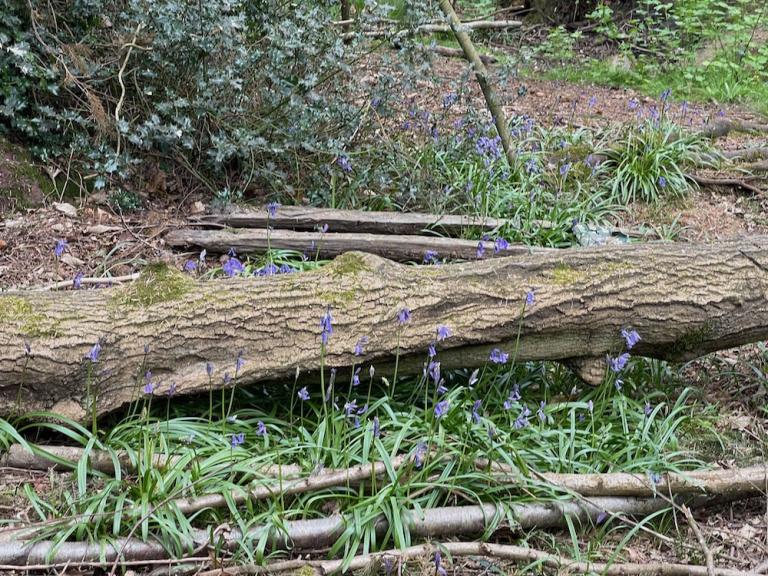
In the middle of my own wrestling and annual remembering, one year I borrowed a scooter to go around Highwoods Country Park. I was struck by the fields of bluebells, and in particular the ones growing out of a broken stump, the photo I started this article with. The photo was actually taken within a couple of hundred yards or so of the home I would ultimately live in , although I didn’t know it at the time.
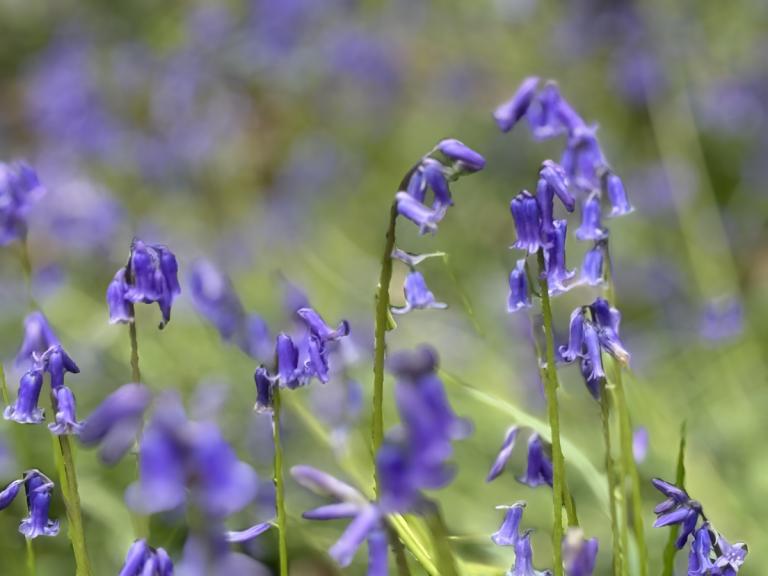
It was only when I looked at the geolocation data that I realized quite how close it was to what became my home. Bluebells speak of death, because they’re visually absent during the winter, but they speak of rebirth because they burst into glorious colour and a beautiful smell in the late spring. I’ve got several bluebell patch patches in my garden now, which we’ve planted under our trees
Seeing a bluebell now tells me there is hope. God does have a future for me.
So whatever the pain you are experiencing right now, or whatever the pain you experience in the future, remember this: it’s okay to grieve. But we don’t grieve in the same way as those who have no hope. We grieve as those who recognize the suffering, but also recognize the patches of new life bursting through. We greive as those who believe that one day the results of Jesus’ resurrection will transform the entire universe, and we have a bright future to look forward to.
Read More
Safe Haven – when God leads you to a new peaceful place. Colchester here I come.
Should a Christian have counseling with a secular therapist?
How a misinterpreted verse can make us feel guilty when we grieve
All these experiences shape my writing. If you are interested in discovering my books, visit the Amazon Transformed By Jesus series page.












 Ad-Free & Subscriber Log-In