


Scattered rabbinic texts mention multiple figures designated by the acronymic curse of Yeshu. But this name, commonly assumed to be synonymous with the Christian Gospel protagonist, is applied to numerous figures, differentiated and distinguished by their patronymics. We see examples such as Ben Stada, or Ben Pandira, which Christian polemicists from the Middle Ages onward seized upon as covert references to the Gospel character of Jesus of Nazareth.
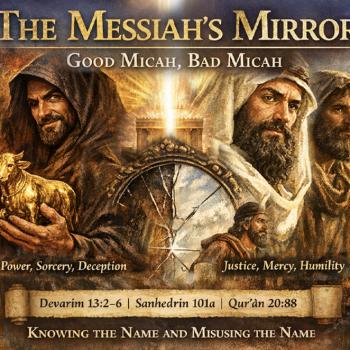
In some editions of the Talmud these names are substituted for one Bilʿam ben Be’or! In the Torah, this figure, anglicized as Balaam, was recorded as a foreign prophet hired by the King of Moab to curse the Children of Israel, but he was forced by Ha’Shem to bless us instead.
In the Biblical account, Bilʿam famously declares: “How great are your tents, O Yaʿqov!” Despite this public blessing, he later led the Children of Israel into wrongful action, through idolatry and sexual immorality.
Talmudically, it was said that he was eventually killed by the Children of Israel, at the age of 33 (Sanhedrin 106b). He is a complex figure, viewed as both a genuine prophet to the nations, and a wayward mercenary diviner whose heart was motivated by greed and a desire to harm the Jewish people—having gone astray, and having thus lost prophetic status.
It is curious, to say the least, that various Talmudic manuscripts and editions use this name rather than the acronym of Yeshu. For one, despite the Christian Church’s claim that the Gospel protagonist was crucified at the age of 33, there is absolutely nothing in their own accounts that suggests this age.
Indeed, even in the Christian Testament we see that opponents of the Jesus character charge him with not even being 50 years old yet claiming to be as old as (and then older than) Abraham (John 8:57-8). If this was a man of 33 years, this would be an odd claim, especially given the notorious centrality of the age of 40 rabbinically, in terms of maturity. Why not thus simply say “you are not yet a man of 40 years old,” rather than jumping to 50?
It would indeed seem that the Christian misconception about their own Gospel narrative stems from their own misreading of the Talmud (Sanhedrin 105-106a-b; Berakhot 7a; ʿAvodah Zarah 4b; Gittin 57a) and wrong assumptions that Bilʿam ben Be’or of the Talmud are at the root of this age-claim.
In tractate Sanhedrin we see that Bilʿam is punished with the imaginative “boiling in excrement” or alternatively “in semen” not for “blasphemy” or the like but for seeking to kill all of the Jewish people (106a-b), during the time of the Exodus. It would seem obvious then that such a reference is far too anachronistic to have anything to do with the Christian narrative.
Indeed, however, the Venice edition of the Talmud interchanges Yeshu references with Bilʿam (Sanhedrin 43a, 107b, Sotah 47a), which would seem to draw from an early tradition originating from the Toledot Yeshu. This work can best be explained as a layered polemical tradition with roots in Late Antiquity, first written in the early medieval period (9th–10th c.), with its earliest strata first being circulated in Late Antiquity (3rd–5th centuries CE). The work survives in diverse manuscript recensions from the 11th century onward, albeit filled with layers of redaction and interpolation not found in the earliest layers.
In this work, however, one Yeshu is presented as an apparently reincarnated gilgul of the archenemy of the Jewish people—Bilʿam ben Be’or—in the Second Temple Era, within the Land of Israel.
Perhaps even more surprising than this, however, is the fact that the apparently anti-Pauline author of the Christian Testament’s Book of Revelation makes use of this same name—Balaam son of Be’or—to describe a Second Temple misleader, who taught the violation of the Torah and its Mitzvot (Revelation 2:14). This work was unquestionably penned within the first century CE, with some arguing for an early date before Jerusalem fell. As such, it would thus seem that based on this proto-Christian usage and its presence from the outset of the Book of Revelation, that this could not possibly be a reference to the Gospel character of Jesus.
So, Who Was the Talmudic Yeshu?
Passages in the Babylonian Talmud describe a figure, termed by the acronym Yeshu, who was expelled by the proto-Rabbinic Sage and Nasi of the Sanhedrin, Yehoshuaʿ ben Peraḥya (103-76 BCE).
It speaks of a Yeshu executed on the eve of Pesaḥ or Passover, which might on the surface sound like the Christian account, until we realize that this figure was executed after forty days of public notice. As well, he was not crucified, nor were any of these other Talmudic individuals designated by this acronymic curse.
The Talmud speaks of healings carried out “in the name of Yeshu ben Pandira,” which should not distract us, since claims of miracle healings were about as common as crucifixion in the Second Temple Era. In fact, it is almost astonishing that none of these Yeshu figures of the Talmudic accounts are said to have been crucified. This is perhaps the most key and defining characteristic of the Gospel Protagonists literary death—albeit the entire crucifixion, death and resurrection account being absent from the chronologically earliest Thomasine a Markan accounts.
On the surface, the name Yeshu resembles the shortened Hebrew form of Yeshuaʿ. Yet the Yeshu figure expelled by Yehoshuaʿ ben Perachya is outlandishly anachronistic. Yehoshuaʿ ben Perachya lived long before the first century of the common era. There is no reasonable way any Jew could have confused a first century Yeshuaʿ with this Yeshu.
As well, the most famously cited Talmudic passage claimed to be a record of a Jesus execution by the Jewish people, is found in Sanhedrin 43a, which clearly describes a lynching rather than crucifixion. It is not as though crucifixion was uncommon. This method of executing enemies of the Roman State, on a charge of insurrection was incredibly common and notoriously used to terrorize the Jewish population into submission to the Roman imperial machine. Messianic claimants certainly fit the proverbial bill in the eyes of Rome as insurrectionists.
The setting for this lynching, is also not terribly far from the site of modern day Tel Aviv, or “Lud” rather than Jerusalem.
So how could antisemites have gotten this so wrong. Perhaps, with all of these other differences, we might find that at least one of these Yeshu characters of the Talmud had twelve disciples… right?
No, once again, we find a disciple list with names that generally have no similarities whatsoever with the Gospel characters. Of Matai, Nekai, Netzer, Buni, Todah, only the first sounds remotely like “Matthias”. The rest have no parallel in Christian tradition whatsoever. Were that a test with five questions, asked—“fill in the blank” for the names of five Gospel disciples—this list would have scored a 20%. That is, if it was actually trying to identify the Gospel protagonist and his literary disciples. It would seem, however, based on the anachronisms and so much else—divergent geography, names, dates, etc.—that these Talmudic Yeshu figures were never intended to point the reader to the Christian narrative, or its cast of characters—real or fictional.
The rabbis were not preserving memories of any real or literary Jesus of Nazareth—nor of a Yeshuaʿ, for the Christians who prefer Hebrew names.
Instead, these were Talmudic cautionary tales warning against heresy, blasphemy and even disregard and disrespect for one’s teacher. The chronological dislocations, contradictory details, and unstable textual witnesses all indicate that the “Yeshu” of this rabbinic literature cannot be harmonized with the characters from the Christian Gospel story—they simply collapse under the weight of their mountain of inconsistencies.
Thus, while later Christian readers accused the Talmud of harboring slander against the Jesus figure, a sober historical reading shows otherwise. The “Yeshu” stories are internally incoherent as biography, and their polemical, pedagogical, and boundary-drawing functions are unmistakable.
Far from offering an alternative record of the Gospel’s Jesus of Nazareth, and although the quotation such people provide, are often (but not always) true segments of the Talmud, when you work out the dates, any Talmudic Yeshu seems to have lived between one to even three hundred years before the Gospel Jesus was said to have lived.
So Again, Who Were These Yeshu Figures of the Talmud?
At this point, you might be starting to suspect that the acronym of Yeshu had a meaning altogether different than referencing the extremely-common Hebrew equivalent of “Josh.” This term would have been a reference to people who were heretics, false prophets, or more specifically, false and failed messianic claimants. And that is where the Christian polemicists have staked their proverbial tent of wrong-assumptions.
Because the sages of the Talmud called such failed messiahs by this acronym, the assumption has been that they must have done so because of one such figure named “Josh” who was so notorious, that by making an acronym similar in sound to his nick-name—Yehoshuaʿ actually being the name of a person being called Yeshuaʿ—that all who heard this reference would know who the rabbis meant.
This Christian conclusion required a complete unfamiliarity with the timeline of Jewish figures mentioned in the Talmudic accounts, as well as with the Hebrew language and parlance of the era and region.
Discrepancies in chronology, method of execution, and the nature of the narrative illustrate why the Talmud’s “Yeshu” is distinct from the Gospel protagonist. Chronological inconsistencies, with the Talmudic narratives place the events involving “Yeshu” in time periods that do not align with the Gospel timeline of Jesus, with some stories dating to as much as a century to three centuries earlier. This makes it abundantly clear that at some point, antisemitic polemicists within the Christian Church read what they wanted to read in the Talmud. When the facts didn’t fit their expectations, they wedge this square peg into the round hole—or perhaps triangle—that they desired it to fit into.
For example, one story associates “Yeshu” with the period of Alexander Jannaeus (127—76 BCE), a Hasmonean king who reigned long before even Roman occupation of the Levant! That “Yeshu” messianic claimant was literally lynched on the eve of Passover by a Jewish court, during the reign of Jannaeus, when Jewish courts still had the authority to carry out executions.
Contrasted with this is the Gospel narrative of the Jesus figure being crucified by Roman authorities under Pontius Pilate (fl. 27—37 CE), a method of execution reserved for non-Roman citizens accused of sedition. The Gospels, when they finally write in a crucifixion, death and resurrection account—absent in the earliest Gospels—portray the Jewish authorities as lacking the power of execution under Roman occupation. Thus, even non-Jewish Hellenist authors knew this much, yet we are supposed to believe that the sages of the Talmud forgot this “minor” detail?
The assumption that rabbinic references to “Yeshu” are polemical allusions to Jesus of Nazareth has persisted in both apologetic and antagonistic readings of the Talmud. Yet the textual evidence itself, when carefully examined, points to something far more complex: the rabbinic Yeshu is an anachronistic, polemically charged construct, not a historical recollection of the Christian Gospel figure.
The Term Yeshuaʿ as a Second Temple Title Rather Than a Proper Name
With all of this in mind, we are left with little choice but to conclude that such chronological incongruities, reports of significantly divergent punishments, shifting designations, and the soon-to-be-explained philological function of Yeshuaʿ as a title rather than a proper name all underscore that rabbinic literature does not—and cannot—be referring to the Gospel literature’s figure of Jesus of Nazareth.
Instead, what we find in the mouths (and pens) of the Talmudic sages was their terminological curse of Yeshu functioning as an acronym, and as a polemical inversion of messianic claims. Far from hearkening to the proper name—or rather nick name—of a heretic imagined as so notorious that even a similar sounding acronym would immediately be associated with him, what we find is a retroactive label for Second Temple heretical figures in the context of rampant failed messianism, reframed in later Jewish-Christian polemic, that have no historical relationship to the figures the Talmud is applying this term to.
The Curse Yeshu as Acronym and Polemical Device
In rabbinic usage, “Yeshu” is often understood not as a simple truncation of Yeshuaʿ as the above conclusions would imagine, but as an acronym for Yimakh Shemo ve-Zikhro, meaning “may his name and memory be blotted out”. This derogatory reshaping signals precisely the opposite of sanctification: it refuses to grant the figure the dignity of a proper name. If the individual in question had actually been named Yeshuaʿ or “Josh”—short for Yehoshuaʿ or “Jesus”—then reducing his name to “Yeshu” would paradoxically preserve it rather than obliterate it. The fact that the rabbis instead reinterpret the designation as an erasure formula indicates that Yeshu here is less a biographical identifier than a polemical device applied to certain messianic claimants.
To understand why rabbinic references to “Yeshu” cannot be taken as literal biographical pointers to the Gospel Jesus, one must first appreciate the semantic range of Yeshuaʿ (ישועה) in Jewish tradition. The meaning of the term Yeshuaʿ has consistently been employed in normative, rabbinic Judaism—to this day—as Messianic “Salvation,” and not as a proper name. As a term, this means “Salvation” or “Liberation”—not in a theological sense, but in a national, Zionist sense. The Mashiach would liberate or “save” the people from the enemies of the Jewish people. Thus, in the Second Temple Era, as today still, we speak of this hope for Yeshuʿah—not a person bearing that word as a proper name, but the actual national liberation of Israel from the clutches of antisemites, via the coming of Mashiach Ben David, and the ushering in of the Yamot Ha’Mashiach—the Messianic Age.
In Tanakh and later Jewish liturgy, yeshuʿah functions as a divine promise and a messianic hope, not a personal designation. The Talmud teaches in tractate Shabbat, that “When a man is brought to judgment, they say to him… Did you await Salvation?” (31a).
Thus, here we see that ke-she-makhnisin adam la-din, omrim lo… ṣipita li-Yeshuʿah (כשמכניסין אדם לדין אומרים לו… ציפית לישועה), is not a reference to a person named Yeshuʿah, but to the Salvation, Liberation or Redemption of the Jewish people through the Yamot Ha’Mashiach.
The term—not name—of Yeshuʿah clearly functions as the eschatological horizon of Jewish faith. To “anticipate salvation” is to participate in the destiny of Israel and in the cosmic unfolding of Divine Redemption of the Jewish People collectively.
In liturgy, we thus daily pray “For Your salvation we have hoped all day long.” in Shemoneh Esre, or “ki li-Yeshuʿatekha kivinu kol ha’yom” (כי לישועתך קיווינו כל היום). No one in their right mind has ever suggested this was a reference to collective Jewish hopes and anticipations of a guy named Josh coming to save us from antisemites.
Thus, yeshuʿah was not merely a man’s name, but a title, a theological claim to be the liberator of Israel. Those who declared themselves as Yeshuʿah but were not merely failed messiahs, but heretics, were rejected by the rabbis, who shortened the term to Yeshu, read as an acronym for erasure. Others, such as Shimʿon ben Yosef (d. 4 BCE), Yehudah Ha’Galili (fl. 6 CE), his son Menachem Ben Yehudah (fl. 66 CE), or later Bar Kokhba (d. 135 CE), were never blotted out with such a curse, since they merely failed in their grandeur attempts at national liberation, they did not lead Israel astray from the Derekh Ha’Shem.
Implications for the Rabbinic “Yeshu” Designation
With all the above in mind, it should be decisively clear why rabbinic texts never present “Yeshu” as a straightforward personal name, and why there are so many examples of people with this designation uses as a curse upon them, who are differentiated only by their patronymics.
For the sake of crushing any further argumentation from the slow learners out there, let us continue…
For example, the Bavli says that with regards to “Rabbi Yehoshuaʿ ben Peraḥya… Yeshu came before him. He pushed him away… Yeshu went, set up a brick, and worshipped it.” (Bavli Talmud, Sotah 47a; Sanhedrin 107b)
Here a heretic with a particular love for building materials or perhaps landscaping pavers, was termed “Yeshu” after being rejected as a disciple to the anachronistic Rabbi Yehoshuaʿ. But the nickname of Yeshuaʿ is already the shortened form of Yehoshuaʿ—think Josh versus Joshua. “Rabbi Yehoshuaʿ ben Peraḥya… Yeshu baʾ lefanav. Daḥafo… halakh Yeshu, heʿamid levenah, ve-hishtahaveh lah” (רבי יהושע בן פרחיה… ישו בא לפניו. דחפו… הלך ישו והעמיד לבנה והשתחוה לה).
This redundancy makes little sense if both are proper names, but it makes perfect sense if Yeshu is a polemical label for a false messianic claimant. Of course, worshipping a brick seems a bit out of the ordinary for the Gospel Jesus, but to be sure, there will be (and have been) people who struggle to make this fit.
As for the patronymic problem in the case of this Talmudic Yeshu, he is further called “Ben Pandera.” The Tosefta preserves an early notice that one “Yaʿqov the heretic came to heal him in the name of Yeshu ben Pandera” (Tosefta Ḥullin 2:22–24).
Thus, here we see that “Ba Yaʿaqov ha’min le-rappeʾo be-shem Yeshu ben Pandera” (בא יעקב המין לרפאותו בשם ישו בן פנדרא), is no mistranslation, nor interpolation. The figure Yaʿqov in this account is referencing his own teacher with the patronymic of Ben Pandera.
No Christian would ever have invoked Jesus with such a patronymic. From the beginning of the Christian religion, this figure was confessed as the Son of God and of Mary, not as the child of an earthly father. Even if one would have imagined him as taking the name of a stepfather of sorts, the name universally given by Christian accounts is Yosef. The very ascription “ben Pandera” places this figure in a wholly different category.
And again, there is the pesky problem of the anachronistic, chronological displacement of the Bavli Talmud connecting this Yeshu with Yehoshuaʿ ben Peraḥya of the Hasmonean period (second–first century BCE). This would be least a century before Pontius Pilate and the life of the Gospel figure of Jesus. This is not a matter of a few decades’ confusion but a relocation into an entirely different historical era. We are asked to suspend disbelief and simply accept that the sages of the Talmud were too stupid to understand this.
To recap the further conclusive proofs against the Talmudic Yeshu curse as relating the Gospel protagonist, the Bavli Talmud further records an execution by stoning or alternatively by lynching, not by the Roman method of crucifixion.
“On the eve of Passover, they hanged Yeshu. For forty days a herald went out saying: He is to be stoned, for he has practiced sorcery and led Israel astray.” (Sanhedrin 43a). That is a pretty significant difference. Yes, this was on “ʿErev ha’Pesaḥ” but they “talu et Yeshu”—they lynched this Yeshu.
And before they did that, for forty days—“Arbaʿim yom haya kruz yotzeʾ ve-omer: yotzeʾ li-sakel, she-kishshef ve-hisiṭ ve-hidiyaḥ et Yisraʾel” (בערב הפסח תלאו את ישו. ארבעים יום היה כרוז יוצא ואומר: יוצא ליסקל, על שכישף והסית והדיח את ישראל).
Roman crucifixion is nowhere mentioned.
In this clearly polemical misidentification, we find decisive proof that this was not a record of Jewish Memory nor was this a historical account of Jewish interaction with the Gospel protagonist. The truth is, we have absolutely no records of any such interactions, or even of Jewish awareness of any such figure having walked the face of the Earth.
It is critical to recognize and emphasize that it was not the Jewish people who identified these figures of Yeshu with the Christian Jesus. This equation was made by non-Jews—Christian apologists and polemicists—seeking to locate the Gospel protagonist in rabbinic texts.
The historical truth, however, is that we had no such figure in our socio-religious memory. Later interpolations like Ha’Notzri, “the Nazarene,” or references to Miriam are demonstrably late additions, centuries—sometimes a full millennium—after the earliest manuscripts, inserted as polemical glosses once Christianity had grown powerful.
Thus, the Talmud does not preserve authentic Jewish knowledge of Jesus. It preserves rabbinic polemics against messianic claimants, employing Yeshu as an acronym and as a title inverted into a curse. The identification of the rabbinic Yeshu with the Gospel’s Jesus of Nazareth is not Jewish testimony, but Christian misreading.
How do we then look forward to the Liberation or Yeshuah of the Jewish People from the lies of antisemitism? We do this not by waiting on our hands for someone to come save us from these lies, but by picking up our pens as swords and going to battle against the armies of darkness, ignorance and deception.















 Ad-Free & Subscriber Log-In