
 The Deacon's Bench
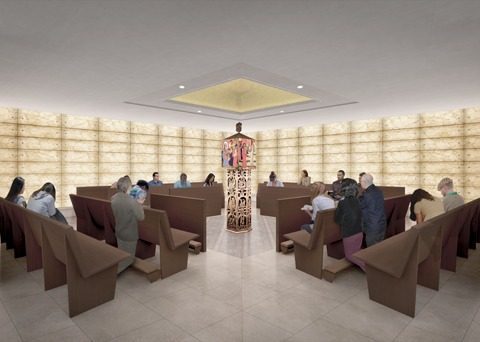
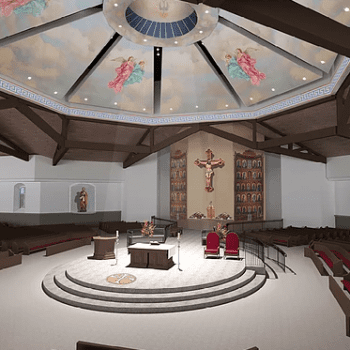
There’s been some critical commentary about the new designs for Christ Cathedral in the Diocese of Orange—and a lot of people have bemoaned the proposed location of the Blessed Sacrament, reserved in a side chapel (shown above). William Newton wrote:
The most important question to ask in entering any Catholic church is, “Where’s Jesus?” The answer in this case is, “Somewhere over there.” In this absolutely vast sanctuary, which seats about 2700 people at present, there was apparently no room for the Son of God, at least not in the Real Presence of the Blessed Sacrament. Instead, the Tabernacle sits like a gilded Tardis, surrounded on four sides by asymmetrical pews, in a side chapel.
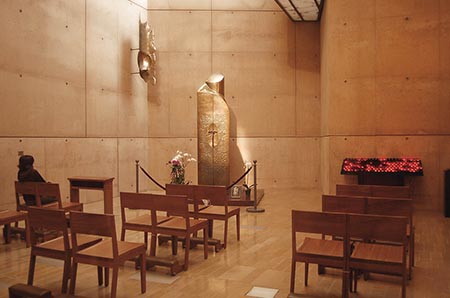
You find a similar situation in other cathedrals and large churches. Below, for example, is the Blessed Sacrament Chapel at the Cathedral of Our Lady of the Angels in Los Angeles:
But is this some newfangled, post-Vatican II innovation? Now seems a good opportunity to take a closer look at what the Church actually teaches on this subject. Fr. George Saunders addressed this topic a few years back, and his analysis is available at the EWTN website:
The Fourth Lateran Council (1215) decreed that the Blessed Sacrament be kept in a secure receptacle and placed in a clean, conspicuous place. The Synods of Cologne (1281) and Munster (1279) stipulated that the Blessed Sacrament be kept above the altar, sometimes in tabernacles shaped like doves and suspended by chains. (An example of this type of tabernacle is on exhibit in the medieval collection of the National Gallery of Art.)
Overall, during these times, the Blessed Sacrament was reserved in four possible ways: in a locked cabinet in the sacristy, a custom originating in the early Church; in a cabinet in the wall of the choir area, or in a cabinet called the “Sacrament House,” which was constructed like a tower and attached to a wall near the altar; in a “dove” receptacle suspended from the baldachino above the altar; and in a tabernacle on the altar itself or in the reredos of the altar.
In the sixteenth century, the Blessed Sacrament became customarily reserved in a tabernacle that was placed on the altar or part of the reredos. However, only in 1863 did the Sacred Congregation of Rites prohibit the use of suspended doves and sacrament houses.
The liturgical reforms of the Second Vatican Council prompted a “rethinking” of the location of the tabernacle in the church. Two important points must always be kept in mind: First, reverence for the holy Eucharist must be preserved and promoted. The “Constitution on the Sacred Liturgy” reminded us that the holy Eucharist is “a sacrament of love, a sign of unity, a bond of charity, a paschal banquet in which Christ is consumed, the mind is filled with grace and a pledge of future glory is given to us” (No. 46).
Second, the significance of the offering of the Mass itself, where the holy Eucharist is confected, must be preserved and promoted. The “Dogmatic Constitution on the Church” asserted, “Taking part in the Eucharistic sacrifice, the source and summit of the Christian life, they offer the divine victim to God and themselves along with it” (No.11).
Accordingly, the “Instruction on the Worship of the Eucharistic Mystery” (1967 issued regulations (later incorporated into the new “Code of Canon Law”) concerning tabernacles (cf. No. 52-57 and Canons 934 944): The holy Eucharist may be reserved only on one altar or one place in any church, and a vigil lamp must bum at all times to indicate and honor the presence of our Lord in the Blessed Sacrament. This tabernacle must be immovable,made of solid and opaque material, and locked to prevent theft or desecration of the Blessed Sacrament. The tabernacle “should be placed in a part of the Church that is prominent, conspicuous, beautifully decorated, and suitable for prayer” (Canon 938).
Here is where some confusion emerges. To promote prayer and devotion, the “Instruction” stated “It is therefore recommended that, as far as possible, the tabernacle be placed in a chapel distinct from the middle or central part of the church, above all in those churches where marriages and funerals take place frequently, and in places which are much visited for their artistic or historical treasures” (No. 53).
For example, at St. Patrick’s Cathedral in New York City, which has a constant flow of tourists, the Blessed Sacrament is reserved in Our Lady’s Chapel located behind the main altar, this beautiful chapel provides a quiet place for the faithful to pray without the distraction of the comings and goings of people. A similar situation exists at the Basilica of the National Shrine of the Immaculate Conception in Washington.
He has much more on the history and background, and I’d encourage you to read it all.
It can be debated just what constitutes “a part of the Church that is prominent, conspicuous, beautifully decorated and suitable for prayer”—particularly those first two adjectives. I remember being frustrated on my first visit to the cathedral in Los Angeles because it was hard to find just where the Blessed Sacrament Chapel is located; you have to go hunting for it, and you will find it tucked into a corner, just a short walk from the sanctuary. The tabernacle at Bellarmine Chapel at Xavier University in Cincinnati is kept in a back room behind the altar. Closer to home, the Blessed Sacrament at the Immaculate Conception Seminary in Douglaston, Queens is reposed inside a gold-colored orb (arguably, the ugliest tabernacle I’ve ever seen) in a chapel that seems to have been carved out of an empty room almost as an afterthought. It’s also a little tricky to find.
Those of us who grew up attending humble suburban parishes constructed after World War II are accustomed to seeing the tabernacle in the most prominent part of the church, usually on or behind the altar. But the notion of a side chapel for the Blessed Sacrament is clearly nothing new. St. Peter’s Basilica has just such a chapel —an opulent repository for the Body of Christ (see below).
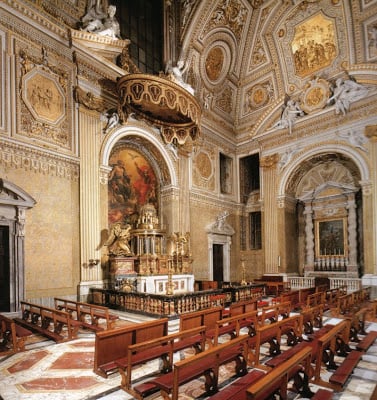
But it is one of several side chapels inside the basilica, and it’s questionable how much it really stands out. You can walk past it on a self-guided tour (and many do) and never realize it’s there.
For many years, my parish in Queens kept the tabernacle on a side altar, underneath a statue of St. Joseph. It was “prominent” and “conspicuous,” and there was a certain poetry to its placement. “St. Joseph watches over Jesus today,” my former pastor used to say, “just as he did in Nazareth.” But about 10 years ago, it was decided that the Blessed Sacrament deserved something better, so the tabernacle was moved to a new altar behind and slightly above the main altar. You can’t miss it. (See below, from Easter Sunday).
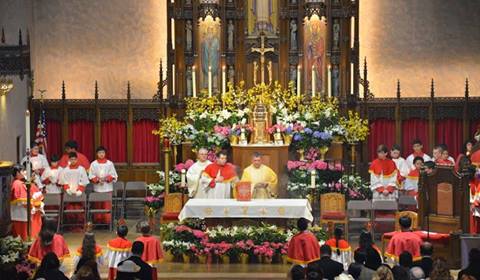
I rather like it there, and the people in the pews appreciate it, too—perhaps because it underscores something Fr. Saunders mentioned in his essay:
The goodness of having the tabernacle in the body of the church either in the center, or at least to the side, is that it fosters devotion to the Blessed Sacrament. For instance, people genuflect in reverence to the Blessed Sacrament. Since the one day most parishioners visit their church is on Sunday, having the tabernacle visible in a prominent and conspicuous location makes them aware of the Eucharistic presence of our Lord. The people are more mindful that church itself is the “House of God” and a sacred space, not just a meeting house. In an age of doubt and disbelief, we need to do all we can to promote and foster devotion to our Lord in the Blessed Sacrament.







 Ad-Free & Subscriber Log-In