

The Sunday celebrating the Baptism of Jesus is an ideal time to articulate a theology of water and respond to our baptismal vocation of caring for God’s Creation.
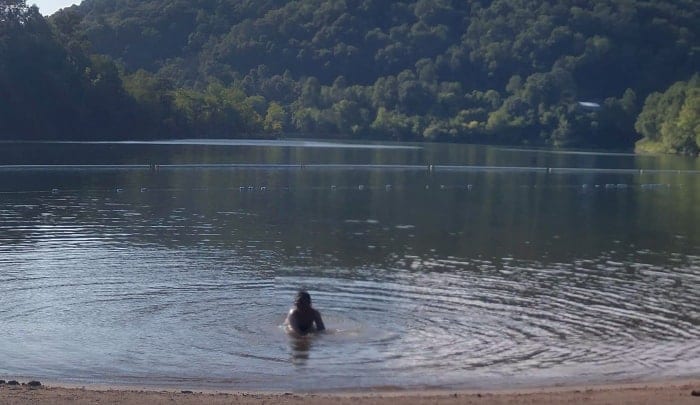
Here are ideas for reading and preaching Psalm 29 and Matthew 3:13-17 on the Sunday celebrating the Baptism of Jesus. This is part of the EcoPreacher 1-2-3 series to equip preachers and congregations for engaging the Bible through an ecological lens. These texts are assigned as part of the Revised Common Lectionary for the First Sunday of Epiphany in Year A.
[This article was originally published in January 2023 and has been updated. Also, read the Spanish version here.]
Eco-Exegesis
Eco-exegesis is a method of interpreting the biblical text through a green lens using the principles of ecological theology. See: 10 Principles for Environmental Preaching and Eco-Sermons.
Psalm 29:3
The voice of the Lord is over the waters;
the God of glory thunders, the Lord, over mighty waters.
In his commentary on Psalm 29, William P. Brown, Professor of Old Testament at Columbia Theological Seminary, notes that the storms and waters of Creation provide a “foil for God’s unrivaled power [and] wild and reckless glory” (Deep Calls to Deep: The Psalms in Dialogue Amid Disruption, Nashville, TN: Abingdon Press, 2021, 161). While certainly destructive, this power is also bursting forth with new life. God’s sovereignty in water refreshes and renews, even as it has the potential to do damage. Thus, we must respect water.

What’s notable is that the psalmist frames these natural phenomena theologically. The faithful are to view all these demonstrations of God’s power in nature from the temple. Yet, the temple is not where the psalmist locates God’s presence. Instead, God is enthroned over the flood, outside in the world beyond human-built religious architecture. Thus, while God’s power in the water cannot be contained, the Israelites pray for this power to give strength and blessing to them. We might say this is a “theology of water” for the community.
Matthew 3:16-17
16And when Jesus had been baptized, just as he came up from the water, suddenly the heavens were opened to him and he saw the Spirit of God descending like a dove and alighting on him. 17And a voice from heaven said, ‘This is my Son, the Beloved, with whom I am well pleased.’
With Psalm 29’s theology of water fully in view, we encounter Matthew’s story of Jesus’s baptism through a lens that reorients us to God’s Creation. Once again, the voice of the Lord is over the waters, this time thundering over the Jordan River where Jesus has come to John to fulfill the call to righteousness through baptism.
As Mark Wallace describes the scene, “all of the basic, primitive elements [of Creation] are woven together to create a compelling environmental tapestry of prophecy and judgment . . . the fire of judgment, the water of renewal, and the life-giving wind of the earthen Spirit are fully set forth and integrated with one another,” (Finding God in the Singing River: Christianity, Spirit, Nature, Fortress Press, 2007, 54).
Theology of Water in the Baptism of Jesus
Further, Wallace insists that “all persons who undergo baptism by water are now singed by God’s fire and invigorated by God’s breath to share the gospel to a world in dire need of reaffirming the integrity of the good earth God has made” (54).
This theology of water in baptism has profound ramifications for the Christian vocation of Earth-care. It means that our baptism calls us to advocate for healthy water, whether in local municipalities, or in fracking-ravaged watersheds, or in ocean bays choked with plastics and other types of garbage.

The Sunday celebrating the Baptism of Jesus is an ideal time to talk with the congregation about the necessity of protecting the sanctity of water. Ask if they know the name of their local watershed, the closest body of water to the church, and the biggest source of water pollution in their area. What is the role of the church in protecting the waters of Creation in which we baptize?
As the Psalmist says, “The voice of the Lord is upon the waters.” God’s voice is calling us to keep those waters clean!
1 Eco-Idea
The Eco-Idea is one succinct statement that tells us who God is and/or what God does in relation to Creation and how we should respond as people of faith.
Just as Jesus heard and responded to God’s voice during his baptism, we hear and respond to God’s voice in the Bible and Creation to honor, protect, steward, and restore the waters of the Earth.
2 Eco-Questions
Eco-Questions are what we can ask to help a congregation draw out the implications of the Eco-Exegesis and Eco-Idea.
- If Jesus were to go to one of the polluted bodies of water near your church, what would he see in those waters? What would he say? In what ways does our baptismal vocation compel us to live out a theology of water that advocates for the threatened waters of Creation?
- How might the church and your congregation live out their theology of water by amplifying God’s voice that still sounds across brooks and oceans, glaciers and snowy mountains? How might we instruct children, youth, and adults on Creation care and even declare the water itself “beloved”?
3 Eco-Actions
Eco-Actions are ways that a congregation might respond to the Eco-Idea and Eco-Questions. One of these possibilities may work well in your ministry context.
- In prayers and preaching, name the body of water nearest to your worshiping congregation that is in need of blessing. Highlight the ways in which God uses the local stream, swamp, lake, river, or ocean to sustain life. Name the sins of pollution, overuse, and misuse that damage the waters of Creation. Suggest ways that your congregation can live out its baptismal vocation by caring and advocating for the local watershed.
- Invite the congregation to a water blessing ritual at a place in nature near your church. Invite people to offer their prayers for healing the waters of Creation. Conclude the event by offering ways to put faith into action. This could include participating in water clean-up efforts and writing local leaders to support environmental protection legislation.
- Hold a workshop on how to conduct a personal “water audit” to track how much water each household uses in your congregation. Then do a “water challenge” to use less water. Offer prizes to the household has the greatest percentage reduction in water usage. Download this worksheet to conduct your water audit.
Read also:
Baptismal Water, Light, and Spirit: Our Ecological Vocation
The Healing Power of “Moonlight”: Race, Erotic Love, and Baptism
Ecological Stations of the Cross: #5 – Waste and trash pollute Earth’s body
EcoPreacher 1-2-3 is a partnership between the Rev. Dr. Leah Schade and the Interfaith Center for Sustainable Development, publishers of Eco Bible, a Jewish ecological commentary on the Hebrew Scriptures. EcoPreacher 1-2-3 provides Creation-centered sermon preparation that is short, accessible, and based on a solid biblical foundation. To see other EcoPreacher ideas and to sign up to receive future EcoPreacher 1-2-3 installments, click here.
The Rev. Dr. Leah D. Schade is a seminary professor and ordained minister. Her opinions are her own. Leah is the author of Preaching and Social Issues: Tools and Tactics for Empowering Your Prophetic Voice (Rowman & Littlefield, 2024), Preaching in the Purple Zone: Ministry in the Red-Blue Divide (Rowman & Littlefield, 2019) and Creation-Crisis Preaching: Ecology, Theology, and the Pulpit (Chalice Press, 2015). She is the co-editor of Rooted and Rising: Voices of Courage in a Time of Climate Crisis (Rowman & Littlefield, 2019). Her book, Introduction to Preaching: Scripture, Theology, and Sermon Preparation, was co-authored with Jerry L. Sumney and Emily Askew (Rowman & Littlefield, 2023).










 Ad-Free & Subscriber Log-In