AI is an ingenious technology that can have lots of uses–sorting through information, analyzing data, developing new medicines, and otherwise serving as a beneficial tool. But the major AI developers are not content with that. Instead, they want to build something superhuman, a machine that can surpass the capabilities of human beings.
And it’s in what journalist Karen Hao calls this “ideological pursuit of the machine God” that the problems come in, from the technology’s dystopian threats to humanity to the financial problems of having to build the infrastructure necessary to reach this massive scale,
Hao was embedded in the AI industry from its early days and tells the tale of how OpenAI morphed from a non-profit dedicated to the goal of “saving humanity” into a for-profit corporate behemoth sucking up more than $1 trillion in investments. She has written a book about her findings, the thesis of which is given in its title: Empire of AI: Inside the reckless race for total domination.
Madeleine Spence writes about Hao for the Times of London in an article entitled I Saw Up Close the Dark Reality of OpenAI’s Race to Create God, with the deck, “When Karen Hao was embedded with the secretive makers of ChatGPT, she discovered paranoia and religious fervour in their pursuit of superhuman power.”
ChatGPT dedicated itself to developing not just AI but artificial general intelligence. “The idea was that this superintelligence could replicate, and then surpass, human intelligence. In OpenAI’s telling, it could become powerful enough to destroy the world, or to create global utopia, solving problems humanity wasn’t smart enough to.”
Its scientists and researchers were some of the brightest minds in the industry. But, Hao says, their belief in AGI was something more akin to a religious fervour. She calls it “the ideological pursuit of the machine god”.
Several former OpenAI employees told Hao about a retreat in the hills of the Sierra Nevada mountains where senior scientists, dressed in bathrobes, sat around a firepit at a sprawling lodge and watched as Ilya Sutskever, OpenAI’s brilliant and eccentric chief scientist, burnt an effigy “representing AGI”.
Originally, as the article tells it, AI had a more limited scope. “Scientists used small and limited data sets to test hypotheses about what artificially intelligent machine learning could do, such as detecting signs of Alzheimer’s by feeding it datasets of brain scans. Now, it was about feeding as much data to the AI as possible in the hope of it developing ‘intelligence’ in any field.”
This required scaling up on an unprecedented scale. This meant, in Hao’s words, “pouring ever more data into them and training them on supercomputers larger than anyone has ever built in human history.” Open AI’s competitors joined into the effort. All of this required the building of vast new data centers, torrents of water to cool the processors, and enormous consumption of energy.
And the ambitions of its makers for what this superhuman, godlike artificial intelligence would do, created problems of its own. Says Hao, “All of the things that we see in terms of the negative impacts of AI come from this scaling idea.” For one thing, while early, limited AI was fed “clean data” from high quality sources, the new unlimited AI was fed virtually everything, from restaurant reviews to the writings of flat earthers. As a result, despite all of this firepower, its findings are often of questionable quality.
Here is Hao’s recommendation:
“We could still rapidly advance AI, just in a different direction,” says Hao. We need to develop more targeted AI. This wouldn’t require huge reserves of computing power, or massive amounts of indiscriminate data. It would simply mean having more specific aims, such as using AI to discover new drugs by feeding it small and specific datasets, and testing the results with rigorous scientific research. It might not create something superintelligent, but you couldn’t argue it wouldn’t benefit humanity, says Hao, and without the unintended consequences.
I was struck with the question she asked when she first came to OpenAI, which she is still asking: “Why choose to aim for human-surpassing superintelligence at all?”
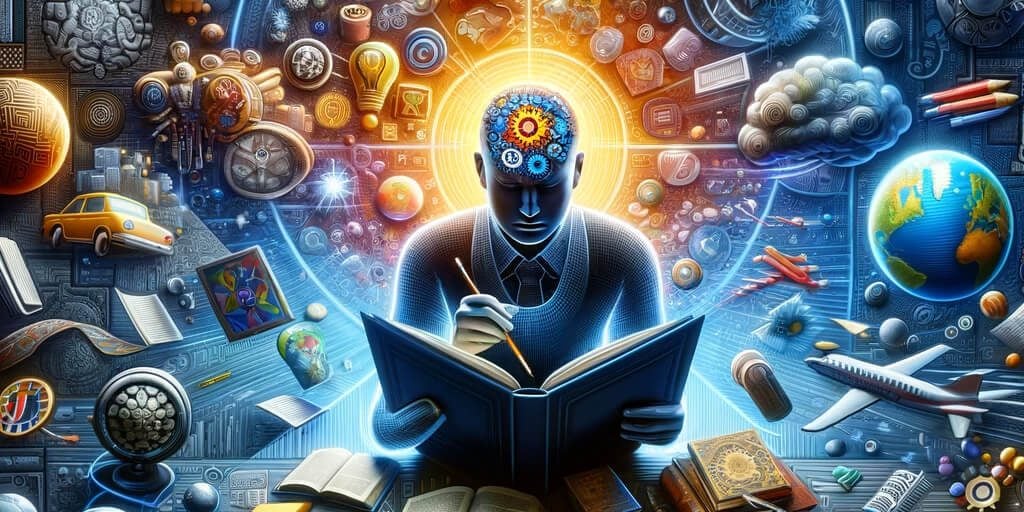
Illustration: AI in Language Learning via Wikipedia, Creative Commons Attribution-ShareAlike 4.0















 Ad-Free & Subscriber Log-In