

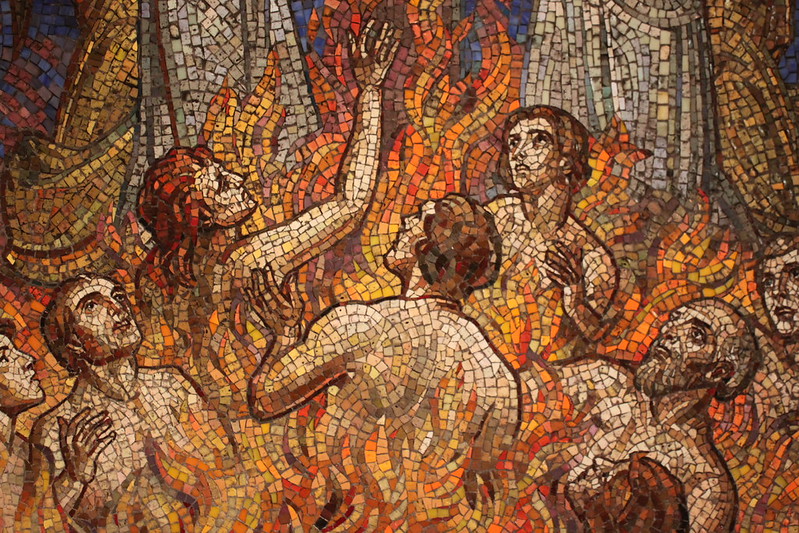
Purgatory seems to be coming back into vogue, even among some Protestants.
Now the Wall Street Journal, no less, has published an article by Catholic author Joseph Bottum entitled Three Cheers for Purgatory. He writes,
Purgatory matches our sense of faith and fallen nature: our awareness that we can be saved, snatched by God’s grace, and yet still not be ready for heaven.
Purgatory, in the thinking of the old ecumenical councils, is the place or condition in the next world where the souls of those who die in a state of grace but not yet free from all imperfection are scoured of guilt for venial sins and purged of the inclination to sin.
Everyone in purgatory is saved, salvation has come, but that doesn’t mean we need to track into heaven the muck we got on ourselves in life. It’s as much a human desire as a divine one, for the ordinary person’s reaction to the Gospel would be to ask for a chance to wash, freshen up a little, put on some clean clothes, before strolling into the beautiful mansion. In C.S. Lewis’s words, “Our souls demand Purgatory, don’t they?”
Bottum admits that there isn’t much if any Biblical warrant for this teaching. “But more telling than proof texts,” he says, “is the human experience, the sense of a thick, rich world in which we live among the dead, praying with and for them.”
His main argument for Purgatory is the value of praying for the dead. “Prayer is possibly at its most efficacious, certainly its most selfless, when we pray for the souls in purgatory. We do serious metaphysical work for them—aiding their future, speeding their purgation, and keeping them present in the thick cosmos that surrounds us.”
Setting aside the biggest issues–the assumptions that our salvation is a function of our good works and that Christians should hold beliefs that are unsupported by the Bible–it seems to me that the belief in the efficacy of prayer for the dead contradicts the belief that souls need a time of purgation to prepare them for Heaven.
If prayer can get souls out of Purgatory, what happens to the souls’ need “to wash, freshen up a little, put on some clean clothes, before strolling into the beautiful mansion”? If souls need, or even desire, that cleansing, surely those who love them should not pray for them to miss out on this preparation.
Of course, the reason for praying for the dead is the traditional belief that Purgatory is nothing like taking a shower or getting all dressed up for a party. Rather, it is a horrible place. It is a realm of burning fire, just like Hell only temporary. (Read this from a modern-day conservative Catholic, who quotes saints and authoritative theologians.) Tetzel in Luther’s day taught that souls must spend 7 years in that fire for every sin until it is purged away, so that people expected to be in purgatorial fires for thousands of years. That’s an unofficial opinion, but it’s based on a saint’s supposed revelation and I’ve heard other Catholics reference it. (Read this from a modern Catholic on Purgatory’s duration.) Progressive Catholics have been saying that Purgatory occurs outside of time, so it’s over in an instant, but the whole point of the teaching according to the theologians is that sinners must endure a “temporal” penalty, that is, one that is within time.
So if you believe such things, of course you are going to want to pray for the dead, that God would spare them such torment. The prayers for the dead are often addressed to the saints, asking them to intercede for the loved one. If they do or if God heeds what Bottum calls the “real metaphysical work for the dead” that our prayers perform, God might extend His mercy and free the soul from Purgatory early.
Which brings me to further questions. If God’s grace is such that He can release a soul from some of the punishments of Purgatory, what makes us think that He cannot release us from the punishments we deserve altogether?
And if our prayers or the intercession of a saint can get someone out of Purgatory, think what Christ’s intercession would do.
The Bible may not say anything about Purgatory, but it does say a great deal about how Christ bears our sins, takes the punishment that we deserve into Himself on the cross, bestows upon us His righteousness, and thus atones for us. Insofar as we are in Christ by grace through faith, where are our sins that need to be purged away?
But don’t we need to be purged of our sinful nature before we can enter Heaven? Death is what does that, as the “flesh” and with it our sinful nature is turned to dust.
Don’t we need to be cleansed and washed before we can enter Heaven? Christ’s blood cleanses us. Our baptism “washes” us.
Don’t we want to “put on some clean clothes” so that we will be presentable in Heaven? We are clothed in Christ (Galatians 3:7).
I think belief in the all-sufficient sacrifice of Christ “matches our sense of faith and fallen nature” and gives us “the sense of a thick, rich world.”
Illustration: Holy Souls in Purgatory by Fr. James Bradley via Flickr, CC BY 2.0















 Ad-Free & Subscriber Log-In