

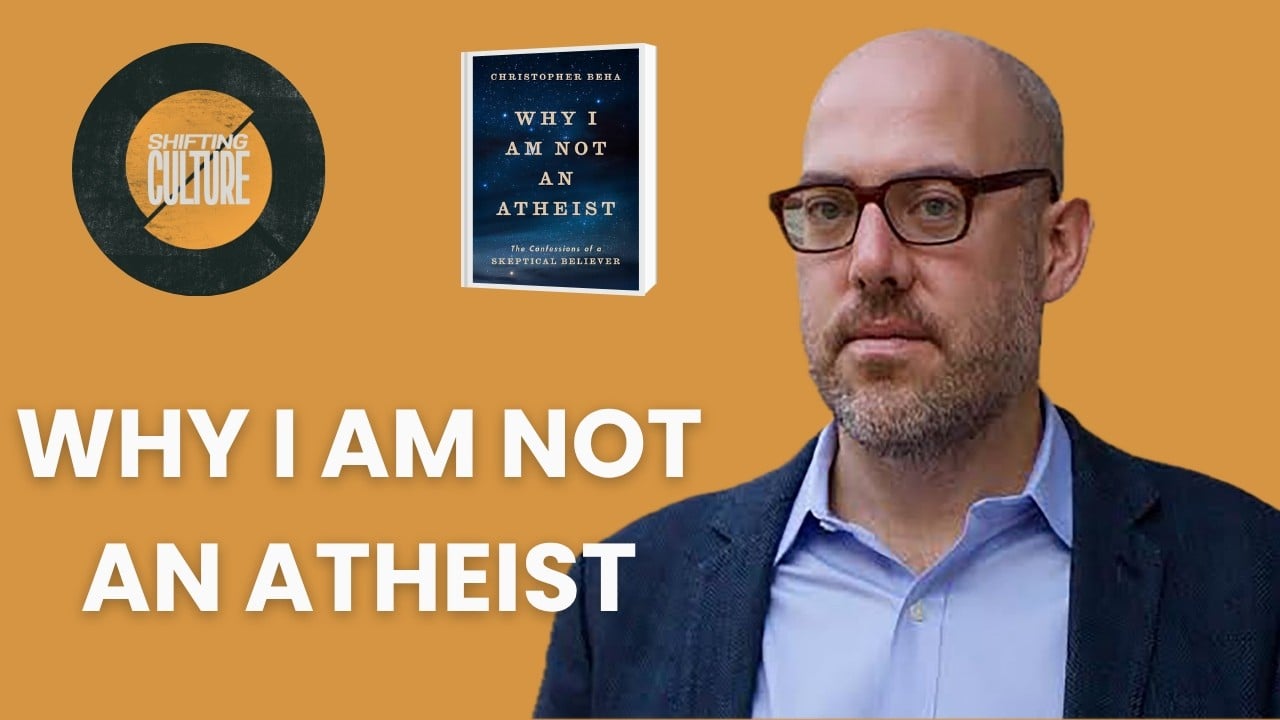
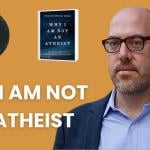
Christopher Beha, a novelist and the former editor-in-chief of Harper’s, has published a book that is getting quite a bit of attention: Why I Am Not an Atheist. It is a memoir, telling how and why he lost his childhood Christian faith and how and why he regained it.
From the editorial description at Amazon.com:
Why I Am Not an Atheist tells the story of this search for secular answers to what Immanuel Kant called the most urgent human questions: What can I know? What must I do? What may I hope? Along the way, Beha traces the development of what he understands to be the two major atheist worldviews: scientific materialism and romantic idealism.
Beha’s passage through these rival forms of atheism leads him to the surprising conclusion that faith—particularly faith in a created order in which each human life has a meaningful part—preserves the best of both traditions while offering a complete and coherent picture of reality.
The Washington Post has published an extract. Here he tells about how, as a young adult, he embraced skepticism, which “seemed the signature achievement of the modern era,” the “shaking off reflexive respect for authority and replacing it with respect for the individual’s capacity to reason about the world.”
So he read the Enlightenment philosophers who gave us this skeptical mindset. But he “was surprised to learn that they largely viewed skepticism as, at best, a starting point and, at worst, a danger to be overcome.”
These thinkers questioned biblical revelation and ecclesiastic authority. But they wanted to prove that some shared foundation of certain knowledge could be built in their place. Unfortunately, they couldn’t agree on what that foundation was.
For example, as a philosophical experiment, Descartes famously doubted everything, until he came up with the one indisputable and certain truth: “I think, therefore, I am.” But Descartes didn’t stop there. He went on to reason that his existence, as a finite and imperfect being, required also the existence of God, an infinite and perfect being. As Beha tells it,
Without this entity, he insisted, one could never get from the indubitable fact of one’s own mental experience to any certain knowledge about the outside world. Needless to say, this solution to radical skepticism was not particularly satisfying to a budding young atheist like myself. But I struggled to come up with a better one.
Nor could the other Enlightenment thinkers. Today, Beha says, we have come to the era of virtual reality, deep fakes, artificial intelligence, and a skepticism that encompasses virtually everything. We are skeptical about the government, the media, the culture, science, all institutions, and the very possibility of objective truth. According to Beha (my emphases),
This in turn makes it easier to appreciate the early modern fear of skepticism. The term increasingly calls to mind not just religious skepticism but vaccine skepticism, election skepticism and the army of “truthers” who coalesce around every major news event. These people often proceed not by proposing an alternative view but by “asking questions” that undermine the official narrative and make it difficult to believe in anything at all, which is precisely the skeptical method.
By now the dangers of this approach should be clear. Today’s great epistemic institutions — government, universities, media — face much the same crisis of authority that befell the religious institutions they replaced. While philosophical skepticism promised detachment and tranquility, modern skepticism has curdled into cynicism and despair.
Pure skepticism, refusing to believe in anything unless we have absolute certainty, gets us nowhere:
What can be done to address this fact, particularly if the philosophers are right and there is no shared foundation of objective knowledge from which to proceed? Hume once suggested that even the most confident conclusions should be tempered by a “degree of doubt.” Looking around today, I’m more inclined to say that skepticism should be tempered with a bit of belief.
What I’m proposing is not a return to simple credulity or a slavish submission to authority, but rather a recognition that it is not really possible to survive on certain knowledge alone. Every person must take some things on faith, if only to open the door and go out into the world.
Accepting this mustard seed of faith would eventually lead Beha to his recovery of the full Catholic Christian faith of his childhood, as he chronicles in his memoir. The excerpt concludes,
By the skeptics’ own lights, it takes belief to recognize the reality of the world outside one’s head, the reality of other people and the obligations that these realities entail. It takes belief to transcend despair and work for a better future. It takes belief to escape the cynicism and nihilism that seem the default mindsets of the day. It takes belief to put skepticism in its proper place.
Notice that what Beha is saying accords exactly with the insights of J. G. Hamann, that 18th century thinker I keep harping on in this blog!
Here is Hamann’s critique of the Enlightenment quest for certainty! Here–and all around us–we see the consequences he predicted! Here we see his case for the necessity of faith, not just for epistemology but for life, an openness to faith that blossoms into faith in Christ!
Hamann also approaches these issues by exploring the nature of language. Next time, I’ll post about another modern thinker who reflects those insights from Hamann’s apologetics.
See my post Why Hamann and the London Writings Are a Big Deal, which will also connect you to most of the other posts I have written about him.
All of this should be an impetus for you to buy John Kleinig’s translation of the London Writings, which I edited, George Strieter commissioned, and was first published by Ballast Press, went to Lexham, and is now from Baker, hailed as “one of the most prominent Christian publishers.”
Illustration with photo of Christopher Beha via Shifting Culture on YouTube.









 Ad-Free & Subscriber Log-In