I was a guest reader for Elijah Laskey’s senior thesis project for the online classical Christian school Wilson Hill Academy. His topic was postmodernism and the church, and in the course of his discussion he mentioned Operation Reconquista, an organization devoted to bringing the Protestant mainline back to orthodox Christianity.
This intrigued me greatly–I appreciate it when I learn something from my students–so I delved into that group. Operation Reconquista is now called Operation Reformation, since the original term, meaning “reconquest,” alluded to the Christian takeover of Spain from the Muslims (719-1492 A.D.). Thinking in those terms is rather fraught today, so, since even conservative mainliners are still mainliners, they sensitively switched to the good old Protestant term “Reformation.”
Here is their purpose, from their website:
The Protestant heritage has been clouded as the Mainline Protestant Churches have drifted into theological liberalism and many conservative Christians have left to form new Evangelical denominations. With many of the conservatives gone, the Mainline Churches have become even more theologically liberal to the point of sometimes even denying all the basic beliefs of the Christian faith. Our Reformation is a long-term attempt to reverse this liberal trend and restore the Mainline Protestant churches to the beliefs that they were founded on and claim to confess on paper.
Why is this important?
When Evangelical denominations formed, leaving their Mainline counterparts, they left behind most of the historic buildings, liturgical traditions, cultural connections, and other aspects of the Protestant heritage. A growing number of people, especially young people, are recognizing the importance of these things after growing up in Evangelical churches that didn’t have them. Because of their strong cultural roots, Mainline Churches have a unique ability to influence the culture, and restoring them to the Gospel will revive the culture and reverse the persistent decline of religion in the West.
The focus is on
seven mainline denominations that have their roots in the Reformation: the Episcopal Church, the Presbyterian Church USA, the United Methodist Church, the Evangelical Lutheran Church of America (ELCA), the Reformed Church in America, the United Church of Christ, and the American Baptist Churches USA.
(The so-called”Seven Sisters” of American Protestantism, the largest denominations in the National Council of Churches, includes the one I grew up in, the Disciples of Christ, but the “
Restorationist” tradition of which this is the more liberal branch doesn’t even pretend to be in the tradition of the Reformation. So the Reconquistas swap it out for the Reformed Church in America.)
The organization states its
beliefs: the three Ecumenical Creeds, the five Solas, the traditional Christian teachings on gender and sexuality, opposition to abortion, opposition to racism, and the reality of sin and the necessity for salvation. But it takes no position on so-called “non-essential issues,” such as evolution and the age of the earth.
In addition to these overall doctrinal commitments, each of the denominations represented includes 95 Theses (get the reference?), representing the historic theology of that tradition, which the Reconquistas want to call the denominations back to. Read, for example, that of the
Evangelical Lutheran Church in America (ELCA). (Are there any of these theses that a confessional Lutheran in the LCMS, WELS, or ELS would disagree with? Is there anything left out?)
The tactic the group is advocating to bring these mainline denominations back to Christian orthodoxy and to their own theological traditions is to encourage disaffected members to not abandon the denomination or form new ones. They should, however, abandon the liberal
congregations, letting them wither on the vine as they are already doing. Instead, they should affiliate with the conservative congregations, which do exist in each of these denominations. In fact, the website provides a
map of the United States that shows the location of these congregations, along with a rating of how conservative they are.
In time, the organization believes, the more orthodox congregations will presevere, as the liberal congregations fade away, putting the conservatives back in control of the institutions. This, of course, will take time and patience. (After all, I would add, the reconquista of Spain took over 700 years!) In the meantime, the group sponsors conferences, hosts discussion groups, and provides resources.
What do you think of this?
I can’t help but be sympathetic, yet skeptical. In most of America, as the map shows, there is not a choice of local congregations within a denomination. In a small town, there will typically be only one. If its minister is heretical, what is the faithful member supposed to do? Christians need spiritual care and feeding, and if they are not getting that, their souls are in danger. It’s noble to stay and fight, but constant conflict is not what Christians need or what congregations are supposed to be about.
To be sure, Operation Reformation urges leaving for one of the new orthodox congregations in the denomination, but that is not always possible. Also, what happens when one of those orthodox congregations needs a new minister? The denominational hierarchy will likely send liberal candidates indoctrinated by liberal seminaries, using liberal resources from a liberal publishing house. The alternative is that the conservative congregations band together to prepare their own ministers and provide their own resources, but that would be a de facto new denomination.
If you are committed to one of these theological traditions–if you are Reformed, Baptist, Methodist, Congregational, Episcopalian, Lutheran, Restorationist, or whatever– there is now a conservative denomination that still holds to that. If there isn’t one where you live, there may well be one in driving distance. You may want to study theology a little more and you may realize another tradition is more helpful and in tune with Scripture. That’s what I did.
HT: Elijah Laskey
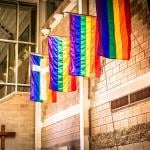
Photo: Christian LGBTQ pride flag with cross hanging in a Metropolitan Community Church by Ted Eytan – https://www.flickr.com/photos/taedc/31154894055/, CC BY-SA 2.0, https://commons.wikimedia.org/w/index.php?curid=58267844














 Ad-Free & Subscriber Log-In