

I’d like us to think about war. Let’s set aside for now the moral issues, requirements for a just war, the particulars of our current war in Iran, as important as those are. I’d like us to consider what a war can and cannot accomplish.
My questions arise from something that President Trump said: “I don’t think about American financial situation — I don’t think about anybody. I think about one thing: We cannot let Iran have a nuclear weapon.”
His answer may have been impolitic, but he states a worthy goal. It would indeed be terrible if Iran–an authoritarian state governed by Islamic extremists from an apocalyptic sect that glorifies martyrdom and promotes death to infidels–gets nuclear weapons.
But can a war prevent that from happening, at least in the long term? We can destroy labs, manufacturing facilities, and uranium stores, but those can be replaced.
We can’t prevent an Iranian engineer from figuring out how to make a nuclear weapon. Israel has reportedly assassinated a number of Iranian engineers to slow that process. But more will always arise, even if they keep quiet about it. And if they haven’t quite figured it out, they can always just ask AI how to make a nuclear weapon. (I know that the mainline AI companies have put in safeguards to prevent access to that kind of information, but other AI systems, including those built in China, don’t have those. And a freely-acquired software program has been developed to remove the safeguards from the mainline products.)
War can take over other countries or defend a country from takeover. War can subjugate a people and make them comply with the victors’ decrees. But it can’t change what is going on inside those people’s minds. It can’t change think how or what they think. It cannot change what they believe and what they know.
This principle was put forward by Martin Luther, no less, in his important treatise Temporal Authority: To What Extent It Should Be Obeyed:
The thoughts and inclinations of the soul can be known to no one but God. Therefore, it is futile and impossible to command or compel anyone by force to believe this or that. The matter must be approached in a different way. Force will not accomplish it.
Ideas can be changed only by persuasion. Religious beliefs can be changed only by conversion.
John Locke and other Enlightenment thinkers took Luther’s point about religious liberty and developed its broader implications for other human freedoms from government control, ideas that would profoundly influence the American founders.
Luther had in mind the Inquisitions of the Catholic Church and the Holy Roman Emperor’s project of trying to squelch the Reformation by laws, punishments, and executions. Locke had in mind the futility of religious wars, such as the Thirty Years’ War, in which the Emperor tried to eliminate the Lutherans and the Reformed by conquering their territories.
Today we think that religious wars are things of the past, though the wars in the Mideast are indeed religious wars as far as the jihadists are concerned. But, more broadly, most of our modern conflicts have been wars over ideology. These are little different from wars of religion. The wars between Western democracy and Fascism, Communism, and Jihadist Islam have all involved conflicts of ideas, of worldviews. To be sure, they also became fights for national and personal survival. But they were still ideological wars. Military victories were not enough. There needed to be a victory in the battle of ideas.
The Nazis conquered most of mainline Europe, putting into power native Fascist parties such as the French Vichy and the Norwegian Quislings and controlling the populations with brutal oppression. But their military occupation did not win over the hearts and minds of the populations they were controlling. Once Germany and Japan were defeated–a necessary first step–in the process of rebuilding, they learned the value of economic and political freedom and adopted Western-style democracy mostly of their own volition and remade themselves into capitalist power houses. They were, in effect, converted.
Communism, an ideology that professes liberation of the working classes, fared somewhat better, but in practice also descended into brutal oppression of those it professed to liberate. Western democracies worked to contain communism–again, a necessary effort–but communism collapsed due to its own economic and political failures. The Soviet Union came apart not because it was defeated militarily but because its people, including its leaders, stopped believing in the controlling ideology. They were, in effect, persuaded.
To be sure, both Fascism and Communism remain and are even having a resurgence today. Ideas cannot be eliminated by military power, even by killing everyone who holds them, since they can come back, often taking new forms, such as China’s hybrid brand of communism, which keeps the authoritarianism but adds enough free market economics to be successful.
The United States’ more recent wars have been especially frustrating. Conservative pundit Rich Lowry surveys America’s conflicts over the last seventy years and takes up the question of why “we win battles, but we lose war.”
While the current war with Iran is not like Vietnam, which involved thousands of U.S. troops on the ground fighting and dying, Lowry says that war had its lessons:
Vietnam demonstrated that military superiority doesn’t equal success, and neither does sheer ordnance or technical proficiency, especially in a limited war against a foe with a fanatical political will alien to American sensibilities.
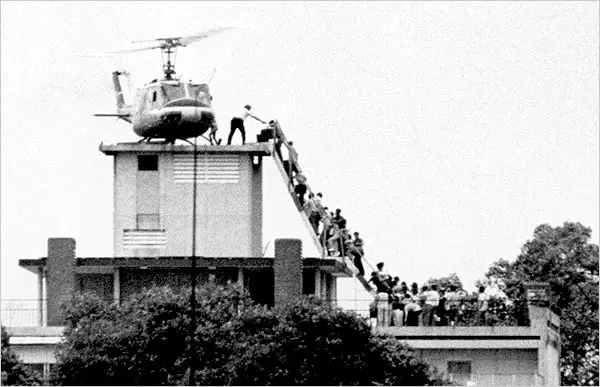
We “won” every battle in Vietnam with our overwhelming airpower, technological superiority, and military prowess. Yet we were eventually driven out, with our people hanging onto helicopters to escape the communist victors.
Lowry doesn’t get into our more recent wars in detail, but we can see something similar in our wars in Iraq and Afghanistan. Our military superiority led to quick takeovers of those countries. We assumed that our ideology of Western democracy would be gratefully embraced by the people we conquered. That didn’t happen. We sort of declared “mission accomplished” in Iraq and mostly pulled out without accomplishing our mission, while in Afghanistan we were reduced to hanging onto the helicopters again.
And that’s the way it’s going in Iran. Overwhelming military success! We’ve destroyed their navy! We’ve destroyed their missiles! We’ve destroyed their nuclear facilities! But Iran is not capitulating.
There is another problem with trying to change what people believe by war and coercion. Not only does that not usually change their minds, it usually reinforces the ideas you are trying to change! Punishing people for their thoughts makes those thoughts more attractive. And it breeds personal resistance to the ideology that the conquerors are trying to impose.
So how do we prevent Iran from ever developing nuclear weapons? Not by bombing them into the stone age and killing their children. That will make them want nuclear weapons. That will also make them want to use them. This is true especially in dealing with honor cultures like those of the Middle East, which tend to be fixated on revenge, often pursuing vendettas that last for generations and centuries.
Rather, we need to persuade them. During the Cold War, neither side resorted to using atomic weapons because of the threat of “mutually assured destruction.” That showed logical reasoning on both sides. That would be an example of persuasion.
Iran does not seem to be as amendable to reason. The Shi’ite sect of Islam glories in apocalyptic fire and revels in martyrdom. But perhaps in time the pendulum will swing the other way, with Iran adopting the more secular brand of Islam and the chance for the material prosperity that peace can bring. Perhaps they will grow tired of the rule of the Mullahs and overthrow them. There were signs that was starting to happen, with demonstrations against the Islamic theocracy just before the war, until the Islamic Guard slaughtered the protesters. But maybe the families of the victims will aim their revenge against their rulers who themselves have been trying to control what their people think. That could very well happen.
The other option is conversion. In Europe, Muslim refugees from Iran and other repressive countries, have been turning to Christianity in large numbers. Right now, though, Muslims call the Christians who are bombing them “Crusaders,” keeping alive that lust for vengeance that dates from the Middle Ages. We would do well to present Christianity as something different from what it was in those days and from the violent religion that they currently have and are suffering under. Namely, a religion of peace.
Photo: The Fall of Saigon by Hubert van Es (April 29, 1975), https://www.nytimes.com/2009/05/16/business/media/16vanes.html, Public Domain, https://commons.wikimedia.org/w/index.php?curid=190591880











 Ad-Free & Subscriber Log-In