


The sacrificial system of ancient Israel feels foreign to modern readers, reduced to simplistic transactions between an angry God and individual sinners. Yet this reductionist view misses the rich theological framework that ancient Israelites understood intuitively.
In chapter 2 of The Cross in Context, I explain how Israel’s tabernacle and temple functioned not merely as religious buildings, but as theological statements about God’s design for creation and the nature of atonement itself.
The Temple as Cosmic Throne Room
Biblical writers consistently portrayed the tabernacle and temple as God’s heavenly throne room on earth. Numerous scholars underscore this point.
The parallels between creation and temple construction are striking: both involve seven commands, both conclude with God’s “rest,” and both establish sacred space where the divine and human realms intersect. The Garden of Eden emerges as the world’s first temple, where humanity was commissioned to “work” and “keep” (the same Hebrew verbs describing priestly service) and expand God’s sacred presence throughout creation.
This temple-throne imagery permeates Scripture. The ark of the covenant serves not merely as a religious artifact but as God’s royal footstool, surrounded by cherubim who form his heavenly court. The high priest’s garments evoke royalty, complete with a crown-like turban inscribed “Holy to the Lord.” Even the mercy seat (kapporet) functions as God’s symbolic throne, the place where heaven and earth meet, where divine justice flows.
A Priestly Worldview of Purity and Honor
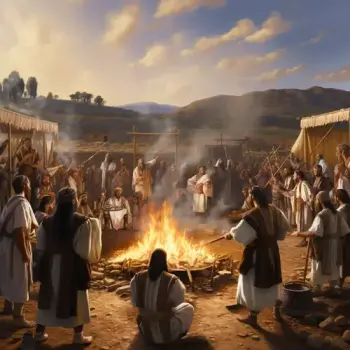
Ancient Israelites organized their world into four distinct categories that modern readers must grasp to understand atonement: holy versus common, and within the common realm, clean versus unclean. This isn’t merely about ritual observance; it’s about recognizing appropriate honor due to the divine King who dwells among his people.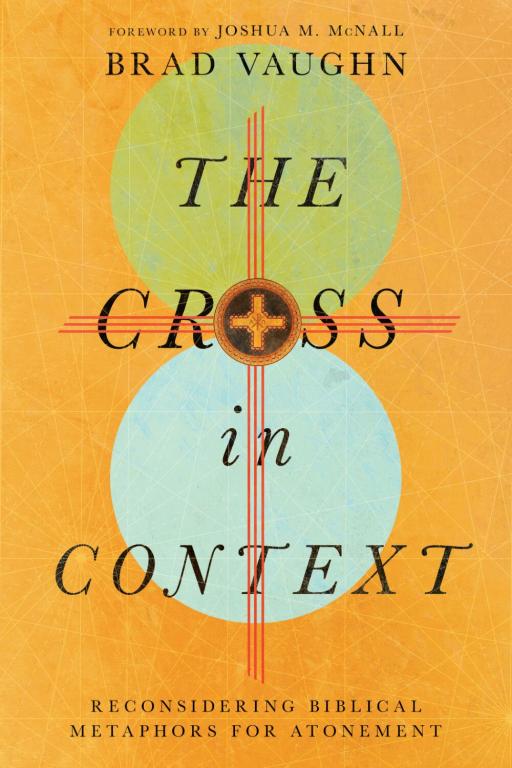
Holiness, I argue, fundamentally expresses unique honor. When something is set apart as holy, it receives distinctive worth and recognition.
The temple becomes holy not through inherent properties but through its relationship to God. Similarly, God’s people are called to holiness—not moral perfection per se, but a life that reflects the unique honor due to their divine King.
Impurity creates the central problem that atonement addresses. Importantly, becoming unclean isn’t necessarily sinful—natural processes like menstruation, childbirth, or touching a corpse can render someone unclean. The moral issue arises when people ignore their unclean state and approach God’s sacred space inappropriately, effectively treating the holy as common. This dishonors God and profanes his dwelling place.
Sin as Debt, Burden, and Relational Rupture
I identify three crucial metaphors that biblical writers use to describe sin’s effects: impurity, debt, and burden. Sin makes people unclean, creates an obligation toward God, and weighs on sinners like a heavy load. These aren’t merely colorful descriptions but reveal sin’s fundamental nature as relational rupture that dishonors God and separates people from his presence.
The debt metaphor proves particularly rich. People become debtors when they borrow, damage property, receive gifts that create reciprocal obligations, fail to meet relational responsibilities, or neglect duties to authorities. Applied to our relationship with God, sin creates genuine indebtedness that requires payment or forgiveness.
Implications for Understanding Atonement
This priestly worldview transforms how we understand atonement’s purpose. Rather than simply appeasing divine wrath, atonement restores the proper relationship between God and his people by addressing the honor-shame dynamics that sin disrupts. When Israel’s sacrificial system functions correctly, it publicly acknowledges God’s unique worth while providing means for cleansing and reconciliation.
My analysis reveals why God cares so deeply about seemingly minor ritual infractions. It’s not divine pickiness but royal protocol. When the sovereign Lord of the universe dwells among his people, appropriate honor and reverence become matters of life and death. Ignoring impurity or treating holy things as common effectively denies God’s kingship and invites the consequences of dishonoring the divine ruler.
Contemporary Significance?
For modern readers, this ancient worldview offers profound insights into human nature and divine grace. We instinctively understand sacred space (e.g., removing hats in memorial buildings, dressing appropriately for formal occasions, showing respect in courtrooms). The temple system amplifies these natural human intuitions and reveals their ultimate grounding in God’s character as the holy King who graciously dwells among his people.
Moreover, my emphasis on honor and shame resonates in global contexts where these dynamics remain central to daily life. Rather than forcing Western legal metaphors onto biblical texts, recognizing the honor-shame dimensions of atonement opens fresh possibilities for cross-cultural communication of the gospel.
The tabernacle and temple weren’t temporary accommodations pending something better. They were prophetic glimpses of God’s ultimate purpose to dwell with his people in a creation fully permeated by his glorious presence.
Understanding their theological significance prepares us to appreciate how Christ’s atoning work addresses not merely individual guilt but the cosmic problem of creation’s defilement and the restoration of divine honor throughout the earth.
This foundational framework proves essential for grasping the subsequent metaphors I explore: purification, burden-bearing, and economic compensation. Without understanding the priestly worldview that generated Israel’s sacrificial system, we can’t fully appreciate either the problem that atonement solves or the means by which Christ accomplishes our reconciliation with God.














 Ad-Free & Subscriber Log-In