


The Gospel
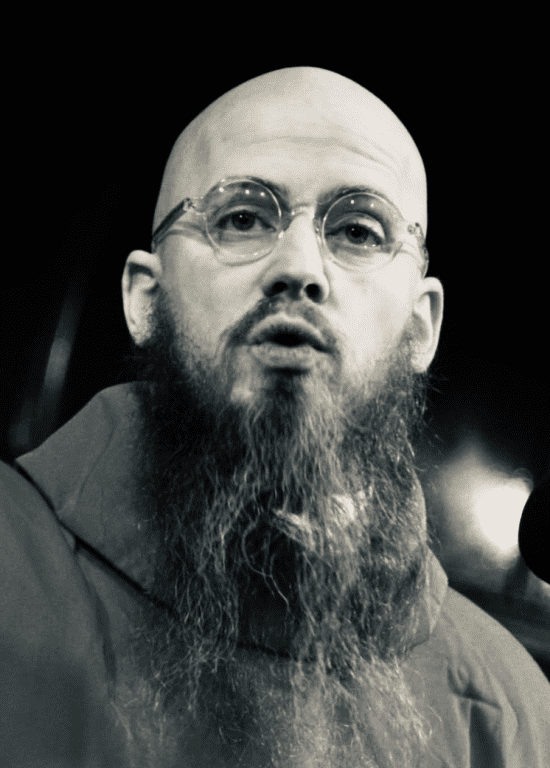
Father Mun Jeong Hyeon has lived what many priests only preached…a faith that left the sacristy and entered the streets.
“The only ones I give attention to are those who are suffering.”
That single sentence defines not just his ministry, but his theology. To attend to suffering was to attend to Christ himself.
Mun’s life revealed a conviction that God is not found in cathedrals of marble and incense, but among the wounded of history. His priesthood moved the altar to the streets…into places filled with tear gas, hunger strikes and the cries of the dispossessed. His courage was not an act of defiance alone…but a theological declaration…that resurrection must be lived out among the crucified.
In this, Mun stands in a lineage of the Korean minjung theologians who saw Christ as the suffering servant present in the people’s struggle. His faith was incarnational in the truest sense…God made flesh in the bodies of the beaten, the poor and the silenced.
The Gathering of the Wounded: Father Mun Jeong Hyeon and the Church of the Streets
During the dictatorship of the 1970s, when South Korea’s rulers demanded obedience and silence, Father Mun gathered courage into community. He helped to found the Catholic Priests’ Association for Justice, which transformed the priesthood from a hierarchical office into a revolutionary body.
“Let those who are hurting come together. Let us raise a voice, just once. That’s it.”
This was not merely a call to protest…it was ecclesiology incarnate. For Mun, the church begins wherever the wounded gather. Speaking out even once was a liturgy…truth telling was and is the Eucharist of the oppressed. His arrest in 1976 alongside future South Korean President Kim Dae-jung made visible his theology of solidarity…the priest does not stand above the people…but among them…sharing both their suffering and their struggle for liberation.
In this act of gathering, Mun enacted a radical Christology…a belief that the body of Christ expands through resistance. The Church was no longer defined by walls or institutions…but by communion in pain…by the shared breath of those who dared to cry out.
Defying Empire: Incarnation as Political Presence
As Korea’s internal dictatorships waned, Mun Jeong Hyeon turned his attention to the power that remained…empire itself. His defiance of U.S. military domination was not born of nationalism, but theology.
“Wherever there is pain, there God dwells.”
Here, Mun’s theology deepens into a kind of anti-imperial incarnation. To him, the presence of American bases, tanks and wire fences was a visible crucifixion…the suffering body of Korea under the weight of global power. His protests against Camp Humphreys and later the Jeju Naval Base were not mere politics…they were sacraments of resistance.
In standing before soldiers and bulldozers, Father Mun made visible what the Church often hides…that faith requires confrontation with empire. Just as Christ confronted the rulers of his time, Mun confronted the modern Caesars. Theologians of liberation speak of “the crucified peoples of history”…Mun stood among them…insisting that God’s incarnation continues wherever oppression takes flesh.
Father Mun Jeong Hyeon’s Theology of Suffering and Hope
For Father Mun, suffering was not to be spiritualized away. It was the raw material of grace.
“The Cross is not a symbol of pain but the place of love.”
His theology reflects the rhythms of han…the deep Korean word for collective sorrow and unresolved injustice. Mun did not seek to escape han…he entered it, prayed within it and transformed it. Like various mystics before him…he believed that the experience of abandonment could become the wellspring of compassion.
By embracing the Cross as love, he reinterpreted redemption not as escape from history, but as engagement with it. Salvation was not about saving souls from the world…it was about turning the world to God’s love and justice.
Jeju and the Sea of Witnesses: Father Mun Jeong Hyeon on Solidarity
In the 2010s, Father Mun moved to Gangjeong Village on Jeju Island, living among activists who opposed the naval base construction. Police beat him during a protest. When asked why he continued despite his age and injuries, he said…
“Peace comes only through suffering.”
This was not a masochistic belief, but an incarnational one. Peace is not achieved through agreement but through endurance…through the bearing of injustice until it breaks under the weight of compassion. His body, aged and wounded, became a living sermon.
Mun’s witness at Jeju parallels the prophets who bore the weight of their message physically. In him, theology and body became indistinguishable. His spine was the scroll upon which the Gospel was written anew.
The Gospel of Courage
In 2012, Father Mun received the Gwangju Prize for Human Rights, recognizing a lifetime of solidarity with the oppressed. But to reduce his legacy to awards is to miss his deeper challenge.
“I want to be with the defeated of history.”
This statement distills the heart of his theology. To be with the defeated is to reject the triumphalism of both Church and nation. It is to choose the path of Christ, who sided not with victors but with victims. Mun’s courage calls us not to admire him, but to follow him…to stand where he stood…with those the world crucifies again and again.
“All my life I have stood on the road, fighting for human rights and peace.”
In the end, his life is a revolutionary homily…that faith without resistance is empty, and that love without risk is no love at all.
References
Mun Jeong Hyeon, interview in Hankyoreh, 2003.
“Statement on Camp Humphreys Expansion,” Catholic Priests for Justice, 2005.
“Jeju Naval Base Protests: Interview with Fr. Mun,” KBS World News, 2012.
Mun Jeong Hyeon, Collected Sermons and Speeches (Seoul: Catholic Press, 2015).
Gwangju Prize for Human Rights Citation, 2012.
Mun Jeong Hyeon, opinion piece, Hankyore, 2025.








 Ad-Free & Subscriber Log-In