

[No Spoilers]
Last night I watched Wake Up Dead Man, the latest in the Knives Out series. Two of the leading characters are Catholic priests, and the murder takes place in their parish.
Furthermore, the plot is 100% centered around questions of faith — it’s not a generic mystery with Catholic-flavor settings, it’s a mystery that is built around Catholicism.
So viewers should reasonably wonder: How well did the film do on its portrayal of the Catholic faith?
UPDATE: Here’s a link to a great Twitter thread by Tim O’Neill that catches a few of the not-quite-Catholic moments that I missed.
Where’s the crucifix?
An intentional detail on the set created to portray the church interior is the absence of the crucifix behind the altar.
==> If you’re new to Catholic stuff, FYI a crucifix is a cross that has an image (sculpted, usually) of Christ crucified on it, rather than just a plain (empty) cross.
Real: You will see real, active, faithful Catholic parishes that don’t have a crucifix behind the altar.
Not real: But there will be a crucifix somewhere on display during Mass. Likewise, during the Veneration of the Cross on Good Friday, expect to see a crucifix, not a bare wooden cross.
However, as you’ll see at those two links, there are apparently instances in the wild where a crucifix is not used, hence the Q&A when Catholics don’t see one and are wondering what’s going on.
In the movie: There are plot-central artistic reasons for the absence of a crucifix. So while it is indeed quite wrong, it’s wrong in a way that is consistent with the overall arc of the story and characters therein.
Our Lady of Perpetual Fortitude?
I’ve never heard of this title for the Blessed Virgin Mary, and a quick search turned up nothing.
However, Catholics naming churches after freshly-invented titles for the Blessed Mother is not unknown.
Consider the parish name to be a signal of the intentional absurdity for the which the film’s franchise is famous.
“Absolution” at the end of Confession?
If you’ve been away from Church for a long time, you might be headed into the confessional as part of your return to the faith.
(Here’s a guide for how to prepare and what to expect.)
Real: Catholic priests take the sacrament of Confession seriously, and generally want to make the sacrament as available as possible. To abuse the sacrament for spurious purposes would indeed be a sign of very serious evil.
Not real: In the Confession scenes earlier in the film, we don’t see the words of absolution. This is not optional! It won’t be skipped. Just no.
In the movie: The first time the film skipped over the words of absolution, I assumed we were looking at condensed time. On a later instance, it seemed like the priest was just not giving it, which isn’t a thing.
On seeing the entire film, I see why, for artistic reasons, those earlier scenes skipped showing absolution — but I still maintain the filmmakers should have handled the earlier scenes in a way that didn’t seem like the priest characters were outright skipping essential parts of the sacrament.
Acting on information learned in Confession?
There are two points in the film when a priest does something outside the confessional after being prompted by information received during the sacrament. There is a third situation where others overhearing a confession may well have acted on that information, though that is not shown in the film.
There is also a scene where a priest’s expression on leaving the confessional gives some hint (though not expressly revealing any information) about the nature of the confession.
Real vs. Not Real: Here’s what canon law has to say about the sacramental seal (emphasis mine):
Can. 983 §1. The sacramental seal is inviolable; therefore it is absolutely forbidden for a confessor to betray in any way a penitent in words or in any manner and for any reason.
§2. The interpreter, if there is one, and all others who in any way have knowledge of sins from confession are also obliged to observe secrecy.
Can. 984 §1. A confessor is prohibited completely from using knowledge acquired from confession to the detriment of the penitent even when any danger of revelation is excluded.
§2. A person who has been placed in authority cannot use in any manner for external governance the knowledge about sins which he has received in confession at any time.
And from The Catechism (emphasis mine):
1467 Given the delicacy and greatness of this ministry and the respect due to persons, the Church declares that every priest who hears confessions is bound under very severe penalties to keep absolute secrecy regarding the sins that his penitents have confessed to him. He can make no use of knowledge that confession gives him about penitents’ lives. This secret, which admits of no exceptions, is called the “sacramental seal,” because what the penitent has made known to the priest remains “sealed” by the sacrament.
What to expect in real life: What you say in confession stays in confession. Expect your priest to keep a poker face on leaving the confessional.
If you want follow-up counseling on anything you mentioned in confession, you will have to explain it again in your counseling appointment, because your pastor won’t discuss anything unless it’s said outside the confessional.
Priests take seal of confession extremely seriously.
Psychopathic priests? Nutcase parishioners?
Amy Welborn’s review of the film (no spoilers) has a major complaint: The fire-and-brimstone priest and his tiny band of followers don’t fit with Catholic reality.
I agree, but would add: I haven’t found this type of clergy or congregation in the Evangelical world, either.
We Catholics absolutely have our share of criminals and nutcases, but the characters in the film are largely fanciful. It’s also highly unlikely that a bishop would have let this kind of ill behavior go on for so long.
==> Too public, too weird, too out of sync with the actual theological and spiritual rifts in the Church.
Of particular note: There’s a moment where something is called “Communion” that does not involve bread or wine. What is shown in the film and how it is described by the chief witness are extreme sacrilege. It’s just not at all what a Catholic would do or how a Catholic would view it, unless you’re absolutely unhinged from reality.
Consider the film to be using extreme hyperbole and artistic license in setting up the deeper point of the story.
Kind, pastoral priests?
The spirituality of the priest who is our lead character, in contrast, is centered on mercy, welcome, and reconciling sinners.
Is that real?
You betcha.
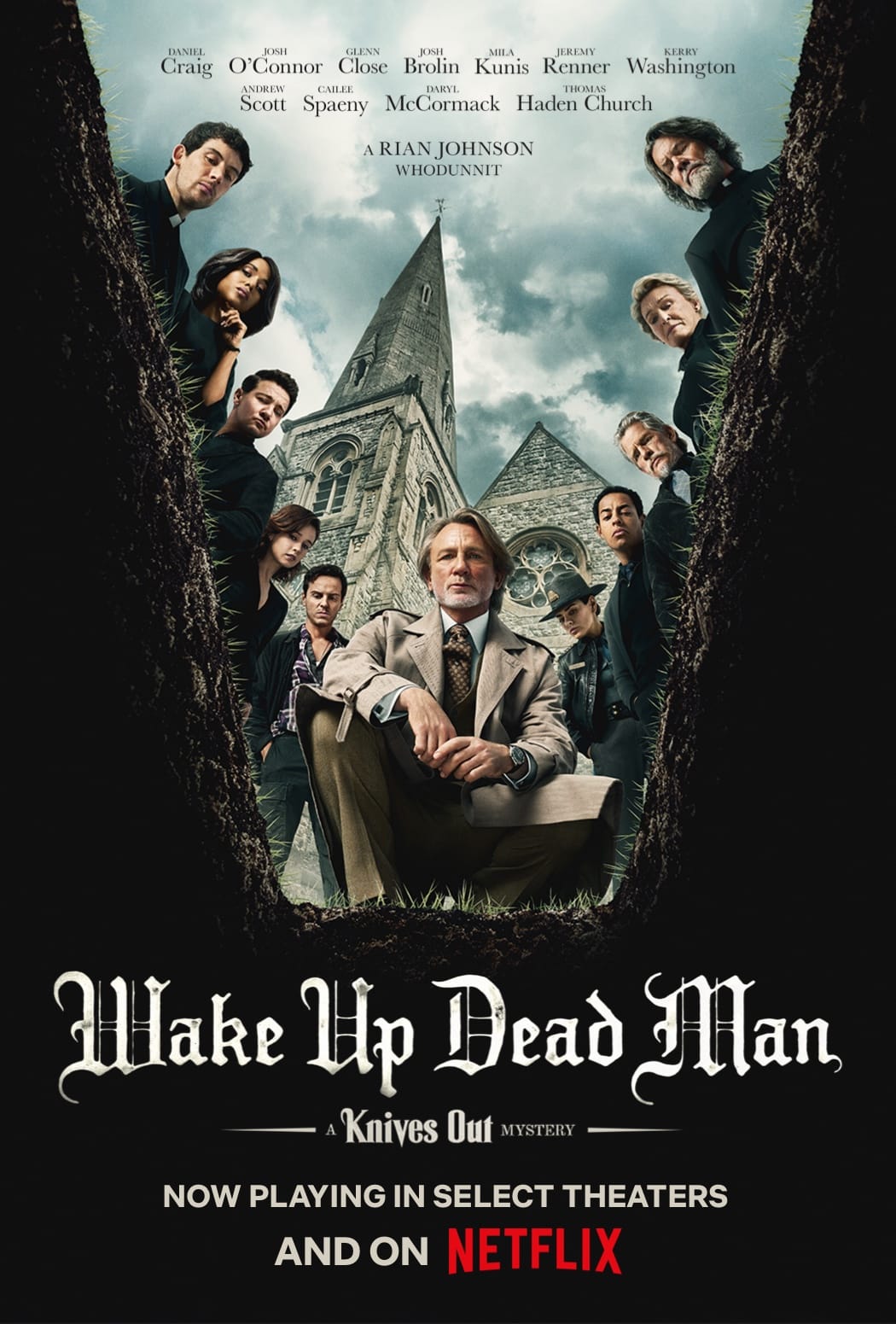
Artwork: Movie poster for Wake Up Dead Man, showing the cast peering into an open grave. FYI the film is not for young audiences. At all. No. No!! But if you like classic golden-era puzzle mysteries, this one is as convoluted as the best of them.











 Ad-Free & Subscriber Log-In