


I have been blogging about Roman Catholic Pope Leo XIV visiting Iznik (formerly Nicaea), Turkey, this weekend to celebrate the 1,700th anniversary of Nicene Council, what the Church calls the First Ecumenical Council. See my other posts here, and here, and here, and here.
The Nicene Council and Creed
Christian Roman Emperor Constantine called this council in the year 325. It was to become the most important theological council in the post-apostolic history of Christianity. Why? It produced a one-page document called the Nicene Creed which supposedly resolved a theological crisis. This document states that Jesus is “very God of very God,” which is to be understood as “truly God from truly God.”
Even though to this day the majority of Christians, thus not just Catholics, adhere to this understanding that Jesus is God just as much God the Father is God, it represents a blatant departure from the earlier Apostles’ Creed, which I believe gets it right about both God and Jesus. It begins, “I believe in God the Father almighty; and in Christ Jesus His only Son, our Lord.” Thereafter, it says no more about the identity of either God or Jesus. Obviously, it distinguishes between them as two beings. Thus, according to the Apostles’ Creed, only “God the Father almighty” is God.
This Nicene Council and its Creed were followed in the year 381 by the Council of Constantinople, called the Second Ecumenical Council. The first council had laid the groundwork for this council, where it was determined that God is three persons even though it did not use the later term “trinity” to further designate God. The reason was obvious, that many Christians objected to identifying God with such an unbiblical term.
The Catholic and Orthodox Church
The online Vatican News reports today that the Armenian Apostolic Patriarch of Constantinople, Sahak II Marshalian, said this weekend, “The effects of Nicaea,” referring to the Nicene Council, “never disappeared. It is a living fact among Catholic, Orthodox, and Protestant churches.” Yes, but being in the majority does not make it right. For example, Orthodox Judaism still says vehemently that Jesus of Nazareth was an apostate who tried to lead Israel astray.
Patriarch Sahak II envisions this celebration of the Nicene Council and its Creed could be a “turning point” for unity among Christians. He asked, “How can we be united?” He meant especially the resolving of a history of hostilities between the Roman Catholic Church and the Orthodox churches. He explained, “The old systems cannot be broken and made new.”
Jesus’ Teaching on Wineskins
Maybe Jesus’ parable of wineskins applies here. He said, “No one puts new wine into old wineskins; otherwise, the wine will burst the skins, and the wine is lost, and so are the skins; but one puts new wine into fresh wineskins” (Mark 2.22 NRSV). Jesus seems to apply this to the covenant instituted by Moses, which Christian often call “the old covenant” (thus Old Testament) and “the new covenant” predicted by the Jewish prophets and exemplified by the church (thus New Testament).
Maybe Jesus’ parable of the wineskins also applies to the understanding about Jesus’ identity. It does not seem the Catholic, Orthodox, and Protestant churches as they are now can be convinced that the Nicene Council got it wrong about Jesus being God, and the Constantinople Council got it wrong about God being three persons. Therefore, there needs to be new wineskins that represent a return to the apostolic faith of the Apostles’ Creed, which clearly established that God is a single person, whom Jesus called “Father,” and Jesus is no more than the Messiah of Israel, the Son of God. But Jesus as “the Son of God” is rightly understood relationally, so that Jesus is a man, though resurrection and now exalted in heaven, sitting beside God Almighty on his heavenly throne, awaiting his return to earth to fully establish his kingdom.
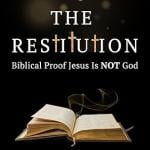
[To learn more about this author’s teaching on the identity of God and Jesus, see his book The Gospel Corrupted: When Jesus Was Made God (100 pp.), which is a primer for his in-depth book, The Restitution: Biblical Proof Jesus Is Not God (570 pp.).]










 Ad-Free & Subscriber Log-In