

Sabbath Dinner
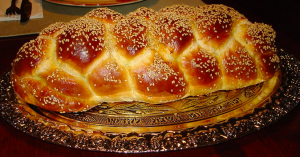
A loaf of challah with sesame seeds, part of
the standard fare for a modern sabbath
dinner. Photo by Aviv Hod, used under
a CC BY-SA 3.0 license (source).
This week’s Gospel passage shows us Jesus as a guest at a dinner being given by a fellow Pharisee. Odd though this would seem to us, these sorts of dinners were not private; at least, not altogether. To take a seat, dine, and contribute to the evening’s conversation—yes, that part would be by invitation! But to come in and listen to the conversation, which might be presumed to be very edifying (as it was being held by scholars and theologians), was, or could be, open to the community. As the sabbath was the greatest day of the week, it would naturally be honored with a special meal, at least on Friday evening—the most convenient time for it, since all the preparations required for such a meal would be on Friday, an ordinary work day. (Remember, the Biblical day is measured from sunset to sunset, not from dawn to dawn or midnight to midnight, as our folk and legal metrics go.)
Superfluous But Interesting Stuff
About the Origins of the Week
One thing I didn’t really get into in my series on sacred time was the relation of the week to the cycles of the moon; lunar cycles are obviously a principal element in the Hebrew methods of measuring time. The moon takes twenty-nine and a half days just about exactly to complete its cycle, new moon to new moon (or full to full if you prefer to think of it that way, but the Bible treats it as new to new). This means that the moon pass from new to first quarter in 7 3/8 days, from first quarter to full in the same amount of time, and so from full to last quarter and from last quarter to new. The Babylonians, whose months lasted twenty-nine or thirty days (alternating), observed the seventh, fourteenth, twenty-first, and twenty-eighth days of the month as holy days of ill omen,1 unsuitable for conducting business. Furthermore, the fifteenth of the month, which would nearly always be the day of the full moon or at most one day removed, was known in Babylonian as šapattu—a term glossed in a lexicography found in the library of Ashurbanipal2 as “day of heart’s-ease,” and thought to be related to the Sumerian word sa-bat, “mid-rest.”
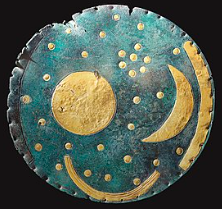
The Nebra sky disk (ca. 1800-1600 BCE), a
depiction of the sun or full moon, a waxing
crescent, the Pleiades, and other celestial
features, created by the Únětice culture.3
Now then! Here follow what our Lord did and said at this particular sabbath dinner. What he did, which is topically rather different (albeit a recurring subject in his ministry), is left out of the reading we hear at Mass; I have included it here in grey as usual.
Luke 14:1, 2-6, 7-14, RSV-CE
One sabbath when he went to dine at the house of a ruler who belonged to the Pharisees,a they were watching him. And behold, there was a man before him who had dropsy.b And Jesus spoke to the lawyers and Pharisees, saying, “Is it lawful to heal on the sabbath, or not?” But they were silent. Then he took him and healed him, and let him go. And he said to them, “Which of you, having an ass or an oxc that has fallen into a well, will not immediately pull him out on a sabbath day?” And they could not reply to this.
Now he told a parable to those who were invited, when he marked how they chose the places of honor, saying to them, “When you are invited by any one to a marriage feast, do not sit down in a place of honor, lest a more eminent man than you be invited by him; and he who invited you both will come, and say to you, ‘Give place to this man,’ and then you will begin with shamed to take the lowest place. But when you are invited, go and sit in the lowest place, so that when your host comes he may say to you, ‘Friend, go up higher’; then you will be honoredd in the presence of all who sit at table with you. For every one who exalts himself will be humbled, and he who humbles himself will be exalted.”
He said also to the man who had invited him, “When you give a dinner or a banquet,e do not invite your friends or your brothers or your kinsmen or rich neighbors, lest they also invite you in return, and you be repaid.f But when you give a feast, invite the poor, the maimed, the lame, the blind, and you will be blessed, because they cannot repay you. You will be repaid at the resurrection of the just.”
Luke 14:1, 2-6, 7-14, my translation
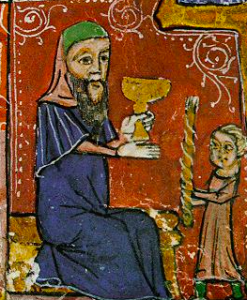
An illumination of the Havdalah (the closing
ceremony of the sabbath) from the Barcelona
Haggadah (mid-14th-c.)
And he happened one sabbath to come into the house of one of the princes of the Phariseesa to eat bread, and they were observing him. And look, a person with edemab was in front of him. And in response, Jesus said to the law-scholars and Pharisees, “Is it allowed on the sabbath to heal, or no?” But they were silent. So, taking hold of him, he healed him and let go of him. And he said to them: “Any of you, if his son, or his ox,c fell into a cistern, wouldn’t he too draw them up out straightaway on the sabbath day?” And they had no strength to answer back to these things.
He spoke by analogy to those who had been called, attending to how they were selecting the first seats for themselves; he said to them, “Whenever you are called by someone to a wedding, do not seat yourself in the first seat, lest a more honorable person than you has been called by him, and when he comes, [your host] calls you and tells you, ‘Give him this place,’ and then with shamed you will begin to keep the last place. But whenever you are called, make your way there and sit back in the last place, so that whenever he comes, he calls you and tells you, ‘Loved one, go up to a higher place’: then your gloryd will be in the presence of everyone dining with you. For everyone who lifts himself up will be brought low, and who lowers himself will be lifted up.”
He also said to the one who had called him, “Whenever you give a luncheon or a supper,e do not alert your loved ones or your brothers or your relatives or your rich neighbors, lest they likewise call you in return, and that become your recompense.f Rather, whenever you hold a reception, call beggars, cripples, the lame, the blind; and you will be happy, because they will not have a recompense for you; so you will be recompensed in the resurrection of the just.”
Textual Notes
a. a ruler who belonged to the Pharisees/one of the princes of the Pharisees | τῶν ἀρχόντων τῶν Φαρισαίων [tōn archontōn tōn Farisaiōn]: Archon, rather than “ruler” or “prince,” would be the loanword-as-translation approach here (i.e., the sort of approach we took in order to “translate” ἄγγελος [angelos] as “angel,” rather than rendering it “messenger” like sensible people). I’ve used prince in the vain hope that, by being vaguely similar in sound to “principle,” it comes as close as I can reasonably expect to hinting at the relation between the different senses of the word ἀρχὴ [archē] (“beginning, source, origin; cause; authority, rule, first place”).
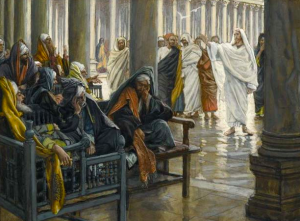
Woe Unto You, Scribes and Pharisees (ca. 1890),
by James Tissot. (The Scripture this references is
Matthew 23; it is—surprise—tough to find even
neutral depictions of Pharisees in Christian art.)
b. had dropsy/with edema | ὑδρωπικὸς [hüdrōpikos]: Edema, previously known as dropsy, is a buildup of fluid in the body, normally in the legs or arms. It is a side-effect of many underlying conditions, including problems with the heart, liver, kidneys, or lymphatic system (the lattermost being a key component of the body’s immune system).
c. an ass or an ox/his son, or his ox | υἱὸς ἢ βοῦς [huios ē bous]: Here we have a difference in preferred manuscripts. Some here read ὄνος [onos], meaning “ass” or “donkey,” rather than υἱὸς, “son.” It’s easy to see how the two words could get confused: ον and υι, if written hastily, could easily resemble each other, and the word is two syllables either way. The real question is, which reading is correct?
I find the reading “son” more credible, for two reasons. The first is that a scribe would be more likely to “correct” a manuscript to make it smoother rather than less smooth; remember, unlike modern errata (which are mostly mechanical and therefore nonsensical), scribal errors involved a human mind, and were therefore rational at least as often as not. For a scribe to see υἱὸς and think That can’t be right—he must have said ὄνος and the last copyist was no good is extremely natural; for a scribe to see ὄνος and think that that calls for correction here borders on the incomprehensible (though the change could still happen, via carelessness or bad handwriting).
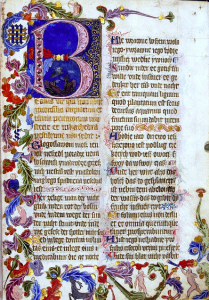
The other reason is rhetorical. We see repeatedly in the Gospels that Jesus is very fond of a fortiori reasoning, arguments of the form “If X is true in this greater case here, how much more will X be true in this lesser case there”—or, occasionally, the lesser first and then the greater. (This is a principle of midrash, or Judaic hermeneutics, which was already in use, known as קַל וָחֹמֶר [qal wâchomer] or “simple and complex”: judgment on halakhic matters might be determined by reasoning from a simple case or principle to a more complicated one, or by starting from something involved and extracting the relevant simplicity.) I think the way to understand what Jesus is saying in this verse is: “If any of you had a son, or even a mere ox, that fell into a cistern,” etc.; we are left to draw the obvious parallel to healing someone from a miserable and potentially life-threatening illness on the sabbath.
d. with shame … honored/with shame … glory | μετὰ αἰσχύνης … δόξα [meta aischünēs … doxa]: Ah, shame. Here, though it impinges only a little on the meaning of our text (social embarrassment is, after all, not relished in our culture either!), we draw near an element of propriety and ethics that is very different in our tradition. The world of the Bible was in this respect closer to, say, modern Chinese or Japanese society than our own: the critical social role of shame, and of its opposite, glory.
In anthropological terms, most societies fall into one of two moral groups, depending on which emotion is treated as the chief mechanism of enforcing its moral rules: the guilt group, sometimes called guilt/innocence societies, and the shame group, sometimes called honor/shame societies. Most Northern European cultures—which for these purposes includes the Anglophone world …

Northern Europe shown in green (actual size)
… are guilt/innocence societies. These tend to prompt their members to evaluate conduct according to its inherent quality as righteous or wicked. They prompt those unjustly accused to take refuge from shame in knowledge of their innocence, and tend to treat fidelity to individual conscience even in the teeth of others’ disagreement and disapproval as admirable.
Honor/shame societies, like those of ancient Judea or modern Arab nations, are quite different. In the main, they do not greatly differ from guilt/innocence societies about the content of right and wrong; the essential difference is that honor/shame societies prompt their members to evaluate conduct according to the image it projects, both of oneself and of one’s social group (of which, of course, we all have many: family, ethnicity, religion, class, favored mana color in Magic: The Gathering, etc.) This can produce clashes when people from an honor/shame culture interact with people from a guilt/innocence culture, but not necessarily clashes of the kind you’d expect; they tend to be clashes, not over right and wrong per se, but over propriety, or good manners—which are an extension of right and wrong, but an extension filtered through a given society’s collective “temperament,” pre-existing history, and current conditions.
For example, both honor/shame societies and guilt/innocence societies will tell you that it’s wrong to lie, while allowing that there is such a thing as a “polite untruth” (Miss Manners taught us that all brides are by definition beautiful); but the honor/shame society will probably classify a lot of things as polite untruths which, in a guilt/innocence society, would just be considered lies. A guilt/innocence society might expect an employee who sees a problem with a proposed plan from a manager to point this out, whereas an honor/shame culture might consider it a rule that an employee never contradicts a manager, and especially not to his or her face: that doesn’t necessarily mean that the employee’s insight can’t be conveyed at all, but it will probably mean, e.g., that the employee must approach some intermediary, describing an abstract problem with an idea that has obvious parallels to the manager’s plan, and trusting that the “question” will be passed along in good time.
That may all sound needlessly elaborate; in justice to the honor/shame cultures of the world, they would probably point out that our system is needlessly confrontational. Maybe they lose some time compared to us, but I dare say they spare a lot of feelings we brutalize in the name of efficiency.
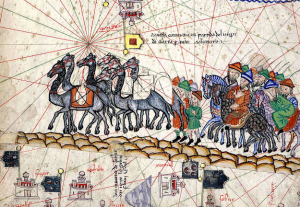
A late 14th-c. depiction of Marco Polo’s
caravan traveling to India from
a Catalan atlas.
In any event, that may go some way toward explaining why Jesus’ teaching in this passage is, superficially, given in the form of a piece of (very good) advice about etiquette; the Near and Far East are home to systems of courtesy so elaborate they would make Queen Victoria blench. But I say “superficially” there for a reason.
On the surface, Jesus is warning against committing a social faux pas that clashes hopelessly with the expected manners of an honor/shame society. If an honored guest has a right to the seat you’ve presumed to sit in, your host has no choice but to embarrass you (and you will be the obvious, public cause of the embarrassment, so really even your host’s discomfort rebounds on you to some degree4). An exceedingly modest choice, by contrast, procures you a positive honor, which your host gets the pleasure of conferring; everybody wins. But note what Jesus says you will have “in front of everyone.” The word used is δόξα, which certainly can mean honor, but it’s more usually translated glory—partly because the term τιμή [timē] is a more standard word for “honor, value, esteem.” Δόξα, though: that’s the kind of thing that God has; in the Septuagint, it’s the usual rendering of כָּבוֹד [kâvoudh], the word we usually translate “glory” in English. As evangelicals who’ve sat through any sermon on an Old Testament text from a recent seminary grad may know already, כָּבוֹד is derived from a Hebrew radical relating to weight—”gravitas” isn’t quite right as a translation, but it isn’t at all far, either. (Either that, or they know that חֶסֶד [chesedh] means God’s faithful love and that Tyndale or somebody like that coined the word lovingkindness for the express purpose of translating it.)
Take note also of the setting. This is about losing or gaining glory at a banquet; and in v. 8, the Lord specifically cites the example of a marriage supper. That is an image that recurs again and again in the New Testament. In my harebrained redesign of the New Testament, the book would very nearly open with the wedding feast at Cana in John 2; this creates a full-circle effect with the most famous instance of all, contained in the Apocalypse:
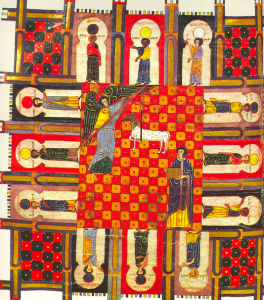
The New Jerusalem, illumination from the
Facundus manuscript of Beatus of
Liébana’s commentary on Revelation.
And I saw heaven opened, and behold a white horse; and he that sat upon him was called Faithful and True … And he hath on his vesture and on his thigh a name written, King Of Kings, And Lord Of Lords. And I saw an angel standing in the sun; and he cried with a loud voice, saying to all the fowls that fly in the midst of heaven, “Come and gather yourselves together unto the supper of the great God; that ye may eat the flesh of kings, and the flesh of captains, and the flesh of mighty men, and the flesh of horses, and of them that sit on them, and the flesh of all men, both free and bond, both small and great.” … And I John saw the holy city, new Jerusalem, coming down from God out of heaven, prepared as a bride adorned for her husband. … In the midst of the street of it, and on either side of the river, was there the tree of life, which bare twelve manner of fruits, and yielded her fruit every month … “I am Alpha and Omega, the beginning and the end, the first and the last. Blessed are they that do his commandments, that they may have right to the tree of life, and may enter in through the gates into the city.”
—Rev. 19:11, 16-18, 21:2, 22:2, 13-14
What, then, is this text in Luke really about? The same thing Jesus is always talking about: the kingdom of God. It is, in essence, another version of the text we heard last week about the last and the first.
e. a dinner or a banquet/a luncheon or a supper | ἄριστον ἢ δεῖπνον [ariston ē deipnon]: The first of these words, ἄριστον, was a vaguely-defined meal that might be eaten any time between mid-morning and a couple of hours past noon.5 Δεῖπνον, on the other hand, was the principal meal of the day; Jewish and Græco-Roman customs agreed in making this the evening meal, and it is usually translated “supper” or “dinner.”6
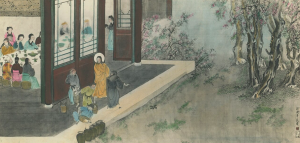
The Wedding at Cana (1937), by Xu Jihua.
f. and you be repaid/and that become your recompense | καὶ γένηται ἀνταπόδομά σοι [kai genētai antapodoma soi]: Besides the idea of “recompense” subtly evoking the Last Day, I wonder if there is another double meaning here. As I’ve alluded to a few times over the past year or two, the verb “to become” in Greek is sometimes used where English would employ “to be”; thus, the surface-level meaning of this passage is indeed “lest you be repaid.” But I see another possible way of taking the text, one that makes a comment on what is, sometimes, the fragility of human motives, their susceptibility to degradation under certain conditions. Of course, no initial motive for giving “a luncheon or a banquet” is stated in our text, but Christ makes it clear that a possible motive (presumably, a possible motive for this or any work of mercy) is that of “reward in the resurrection of the just.” Could he be highlighting how, if met too often by terrestrial rewards, it can be dreadfully easy to sink from the level of doing works of mercy to that of merely exchanging favors with people? In which case, getting a favor back has indeed “become your recompense,” in this life and the next—that is, in this life.
Footnotes
1“Holy day of ill omen” is a counter-intuitive phrase to us, which in some ways shows how colossal a difference has been made to our religious mind-scape by Abrahamic monotheism. (For any who have read C. S. Lewis’ magnificent Till We Have Faces, the house, priest, and service of Ungit are far more characteristic of the ancient meaning of the term “holy”; for any who have not, suffice it to point out that Hades, Persephone, Hecate, the Furies, and the Fates were every bit as “holy” as Zeus, Apollo, Helios, and the Muses.) The idea that the holy should in any way be presumed to be “on our side” is, at least arguably, an innovation of Judaism, developed by leaps and bounds in Christianity thanks to the doctrine of God’s Incarnation.
2Ashurbanipal (originally Aššur-bāni-apli, later Hellenized and then Latinized as Sardanapalus) was a king of the Neo-Assyrian Empire, reigning from 669 to 631 BCE. He was a highly literary ruler, and the library he constructed at Nineveh may have held as many as a hundred thousand books at its zenith, though at its excavation it held about thirty thousand. Ashurbanipal was also exceptionally cruel, even by Assyrian standards; he is held by many (though not all) Assyriologists to have been indirectly responsible for the collapse of the Neo-Assyrian Empire in 609, only twenty-two years after his death, and he certainly failed to retain Assyria’s hold on Egypt, which his father Esarhaddon had conquered just two years before Ashurbanipal’s succession to the throne.
3The Únětice culture (pronounced oo-neh-tee-chay) existed from around 2300 to 1600 BCE (roughly the period of the Middle Bronze Age in the Mediterranean), occupying roughly what is now the Czech Republic, northern Austria, eastern and central Germany, Silesia, western Slovakia, and some adjoining areas of Hungary and Poland. The Nebra sky disc employed both bronze smelting and gold-smithing, and some of its features seem to indicate that it was used to harmonize the solar and lunar cycles for the purpose of establishing a calendar (lunisolar calendars remain common in East, Central, and South Asia, and are known to have been in use in the Near East and by the Celts and Greeks in very ancient times).
4“You ruined everything, ruiner!”
5It was honestly a little hard not to translate this as “brunch.”
6“Dinner” has been the principal meal of the day in English for a long time—since before the Renaissance, which is (by some accounts) when the timing of dinner began incrementally to shift, from the midday meal it had traditionally been to one held in the mid-afternoon. By the close of the Victorian period, “dinner” had apparently migrated to the evening. “Supper,” on the other hand, was for a long time a very late, fairly light, “extra” meal, more like a final snack before bed (which makes little sense on our schedules, but is understandable if dinner is served at noon and you then don’t retire until after 10 p.m., as I gather Louis XIV’s schedule called for—as far as I can tell, this is just the sort of factoid that comes up anyway if you try to do a little bit of research into the history of mealtimes). As the chief meal moved later, supper as a distinct thing became even more superfluous than it had been anyway, and the two words, a little oddly, wound up merged in referent.










 Ad-Free & Subscriber Log-In