

Housekeeping
Much as I have done in the past, under the new translating-the-whole-New-Testament regime for the blog, I’ll offer a little bit of intro material up front (mostly just an on-ramp to the text itself). I’ll then offer two renderings of the passage in question: first, the Catholic Edition of the Revised Standard Version (RSV-CE), which is the “default” translation used by the Ordinariate of the Chair of Peter; and second, my own rendering. Following that will be textual notes, giving further information about particular words, phrases, etc. Finally, if it seems appropriate, I will include some material following the textual notes exploring ideas that did not fit neatly elsewhere, with footnotes (as needed) at the very bottom of the page.
Lest I be misunderstood either as having, or as claiming, an authority I do not possess:
…I am not a licensed professor of theology (just a guy who’s read a good amount of theology and church history).
…What I offer my readers has not been examined for, nor received, declarations of Nihil Obstat or Imprimatur.
…I have no advanced academic degrees—just a bachelor’s in Classics from College Park.
…I am not invested with Holy Orders.
I rely on the work of many scholars who are both my predecessors and my betters—especially the good people of the Society of Biblical Literature, whose verdict on the original Greek text I generally follow—in verifying, supplementing, and sourcing my understanding. I am a layman, with a bachelor’s degree in Classics, who strives for complete orthodoxy in everything he publishes.
PROTESTATION OF ORTHODOXY AND FILIAL SUBMISSION TO THE CHURCH
Since my conversion to the Catholic faith in 2008, to the best of my knowledge, I have never deviated theologically at any time from any part of the holy Catholic faith. If I have done so, anywhere or on any occasion, it has been unwitting and unintentional. Moreover, I submit all that I write, have written, and shall write to the judgment of the Catholic Church in communion with our Holy Father the Apostle Peter, his successor Pope Leo XIV, and their successors, the Bishops of Rome.
The Prologue, Part I (John 1:1-13)
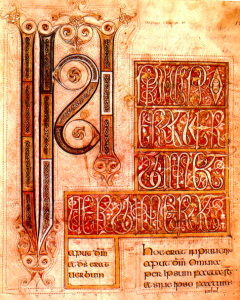
Incipit of John from the Barberini Gospels,
a Hiberno-Saxon illuminated evangeliary1
probably dating to the late 8th century, now
housed in the Vatican Library.
The Gospel of John opens with an evocation of the creation narrative at the start of the Torah, describing it in terms of a coöperation between God and a demiurgic Logos, a Hellenistic concept here adapted as representative of divine Wisdom. This Logos is stated to be at the same time the primordial light; a dichotomy is set up between this light and darkness—war is not (or not yet) indicated, but a separation is established.
Having started at the beginning of all stories, the author then moves to the beginning of the story of Jesus (that is, its beginning for most people)—i.e., the ministry of St. John the Baptist. He is defined as the herald of this Logos, which somehow enters creation. Paradoxically, though there is some particular part of creation that is specially his, the Logos goes unrecognized there; at the same time, there are evidently other parts of creation that do welcome him. Upon these other parts, he confers a strange gift, one far exceeding the promises of the Torah.
If you’d like to read the translation and notes on the second part of the Prologue (vv. 14-18), you’ll find that here.
John 1:1-13, RSV-CE
In the beginninga was the Word,b and the Word was with God, and the Word was God.c He was in the beginning with God; all things were made through him, and without him was not anything made that was made. In him was life, and the life was the light of men. The light shines in the darkness, and the darkness has not overcomed it.
There was a man sent from God, whose name was John. He came for testimony, to bear witness to the light, that all might believee through him. He was not the light,f but came to bear witness to the light.
The true light that enlightens every man was coming into the world.g He was in the world, and the world was made through him, yet the world knew him not. He came to his own home, and his own peopleh received him not. But to all who received him, who believed in his name, he gave poweri to become children of God; who were born, not of blood nor of the will of the flesh nor of the will of man,j but of God.
John 1:1-13, my translation
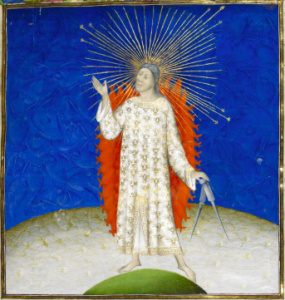
“The Creation” (ca. 1411), an illumination
from a copy of the Bible Historiale (a Medi-
eval translation of the Bible into French2).
In the beginninga was the Word,b and the Word was there with God, and the Word was God.c He was there in the beginning with God. Everything came to be through him, and apart from him not one thing came to be. What came to be in him was life, and this life was humans’ light; and the light appears in the darkness, and the darkness did not graspd it.
A person came to be sent from God: his name was Yochanan; he came as a witness, in order to witness about the light, in order that everyone might have faithe through him. This one was not the light,f but [was here] in order to witness about the light. The true light, which lights up every person, was coming into the world.
He was in the world,g and the world came to be through him, yet the world did not know him. He came to his own, and his own peopleh did not receive him. Such as did take him, he gave to them authorityi to become God’s children—to those that had faith in his name, who were not born from blood, nor from the flesh’s will, nor from a man’s will,j but from God’s.
Textual Notes
a. In the beginning | Ἐν ἀρχῇ [en archē]: In three cases—notes a, b, and j, on the words ἀρχή, λόγος, and ἐξουσία—I have settled on a translation that I’m dissatisfied with, but which seems like the least-bad choice I can find. To a degree, the same is true of notes c and e.
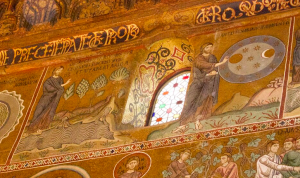
12th-c. mosaic in the Palatine Chapel of the
Norman Palace in Palermo, Italy, showing the
3rd and 4th Days of Creation. Photo by Colsu,
used via a CC BY-SA 4.0 license (source).
So. Ἀρχή is a difficult word, because it unites two threads of meaning that are both familiar in English, but which we don’t habitually refer to by means of a single term, with a couple of exceptions that, of course, don’t really work here. What it basically means is first. Not that it’s the ordinal number3 with that meaning, that’d be πρῶτος [prōtos]. Rather, in a set of things, the ἀρχή is “the first” of the set—maybe in the sense of being the earliest, or the original; maybe in the sense of being the supreme, or most important, or most illustrious member of the set. (The related verb ἄρχω [archō] means both “to start, begin” and also “to lead, rule, govern, command,” and its derived noun ἄρχων [archōn] is a term for a ruler or magistrate.) The double sense of the English word “priority,” logical versus chronological, is fairly close to the two strands of meaning in ἀρχή.
Given that this passage is both about the Creator and designed to echo the opening words of Genesis—concerned with one who is supremely illustrious, and set at the first momen of time—the possible double meaning is well suited to the text. It may easily be deliberate. In fact, the Septuagint’s Genesis 1 uses the words Ἐν ἀρχῇ to translate the Hebrew בְּרֵאשִׁית [b’rê’shyth]; this is unremarkable in itself, but what’s quite neat about it is that the word רֵאשִׁית—the initial בְּ is a preposition—is related to רֹאשׁ [ro’sh], as in Rosh ha-Shanah, “head of the year” or “first of the year.” The point is, this is a double meaning that wouldn’t get lost across the Semitic-Hellenic divide, either conceptually or linguistically.
b. Word | λόγος [logos]: Ah yes, the famous word; the Word.
The reason this rendering isn’t quite satisfactory is that, while λόγος was a standard term in contemporary Greek, it wasn’t really used with this meaning? It could, in theory, etymologically. It’s akin to the verb λέγω [legō], which means “to build things with small plastic bricks that really hurt your feet if “to say, speak.” But of course, in any language, certain words and phrases acquire set meanings that can be far more particular than their supposed semantic range; which is why you can ask someone to hand you your bank statement and they’ll do it without batting an eye, but if you ask them to hand you your bank utterance, eyes will assuredly be batted. (Or maybe “batten”?) So yes, you could use λόγος to mean “individual vocabulary item” in Koiné Greek, but in most cases you would sound like a maniac doing it.
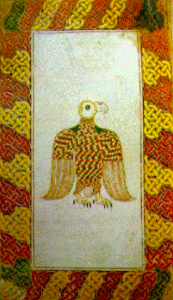
Ilumination of the Eagle as John’s symbol in
the Book of Durrow, a Hiberno-Saxon
evangeliary likely produced in Ireland, ca. 700.
What did they use it for, then? Well, the significance of λόγος gravitated toward something like the underlying idea that words express. All the following renderings can be defended in this context or that:
- thought
- idea
- message
- account
- reckoning
- reason
- cause
- argument
- speech
- saying
- proverb
Several of these meanings are not too far from one of the Hebrew words which λόγος is often called in to translate in the Septuagint, namely דָּבָר [dâvâr]; it so happens that the plural of דָּבָר is the Hebrew title for the book we refer to, in our Biblical Anglo-Greek, as Deuteronomy. Note how this hints that we are taking in the whole breadth of the Torah—from the beginning of creation (all of it “made by word” and beginning with light in both Genesis and John), to the fresh ratification of the Law immediately before Moses’ death. It should become clearer next week, when we reach the end of John’s prologue, why I find it faintly to echo this passage:
When ye heard the voice out of the midst of the darkness … ye came near unto me, even all the heads of your tribes …; and ye said, “Behold, the LORD our God hath shewed us his glory and his greatness, and we have heard his voice out of the midst of the fire: we have seen this day that God doth talk with man, and he liveth. Now therefore why should we die? for this great fire will consume us … For who is there of all flesh, that hath heard the voice of the living God …, as we have, and lived? Go thou near, and hear … and speak thou unto us all that the LORD our God shall speak unto thee; and we will hear it, and do it.”
And the LORD heard the voice of your words, when ye spake unto me; and the LORD said unto me, “I have heard the voice of the words of this people … they have well said all that they have spoken. O that there were such an heart in them, that they would fear me, and keep all my commandments always, that it might be well with them, and with their children for ever! Go say to them, ‘Get you into your tents again.’ But as for thee, stand thou here by me, and I will speak unto thee all the commandments … which thou shalt teach them, that they may do them in the land which I give them to possess it.”
—Deuteronomy 5:23-31
I discussed the philosophic background of λόγος a bit, back in §IIIc of the Outroduction. John is more famous for it than anyone else, but the idea appears elsewhere in the New Testament. St. Paul does not happen to use the term, yet his description of not only who but what Jesus is in Colossians 1 is a solid run-down of how some Hellenistic Jews would have conceived of the divine Λόγος.
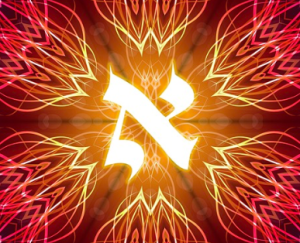
An artistic depiction of the letter ‘Aleph.
Image by Ben Burton (Pixabay user
BRBurton23), obtained via Pixabay.
Given the different meanings of λόγος among Platonists, Pythagoreans, Stoics, etc., a few versions of a Judaic “λόγος theology” would have been possible. For instance, the divine Λόγος might be merely a personification of God’s wisdom—an abstraction, not a distinct being. This wouldn’t have upset the personification. It was already generally agreed that there was some poetic license in descriptions of divine Wisdom: for one thing, she was usually a she, and, to borrow a line from Tony Kushner: “God is a man. Well, not a man, he’s a flaming Hebrew letter, but a male flaming Hebrew letter. The Aleph Glyph.”4 The New Testament doesn’t really dwell on this, and speaking of Wisdom in terms of the masculine λόγος rather than the feminine σοφία [sofia] sidesteps the topic in any case. That aside, Wisdom often describes herself (e.g. in Proverbs 8:22-30) as being “the first of God’s works,” etc.: if this were not poetic license, this would imply that before God “created” Wisdom, he lacked wisdom, which I’ll say with some confidence is probably not what the author of Proverbs had in mind!
Alternatively, one might view the Λόγος not as a mere allegory, but as a demiurgic spirit, similar in principle to the more exalted angels. Hellenistic and esoteric forms of Judaism often proposed intricate angelic hierarchies, and linking them both with the governance of creation and the giving of the Torah was commonplace in Judaism (hence, probably, St. Paul’s talk of Judaizing as “submitting to the weak and beggarly elements” in Galatians). The names tumble off the tongue like polished stones. Metatron, the Voice of God, sometimes held to be Enoch the Patriarch; Uriel, one of the Seven Seraphim, the guider of the arts; Kerubiel, the prince of the Cherubim; Sandalphon, seen as the protector of unborn children and occasionally identified with the Prophet Elijah; Gabriel, the angel most frequently associated with revelations and prophecies; Gabuthelon, one of the nine archons appointed to govern the earth for the end of the world; Raphael, patron of all healing and correction;5 and so forth.
The author of John does not pursue either of these. The direction he did go in is explored further in note c.
c. was with God, and the Word was God/was there with God, and the Word was God | ἦν πρὸς τὸν θεόν, καὶ θεὸς ἦν ὁ λόγος [ēn pros ton theon, kai theos ēn ho logos]: First of all: I think I can say without fear of contradiction that πρὸς is a really interesting word; it isn’t true, but I think I can say it without fear of contradiction.

John Tenniel’s illustration of the White Knight
(1871) for Through the Looking-glass: And
What Alice Found There, by Lewis Carroll. Note
the echoes of Dürer’s Ritter, Tod und Teufel.
Joking aside, this usage of πρὸς honestly is kind of interesting. It normally means “towards,” though—pace the titles of half of all dissertations for the last forty years—”towards” isn’t going to work if there’s no verb of motion. This preposition can also, more rarely, mean “against” or “at” (in the oppositional sense “at” sometimes carries); I almost went with “in the presence of” (but that would really call for a noun in the genitive). I did ultimately settle for “with,” though that more typically represents σύν [sün].6
Anyway, to pick up the thread from note b: our text chooses to describe the Logos very unusually. It is clearly a being unto Itself, in some sense genuinely distinct from the Father (and we’ll be getting extra cause to think this next week as well); otherwise it could scarcely be “with” him. Yet at the same time, “the Word was God.” The stern monotheism of the Tanakh, far from being downplayed or explained away by John, is deliberately evoked here, while the Logos is not only given godlike honor here, but actually identified as the Creator: in the more elegant English of the King James, “without him was not anything made that was made.” I wouldn’t call this a “proof-text” of the Trinity (I don’t think that’s a helpful way to approach the Bible), but I do think the only way of making sense of this paradox is going to be something very like the doctrine of the Trinity.
d. overcome/grasp | κατέλαβεν [katelaben]: “Apprehend” would also have been a decent rendering here, at least insofar as it captures both the “physical” and intellectual senses of this verb, καταλαμβάνω [katalambanō]. Its base meaning is “to take from, accept, receive,” consisting in κατά “down, down from, along” + λαμβάνω “to take, lay hold of.”
e. believe/have faith | πιστεύσωσιν [pisteusōsin]: The Greek noun πίστις [pistis], and words that derive from it, like the verb πιστεύω [pisteuō], can nearly always be translated as either “belief” or “trust.” I’ve settled on the religiously-tinged rendering “faith”—not without reluctance, as “belief” often captures the tone better in particular passages, and πίστις is by no means a specially religious term. However, “faith” is the only translation of the bunch that’s really capable of carrying both of the other two meanings, and which can also suggest the idea of loyalty (which isn’t a common meaning of πίστις in the New Testament but does occur here and there, and which I gather was more frequent in non-Biblical Greek).
f. He was not the light/This one was not the light | οὐκ ἦν ἐκεῖνος τὸ φῶς [ouk ēn ekeinos to fōs]: The evangelist begins to touch on the legacy of St. John the Baptist, which was hotly contested well into the first century. “Baptistine Judaism”—Judaism as practiced by those who followed the Baptist, but evidently did not move from that movement to the primitive Beyt Yeshua7 for whatever reason—apparently existed during St. Paul’s third missionary journey, because he catechized and baptized a clutch of them; so, as much as twenty-five or thirty years after their prophet was executed, and as far afield as Ephesus, disciples of the Baptist were still going strong, and were still distinguishable from Christians. Strictly speaking, the controversy over St. John the Baptist’s legacy has never entirely disappeared. The Mandæan religion of southern Iraq may really go all the way back to the first century, and even if it is younger, it’s probably not by much; and Mandæan theology advances an idea of John the Baptist—whom they consider their founder and greatest prophet—quite different from the Christian interpretation. In fact, Mandæans consider both Jesus and, more remotely, Abraham to have been Mandæan priests who turned apostate.8

The Hebrew text of Genesis 1 written on an egg,
at the Israel Museum in Jerusalem. Photo by
Wikimedia contributor Sputnikcccp, used via
a CC BY-SA 3.0 license (source).
g. world | κόσμον [kosmon]: There are a handful of terms in the New Testament that get translated “world”; κόσμος [kosmos] and αἰών [aiōn], because they can mean other things as well, are the two that tend to carry theological meaning (that is, when there is any theological meaning to carry—there may or may not be). The verb κοσμέω [kosmeō], which means “to set in order, arrange,” hints at the alternate meaning κόσμος can have: “order,” “system,” “law,” and even “government” or “ruler.” In the expression nōvus ordō sæclōrum or “new world order,” the latter two words could be expressed in Koiné Greek by the single word κόσμος, and the whole phrase as νέος [neos] κόσμος. Thus, we get a picture of the world as “the System” or “the Establishment,” which may often gel with what we mean by “the World” when we speak of the World, the Flesh, and the Devil.
However, a note of caution is called for here. Instinctive loathing for Systems and Establishments descends to our culture largely, if at significant removes, from the Romantics. Some Romantics were anti-establishment out of ego,9 while for others, there was a more serious, genuinely ethical concern in play—the reckless corruption of the environment with the waste products of mass-production, for instance, gave us Blake’s jab at “dark Satanic mills” in “Jerusalem.” The Romantics in turn form a quiet backdrop to the dystopian literature of the twentieth and twenty-first centuries,10 and it is this dystopian genre which probably influences our suspicion of Systems and Establishments most. The thing is, all of this lies downstream of certain developments in philosophy, political science, and technology that are extremely recent by historical standards. The resemblance between this and the apocalyptic outlook that formed the authors of the New Testament may be seen as a happy accident, but it’s important to recognize that it is an accident; our knee-jerk attitudes to ideas like “big government” or “success” or what have you will not necessarily be the same as what theirs would have been. We must be careful to take in what the text says—rather than what we expect it’ll say, what it’ll obviously say, what everyone says it says.
h. his own home … his own people/his own … his own people | τὰ ἴδια … οἱ ἴδιοι [ta idia … hoi idioi]: The feel of the Greek, thanks to its normative use of gender in adjectives, is a little subtler than is possible to the English. It simply says “[neut. pl.] his own … [masc. pl.] his own,” and the gender distinction is enough to establish a switch from things to people.
i. power/authority | ἐξουσίαν [exousian]: “Power” may be the better translation of ἐξουσία, considered in isolation. It derives from the defective and impersonal verb11 ἔξεστι [exesti], meaning “it is possible” or “it is permitted”; this word in turn is the preposition ἐκ/ἐξ [ek/ex] (“from” or “out of”), plus a form of the verb εἰμί [eimi], “to be.” However, Greek has a lot of words that can be translated “power”—κράτος [kratos], δύναμις [dünamis], ἰσχύς [ischüs], ἐνέργεια [energeia], βία [bia]. My approach to translation is, as far as possible, to establish complete equivalence between Greek words and English words, so that a given Greek word is always rendered by the same word in English, and the English word in question only represents that word in Greek. Of course, this is often just not possible if you want an English text you can actually read; many compromises have to be made. But I’ve been trying to reserve “power” as my translation of δύναμις, and compromise isn’t really necessary to this passage: “authority” is a perfectly good rendering of ἐξουσία. (My waffling here is, almost literally, that of a child moaning about the difference between She didn’t say we can’t do that, she said we’re not allowed to do that, it’s not the same!)

A “carpet page” illumination of a cross with
Hiberno-Saxon knot-work, in the Lichfield
Gospels (early-mid 8th-c.) Photo anonymous,
used via a CC BY-SA 3.0 license (source).
j. the will of the flesh … the will of man/the flesh’s will … a man’s will | θελήματος σαρκὸς … θελήματος ἀνδρὸς [thelēmatos sarkos … thelēmatos andros]: The NIV (which was quite popular with evangelicals when I was an adolescent in the late 1940s) does something that really bugs me here, but which is half-right: it renders these phrases “not of human decision or a husband’s will”. Now, selecting husband’s as a translation of ἀνδρὸς is perfectly defensible. I’d even argue that that sense is the most probable in this verse, since the word for “man” in the generic sense, which has already appeared in the prologue of John, is ἄνθρωπος [anthrōpos], and placing ἄνθρωπος and ἀνήρ [anēr] (the dictionary form of ἀνδρὸς) close to each other in one passage somewhat invites the reader to contrast the two terms. But translating θελήματος σαρκὸς, “of the will of the flesh,” as “of human decision” …? This I don’t like. I have an ingrained dislike of interpretation that presents itself as translation, and this has got that in spades; moreover, it relies on an opposition (between terms for “flesh” and “spirit,” σάρξ [sarx] and πνεῦμα [pneuma]) that our text is on the brink of exploding completely.
To proceed to the next section of this Gospel’s text (vv. 14-18), go here.
A Theological Postscript; or:
Charles Taze Russell Is Still Wrong, Doing Your Homework Is Still Right
The Watch Tower Bible and Tract Society, a.k.a. Jehovah’s Witnesses, have historically zeroed in on the wording of John 1:1—specifically, the lack of the definite article (“the,” ὁ in Greek) before θεὸς (“God”) in the phrase θεὸς ἦν ὁ λόγος, “the Word was God.” Though this isn’t usual in English, Greek normally does speak of “the God,” ὁ θεός; on the other hand, Greek lacks an indefinite article, the “a” or “an” of English. Therefore, Jehovah’s Witnesses assert, English translations ought to be inserting the indefinite article here: “the Word was a God.”
This is, first of all, a valuable lesson in why just using an interlinear12 is not the same as actually learning Ancient Greek. Foreign languages are not “English but with all the words replaced.” They have their own grammars and syntactic systems and histories, developing under pressures that usually have nothing to do with English. Yes, Greek and English do both have the definite article; and yes, Greek does lack the indefinite article. But it doesn’t follow that when translating a Greek text, you can just toss in an English indefinite article in front of any noun you please and get a proper translation. The rules for using the Greek definite article are very different from the rules that control its use in English, because—and I’m going to shock you here; take a minute if you need to—Koiné Greek and Modern English are different languages, as we say in the academic jargon of linguistics.
What’s actually going on is hinted at in the syntax. The canny reader may have noticed that, even though I said θεός means “God” and λόγος (sort of) means “Word”, I translated a phrase that goes “θεός … λόγος” as “the Word … God,” inverting the word order. This is because the form of English we speak nowadays is strongly reliant on word order to convey meaning. A certain amount of juggling, it’ll tolerate; but place can’t emphasis where for word you just any-any—ahem, excuse me: that is, you can’t place any word just anywhere for emphasis. However, Greek is much more inflected than English.13 This means the grammatical function of a word in a given sentence is part of that word’s spoken or written form—ὁ θεός shows the nominative case of this word (and of the masculine form of the article), used mostly when it’s the agent of a verb; meanwhile, τὸν θεόν displays the accusative case of the same words, a case used as the object of many prepositions. The upshot of this is that in Greek, you can play pretty freely with the word order without causing any confusion about the meaning. So if you want to move a word to the front for emphasis, you can. The sequence “God was the Word” emphasizes the deity of the Logos in the same way “red was the car” emphasizes the redness of the car (but with the advantage that the word order doesn’t sound wonky in Koiné).
Ironically enough, the point cited by Jehovah’s Witnesses—the absence of the definite article in front of θεός—speaks for, not against, the trinitarian reading. It suggests a total identification of God with the Word, because the article that would normally attach to a noun (like θεός) can get left out if that noun is in what’s called predicative position. This expression means that it’s the basic information being given about the subject of the sentence (as opposed to being extra information that isn’t central to the meaning of the sentence). In other words, the identity of God with the Logos is the point here, not only rhetorically, but even grammatically.
Footnotes
1An evangeliary is a book containing at least one, usually all four, of the canonical Gospels. (I suspect this word comes from the Middle English evaungel, rather than being a straight adaptation of the Latin evangelarium; were it from the Latin direct, we would instead expect *evangelary, with no ‘i.’)
2If you’re thinking Hey, how could they have a vernacular Bible in the Middle Ages if the Bible was on the Index of Forbidden Books?, the answer is that the Bible as such was never on the Index, which didn’t exist in the Middle Ages anyway. (The date given in Britannica for the first issuance of the Index Librōrum Prohibitōrum is 1559, well into any definition of the Renaissance.) Some specific translations of the Bible were placed on the Index, once it did come into being, yet even this was not as absolute as it probably sounds. The idea behind the Index Librōrum Prohibitōrum was as follows: All else being equal, you shouldn’t read books likely to damage your faith; since people err for all sorts of reasons, it’s easiest to just list books that contain ideas apt to endanger people’s faith, especially heresies, and tell people not to read stuff on that list. Note the phrasing, ideas apt to endanger people’s faith: this is not the same as “things the Church considers false.” It could cover speculations, or even confirmed truths, that are so complex or sensitive they’re prone to give scandal. (The insidious breadth of prone to give scandal may start to show why, even though I want what the Index was to be properly understood, nevertheless I am not hot on the concept, and am glad it’s been removed from the Church’s discipline.) Moreover, while the Index was a way of preventing the free exchange of ideas, people tend to have a very wrong idea of how it worked. It was a bit like the Restricted Section in the Hogwarts library: Harry, Ron, and Hermione couldn’t just assume they’d get to borrow any book they asked for, nor could they casually browse its shelves, but they could ask permission for something specific if it was relevant to a class, and a request made under those conditions would likely be allowed (especially as they got older). Educated Catholics could and did read books that were on the Index throughout its existence, from the mid-sixteenth to the mid-twentieth centuries. Even when they did so only for the purpose of penning rebuttals, still, you have to read a book before you can rebut it. (Except Jack Chick, God rest his loony little soul: he was allowed to not-read whatever he wanted, as long as we got those hilariously insane comic booklets out of it, which we did—and which, as I’ve just learnt to my absolute delight, the second sentence of his biography on Wikipedia chose to describe as “sequential-art morality plays.” Look at that phrase. She’s gorgeous the way she is, I don’t want her to change.)
3Don’t feel bad if you can’t remember which ones are ordinal numbers and which are cardinal—I have to look it up every time.
4This line comes from Perestroika, the second half of Kushner’s dramatic dyad Angels in America (the first half is Millennium Approaches). If you aren’t familiar with it and are thinking of checking it out, … adjectives fail me; just be aware, it is very much not a sincerely religious work in the tradition of Catholic orthodoxy!
5Gabriel, Raphael, and Uriel are traditional angelic names (the first two appear explicitly in the Catholic canon); Gabuthelon, Kerubiel, Metatron, and Sandalphon are less generally familiar, though thanks to a handful of literary appearances, Metatron, often the Metatron, is known to some extent outside Jewish and esoteric circles. (Some of these names are drawn from the “Greek Apocalypse of Ezra,” one of the approximately infinite number of books called “I/II/III/IV/V/VI Esdras.”) Typical pronunciations of these putative angelic names are: gā-brē-ĕł; rä-fā-ĕł; yü-rē-ĕł; gà-bû-thĕ-løn; kĕ-rû-bē-ĕł; mĕt-à-trøn; sän-däł-føn.
6This is where we get the prefix syn-. The word and prefix are cognate with the Latin cum and co-/con-, a fact highlighted by a Greek dialectal variant of σύν, the Old Attic form ξύν [xün]—which starts with a ks-sound, not a z-sound. (“Attic” here refers to Attica, the peninsula on which Athens is located: anything from Attica is “Attic.”)
7A בֵּית [bêyth]—an Aramaic word that literally means “house,” often borrowed (as beth, beit, or beyt) when used in this sense—was a Judaic school of interpretation and practice, addressing any disputed questions of doctrine or of ritual. A beyt was generally led by and named after the rabbi who founded it; I’m not clear whether normal practice was for this head to designate a successor of his choice, or whether it was expected to pass to his eldest son, or what. The two most prominent בָּתַּיָּא [bâtaiyâ’] (the plural form of the Aramaic) in Jesus’ time were Beyt Hillel, founded by Hillel the Elder, and Beyt Shammai, founded by Shammai the Elder: loosely speaking, Beyt Hillel was the relaxed, focus-on-the-point way of practicing the Torah, and Beyt Shammai was rigorist, don’t-omit-the-details approach. (R. Gamaliel I, the Gamaliel mentioned in Acts, was the grandson of Hillel.) “Beyt Yeshua” is my own (strictly imaginary!) coinage for what the followers of Jesus might have been called from the beginning of his public ministry until, say, the Council of Jerusalem, twenty to twenty-five years later.
8Their repudiation of Abraham as well as of Jesus makes Mandæism oddly difficult to describe. They are often classified as Gnostic (which, remember what I told you about that word: Off. Limits.); this is at least etymologically correct, as their name derives from מַנְדַּע [mandaṛ], a Syriac word for “knowledge,” and Gnostic ideas clearly circulated widely in the region till well after the rise of Islam, especially among Shia. The Mandæans seem to fit with other ethno-religious groups of the Near East—Alawites, Assyrians, Druze, Maronites, Samaritans, Yazidis, Zoroastrians—but while most of these are closely related to some Abrahamic faith, and the Mandæans do share doctrinal and ritual elements with Christians and Jews, calling them Abrahamic when they disown Abraham just seems off? Perhaps some new anthropological category is called for, like, I don’t know, NEMR for “Near-Eastern monolatrous religion.” Or some other phrase-and-acronym that’s like that, except good.
9Yes, Lord Byron, we are all looking at you, and no, it’s not out of admiration.
10This category includes: Aldous Huxley’s Brave New World, Sinclair Lewis’s It Can’t Happen Here, C. S. Lewis’s That Hideous Strength, Ray Bradbury’s Farenheit 451, Philip K. Dick’s Minority Report, Anthony Burgess’s A Clockwork Orange, Theodor S. Geisel’s “The Lorax,” Margaret Atwood’s The Handmaid’s Tale, and Madeleine L’Engle’s A Wrinkle in Time. That is all. There are no other dystopias, definitely not any other famous ones. (People often hold up George Orwell’s greatest work, Animal Farm, as a classic dystopia, but this is actually an example of the roman à clef or “novel with a key,” which is really just current and/or recent gossip with the names changed.)
11We have here two technical grammatical terms: defective and impersonal. 1. “Defective” means a verb that only has some of the grammatical forms we’d expect it to. These are rare in Modern English, since we make far fewer distinctions of form in verbs than we used to; if you’ve read some very archaic Early Modern English literature, you may have come across the word quoth (as in “quoth he”), which shows no forms except this one, a past-tense third person singular. (This word is, a little surprisingly, not an antiquated form of to quote—the closest surviving modern relative of quoth is, of all things, the word bequeath.) 2. As for “impersonal,” this means that it doesn’t (in any ordinary sense) have a subject: classic English impersonals are “it’s raining” and “it’s snowing.”
12In the strictest sense, an interlinear translation (usually of the Bible, or some other classical work composed in a foreign tongue) provides the original text, with the lines spaced widely enough for it to be accompanied by an English translation immediately below it, individual word by individual word. Interlinears are especially helpful for technical study of such texts at the grammatical level. The bilingual Loeb Classical Library—you know the little hardback ones, red for Latin and green for Greek?—does not technically consist in interlinears, since the text and translation are on opposite pages, but obviously the concept is similar.
13Indeed, you’ve probably heard that English is “an uninflected language,” which is at best a convenient, reckless lie. Middle English, and especially Anglo-Saxon or Old English, were certainly far more inflected than the English of today; but Modern English does have inflections. Our verbal system still relies on inflection quite a bit: both the –ed we use for the past tense of weak verbs, and the vowel change (or apophony) we employ for the same purpose in strong verbs (as in sing, sang, sung), are forms of inflection. Likewise, the plurals and possessives of all of our nouns are shown by inflection; and our personal pronouns are still built on the scaffolding of a three-case system, with distinct forms for nominative/subjective, accusative/objective, and genitive/possessive cases (though intrusions from Old Norse have given our pronouns a slightly confused appearance in a couple spots).









 Ad-Free & Subscriber Log-In