

Here beginneth WHITSUNTIDE, or the Octave of Pentecost
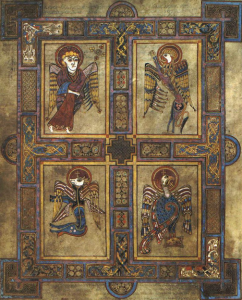
Folio 27v from the Book of Kells (c. 800),
an illuminated Irish evangeliary.
24. Whitsunday, or Pentecost
Here endeth the Paschal season, and continueth Whitsuntide
25. St. Bede the Venerable (673-735), OSB* | patron of English writers and historians
26. St. Philip Neri (1515-1595), CO* | founder of the Congregation of the Oratory, patron of comedians, artists, and writers
27. St. Austin of Canterbury (?-604), Apostle to the English | Ember Wednesday of Whitsun Week
29. Ember Friday of Whitsun Week
30. Ember Saturday of Whitsun Week
Here endeth Whitsuntide, and beginneth the First Part of TRINITYTIDE
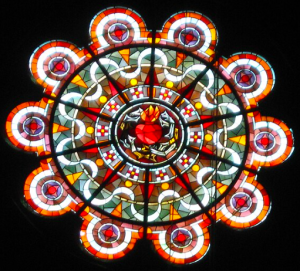
Stained glass depiction of the Sacred Heart of
Jesus from Sacré-Cœur Basilica in Paris.
Photo by Mylonas, used via a CC BY-SA 3.0
license (source).
31. Solemnity of the Most Holy Trinity (Feast of the Visitation of the Theotokos suppressed)
1 Jun. St. Justin (c. 100?-c. 165), Martyr | patron of apologists
2. SS. Marcellinus and Peter the Exorcist (?-304), Martyrs | martyrs of the Roman canon from the Great Persecution
3. SS. Charles Lwanga (1860-1886) and Companions, Martyrs | patrons of converts and of torture victims
5. St. Boniface (c. 675-754), OSB,* Bishop and Martyr, Apostle to the Germans
7. Solemnity of the Lord’s Body and Blood, or Corpus Christi
9. St. Columkil** (521-597), Abbot; St. Ephræm the Syrian (306-373), Deacon and Doctor of the Church | patron (Columkil) against floods; patron (Ephræm) of spiritual directors
11. St. Barnabas, Apostle and Martyr | patron of peacemaking and peace-keeping missions and against hailstorms
12. Solemnity of the Sacred Heart of Jesus
13. Immaculate Heart of Mary; St. Anthony of Lisbon (1195-1231), OFM,* Doctor | patron (Anthony) for travelers and lost items
14. Second Sunday after Trinity
20. St. Alban (?-c. 304?), Protomartyr of Britain | patron of Britain, converts, refugees, and torture victims
21. Third Sunday after Trinity
22. SS. John Fisher (1469-1535) and Thomas More (1478-1535), Martyrs | patrons of statesmen and lawyers (More) and of those imprisoned for their faith (both)
23. St. Audrey (636-679) and All Holy Nuns | patroness of throat complaints
24. Solemnity of the Nativity of St. John the Baptist
27. St. Cyril of Alexandria (376-444), Bishop and Doctor | opponent of the Nestorian heresy
28. Fourth Sunday after Trinity
29. Solemnity of SS. Peter and Paul | patrons (Peter) of fishermen, locksmiths, shipwrights, and shoemakers, and (Paul) of Gentiles, missionaries, and theologians
Here beginneth the Second Part of TRINITYTIDE
30. First Martyrs of the Church of Rome
1 Jul. St. Junípero Serra (1713-1784), SJ* | patron of vocations and California
3. St. Thomas, Apostle and Martyr | patron of doubters and skeptics, architects, and the peoples and countries of the Indian subcontinent
4. Independence Day
5. Fifth Sunday after Trinity
6. St. Maria Goretti (1890-1902), Virgin and Martyr | patroness for forgiveness
9. Our Lady of the Atonement | adaption of the Mother of Sorrows; associated with Anglican reconciliation to the Holy See
11. St. Benedict (480-547), OSB,* Abbot | patron against curses, gallstones, and poison, for cavers, civil engineers, and coppersmiths, and of Europe
12. Sixth Sunday after Trinity
14. St. Kateri Tekakwitha (1656-1680), Virgin | patroness for the Mohawk people, ecology, and exiles
15. St. Bonaventure (1221-1274), OFM,* Bishop and Doctor | “the Seraphic Doctor,” patron for bowel disorders
16. Our Lady of Mount Carmel | co-patroness (with Elijah the Prophet) of the Carmelite Orders
19. Seventh Sunday after Trinity
22. St. Mary Magdalene | Apostola Apostolorum (“Apostle to the Apostles”), patroness of people ridiculed for piety, penitents, hairdressers, and the contemplative life (including Magdalen College, Oxford and Magdalen College, Cambridge—both pronounced “maudlin”)
24. St. Charbel Makhlouf (1828-1898), OLM* | patron of Lebanon
25. St. James the Greater, Apostle and Martyr | patron of equestrians, veterinarians, pharmacists, woodcarvers, Seattle, Nicaragua, and Spain (especially Santiago de Compostela)
26. Eighth Sunday after Trinity
29. SS. Martha, Mary, and Lazarus | patroness (Martha) of cooks, servants, homemakers, and inn- and hotel-keepers; patroness (Mary) of lectors; patron (Lazarus) of lepers and beggars
31. St. Ignatius de Loyola (1491-1556), SJ* | founder of the Jesuits, patron of soldiers, spiritual retreats, the Archdiocese of Baltimore in Maryland, and the Basque province of Biscay
1 Aug. St. Alphonsus Liguori (1696-1787), CSsR* | founder of the Redemptorists, patron of confessors and moralists and for arthritis
2. Ninth Sunday after Trinity
4. St. John Vianney (1786-1859) | “the Curé d’Ars,” patron of parish priests and confessors
5. Dedication of St. Mary Major (434) | the first basilica in the West known to have been consecrated in honor of the Mother of God
6. Transfiguration of the Lord
*Religious order abbreviations:
CO: Congregation of the Oratory (Oratorian family)
CSsR: Redemptorists (Liguorian family)
OFM: Conventual Franciscans (Franciscan family)
OLM: Baladites (Maronite Rite)
OSB: Benedictines (Benedictine family)
SJ: Jesuits (Ignatian family)
**Or Columba; not to be confused with St. Columbanus (543-615), who is memorialized in November.
NOTES ON THE CALENDAR
I. The Anglican Use
This calendar follows that of the Ordinariate of the Chair of Peter, the US branch of what’s informally called the “Anglican Use.” An ordinariate is like a diocese, but its organizing principle is common heritage rather than geography alone. We have two sister Ordinariates, named for Our Lady of Walsingham (which serves the British Isles) and Our Lady of the Southern Cross (chiefly serving Australia). Ordinariate members are Catholics with an Anglican or Episcopal background, now in full communion with the Pope; however, we retain a ritual and spiritual inheritance from the Church of England, known as the “Anglican patrimony”—our cultural expression of the faith—which affects several aspects of our liturgy. On the calendar above and in the guide below:
- seasons (both formal and informal) are given in headings in red, or gold for Eastertide;
- Sundays, solemnities, and feasts are marked in boldface;
- customs and duties specific to the Anglican patrimony are in blue; and
- important American secular observances appear in green.
In the Anglican Use, Sundays outside Advent, Christmastide, Lent, and Eastertide are measured not according to Ordinary Time, but as they occur after Epiphany and after Trinity. This year, after Trinity Sunday (31st May), adding nine to the number of the Sunday after Trinity will give the equivalent Sunday in Ordinary Time: e.g., the Second Sunday after Trinity (14th June MMXXVI/2026) will be the Eleventh Sunday in Ordinary Time.
II. General Rules
Catholics normally must attend Mass on all Sundays and on all Holy Days of Obligation.* Many feasts in the Church’s calendar, including Easter and Pentecost, always fall on Sundays. Holy Days of Obligation are set by national bishops’ conferences, and are chosen from among the solemnities of the Church’s calendar, which may be tied either to the date of Easter or to a fixed date of a month. In the US, Holy Days of Obligation are as follows:
- The Immaculate Conception of the Mother of God, 8th Dec.
- The Nativity of the Lord, 25th Dec.
- The Solemnity of the Mother of God, 1st Jan.
- The Ascension of the Lord, ten days before Pentecost.**
- The Assumption of the Mother of God, 15th Aug.
- The Solemnity of All Hallows, 1st Nov.
Catholics must also do some form of penance on all Fridays of the year. In Lent and on the Ember Fridays of September and Advent, abstinence from meat (which for ritual purposes does not include fish or shellfish) is the obligatory form of Friday penance; at other times, the choice of penance is a matter of personal discretion, though abstinence is traditional. Further general information on the calendar can be found in this post; sections III and IV below explore the current and immediately approaching months and seasons (and are therefore often updated).
*This duty is waived for those with a serious reason to omit it, such as illness, lack of transport, etc. The duty to attend Mass on Holy Days of Obligation is usually waived for Catholics if the day falls on a Saturday or a Monday, so as not to overburden the faithful with two consecutive days on which they must attend Mass. However, in the US, Immaculate Conception and Christmas Day always carry the duty to attend Mass: the former honors our national patroness, and the latter is one of the three greatest feasts of the Church.
**This description reflects the traditional timing for Ascension, the fortieth day of Easter (always a Thursday). This date is usually kept in the Ordinariate, but in most US dioceses, Ascension is transferred to the following Sunday.
III. The Months: May and June
May might be named for the majōrēs, the venerated elders who were the forefathers of Roman society. In Catholic devotion, May is specially associated with the Mother of God, and “May crownings” of some treasured image of her are a frequent parish custom. Though overridden by Trinity Sunday this year, 31st May usually commemorates the Visitation, Mary’s visit to St. Elizabeth before and during the birth of St. John the Baptist. For Ordinariate Catholics in particular, it is the month of many of our majōrēs: the Reformation martyrs of England and Wales on the 4th; three bishops of the tenth-century English Benedictine Reform are honored together on the 19th, the most famous of the three being St. Dunstan; the eighth-century Northumbrian scholar St. Bede the Venerable is commemorated on the 25th; and on the 27th, we remember the saint who is for the English people what St. Patrick was for the Irish—St. Austin (or Augustine) of Canterbury, the first Catholic bishop of that see, sent to establish a mission among the Anglo-Saxons by Pope St. Gregory the Great.
June is believed to owe its name to the goddess Jūnō, the matron deity of ancient Rome; it may also, or instead, be named for the jūnōnēs, tutelary spirits who watched over women, equivalent to the geniī who guarded males. In the Catholic calendar, June is strongly associated with the Sacred Heart of Jesus, and with martyrs: three memorials of great martyrs finish the month, namely the Solemnity of the Nativity of the Baptist, the Solemnity of SS. Peter and Paul the Apostles, and the Memorial of the First Martyrs of Rome (which form a striking pendant to the first four days of Christmas, commemorating the Lord’s birth, St. Stephen Protomartyr, St. John the Evangelist, and the Holy Innocents).
IV. The Seasons: Eastertide, Whitsuntide, and Trinitytide
The fifty days of Easter are the most joyous of the Christian year. The colors most associated with Easter are gold and white. Its first forty days correspond to the time the Lord spent on earth following the Resurrection. At the close of these forty glorious days, he departed into heaven: this occasion, on which he both went up into heaven and proclaimed “Lo, I am with you always,” took place on a Thursday, the day of the week on which he instituted the Eucharist. The Ascension is typically transferred to the following Sunday in American dioceses; but there are exceptions, the Ordinariate included, that still keep Ascension Thursday. (For more harebrained theories about the symbolism of the days of the week, see these linked posts from my series on sacred time at the weekly level.) For nine days after that, the Mother of God, the Myrrh-bearers, and the Eleven Apostles continued to meet in the Upper Room where Christ and the Twelve had celebrated the Last Supper—a room often called the Cenacle in the West, from the Latin cēnāculum “dining room.” There, they awaited the promised gift of the Holy Ghost. These ten days form the second part of Easter. (The modern practice of the novena is a deliberate imitation of the Cenacle.)
On the tenth day, at midmorning, our Lord the Spirit descended on them, on the feast of Pentecost: thus the Church as we know it was born. Alongside Easter and Christmas, Pentecost is therefore one of the three most exalted feasts of the Christian year, and was once observed with an octave, i.e. with the subsequent week treated as if all its days were a single day. In 1969, the Octave of Pentecost was abolished; however, the Ordinariates typically (and with permission) maintain red vestments throughout the week following Pentecost, a sort of “soft octave.” This period is accordingly known as Whitsuntide—though the name contains an ironic anachronism: today, Pentecost is strongly associated with red, which symbolizes the flames that appeared over the heads of the Cenacle, but the name Whitsunday or Whit Sunday is held to derive from “White Sunday,” its principal color association in the influential Sarum Use of the Middle Ages.
Whitsuntide, or Whitsunweek, was also an Ember week in the Church’s earlier calendars. The Ember weeks were four weeks in the year, normally shortly before the solstices and equinoxes, of which the Wednesday, Friday, and Saturday were set aside for fasting, prayer, and the sacrament of penance. (In the English tradition, the Ember weeks specially recommended prayer for those preparing for ordination.)
At the close of Whitsuntide comes Trinity Sunday, which is our portal into the last grand cycle of the liturgical year. There are three such cycles. The first celebrates divine revelation reaching its climax in the Incarnation, centering upon Christmas and Epiphany. The second celebrates our redemption; this is the Paschal cycle. The third celebrates the most holy Trinity, to whom we are to be united in eternity, and this is defined by Trinity Sunday at its beginning and the Solemnity of Christ the King, an anticipation of the Parousia, at its end. Formally, the Trinity cycle is one continuous season—Trinitytide—representing its eternal character; informally, five subdivisions can be distinguished (Apostletide, Assumptiontide, St. Michael’s Lent, Hallowtide, and Doomtide), of which we shall speak more presently.


 Ad-Free & Subscriber Log-In