

You can find my two-part introduction to the Gospel of John at these two links, and my index/outline for it here; for the previous installment on John 7:1-31, go here. (My apologies for getting this out so late, and with no Patreon sponsor early version! I was without a working laptop charger for a couple of days, which set me back quite a bit work-wise.)
The Gospel of John: Sukkot, Part II (John 7:32-52)
The theme of Yeshua’s cross-examination again grows prominent: questions dart back and forth among the throng of worshipers, the Levitic nobility, the educated Pryshaya, and the templar police.
A point made in last week’s post, but there relegated to a footnote, is worth reiterating here. There are four plants prescribed for use in Sukkot by the Torah, and they grow in four distinct habitats in the Holy Land. They are: the אֶתְרוֹג [‘ethroug], or citron, a tree bearing a lemon-like fruit, which grows best on the coastal plains in the center-west of Canaan; the לוּלָב [lúlâv], or date palm, which thrives especially in the arid reaches of the south; the הֲדַס [hàdhas], or myrtle, which likes the east-central hills; and the עֲרָבָה.[3àrâvâh], or willow, found mostly in the cool, mountain-watered north. (The last three are bound together for use in the processions of Sukkot, and the three-in-one boughs that result are often known simply as lulavim, “palm branches”—in the case of the citron, a fruit rather than a branch was used, carried in the other hand.) Every worshiper needed to have all four to celebrate Sukkot appropriately, so they would have needed to gather extra of the species available to them and then trade their surplus for the other three species when they gathered in Yrushalem.
Most of note d is a complete digression, and is accordingly in small print for those who prefer to skip it.
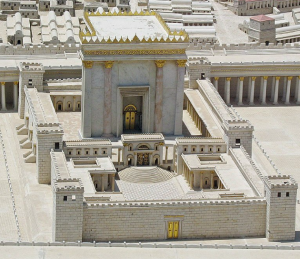
The Second Temple as represented in the
Holyland Model of Jerusalem (completed in 1966,
by Michael Avi-Yonah); photo by Ariely, used via
a CC BY-SA 3.0 license (source).
John 7:32-52, RSV-CE
The Pharisees heard the crowd thus muttering about him, and the chief priests and Pharisees sent officers to arrest him. Jesus then said, “I shall be with you a little longer, and then I go to him who sent me; you will seek me and you will not find me; where I am you cannot come.” The Jews said to one another, “Where does this man intend to go that we shall not find him? Does he intend to go to the Dispersion among the Greeksa and teach the Greeks? What does he mean by saying, ‘You will seek me and you will not find me,’ and, ‘Where I am you cannot come’?”
On the last day of the feast, the great day,b Jesus stood up and proclaimed, “If any one thirst, let him come to me and drink. He who believes in me, as the scripture has said, ‘Out of his heart shall flow rivers of living water.’”c Now this he said about the Spirit, which those who believed in him were to receive; for as yet the Spirit had not been given, because Jesus was not yet glorified.
When they heard these words, some of the people said, “This is really the prophet.” Others said, “This is the Christ.” But some said, “Is the Christ to come from Galilee? Has not the scripture said that the Christ is descended from David,d and comes from Bethlehem,d the village where David was?” So there was a division among the people over him. Some of them wanted to arrest him, but no one laid hands on him.
The officers then went back to the chief priests and Pharisees, who said to them, “Why did you not bring him?” The officers answered, “No man ever spoke like this man!” The Pharisees answered them, “Are you led astray, you also? Have any of the authorities or of the Pharisees believed in him? But this crowd, who do not know the law, are accursed.”e Nicodemus, who had gone to him before, and who was one of them, said to them, “Does our law judge a man without first giving him a hearing and learning what he does?” They replied, “Are you from Galilee too? Search and you will see that no prophet is to rise from Galilee.”f, g

Unripe dates growing on a date palm.
Photo by Mohamed Toorani, used via
a CC BY-SA 4.0 license (source).
John 7:32-52, my translation
The Pryshaya heard the crowd murmuring these things about him, and the high priests and Pryshaya sent subordinates in order to seize him.
Then Yeshua said: “A little time yet I am among you, and I depart to the [one who] dispatched me. You will search for me but not find, and where I am you cannot come.”
So the Jews said to each other, “Where is this man going to journey to that we will not find him? He is not going to journey into the dispersion of the Greeksa and teach the Greeks, [is he]? What is this word which he said: ‘You will search for me but not find, and where I am you cannot come’?”
On the last day, [which is] the great day of the feast,b Yeshua stood up and cried out, saying, “If anyone is thirsty, come to me, and if he has faith in me, drink. Just as the Writ says, rivers of living water will flow from inside him.”c (This he said about the Spirit which those who have faith in him were going to receive; but the Spirit was not [there] yet, because Yeshua was not yet glorified.)
Then those of the crowd who heard these words were saying, “This man is truly the prophet”; others were saying, “This is the Anointed”; but they were saying, “But the Anointed does not come from the Galilee? Doesn’t the Writ say that [he is] of the seed of Dawid,d and from the village of Beyt Lechem,d where Dawid was, comes the Anointed?” So there came to be a tear in the crowd because of him. Some wanted to seize him, but no one laid their hands on him.
Then the subordinates came to the high priests and Pryshaya, and they said to them: “Why did you not bring him?”
The subordinates responded, “No person ever spoke like him.”
So the Pryshaya responded, “You have not been led astray too, [have you]? Not a man of the princes or of the Pryshaya have had faith in him, [have they]? But this crowd, which do not know the Law, are damned.”e
Nikodemos says to them (who came to him before), being one of them: “Our Law does not judge a person except it first hears from him and knows what he does, [surely]?”
But they told him in response, “Are you not from the Galilee too? Investigate and see that no prophet arises from the Galilee.”f, g
Textual Notes
a. the Dispersion among the Greeks/the dispersion of the Greeks | τὴν διασπορὰν τῶν Ἑλλήνων [tēn diasporan tōn Hellēnōn]: The dispersion, or diaspora (a transliteration of the Greek), refers to the Jewish population that already lived outside Palestine, but especially—as the text indicates—those in the greater Mediterranean, whose native language was Greek. There were also Jews elsewhere, and had been for centuries. Bavel, known to us as Babylon, was at this time under the control of the Iranian Arsacid dynasty (better known as the Parthian Empire), and was a major center of Jewish life. Not all of the exiles had chosen to return to the Holy Land; indeed, by some lights, Bavel was a more important center of Jewry, from a purely cultural perspective, than was Yrushalem itself. There were also Jewish communities even further to the east, at least as far as Cochin (modern Kochi) in the south of India. Archæological evidence for the Jewish presence in the Horn of Africa goes further back than the destruction of the First Temple. This may lend color to the tradition that the Queen of Sheba,1 who famously visited Solomon, converted to Judaism: this could preserve, either literally or in simplified form, a real conversion or group of conversions.

Persian miniature (c. 1595) of the Queen
of Sheba.
But we are most concerned with the Roman-world diaspora. Mediterranean, Greek-speaking Jews, or “Hellenists,” were especially concentrated along the margins of the eastern Mediterranean and the Ægean, particularly in Anatolia. The city of Antioch,3 formerly the capital of the Seleucid Empire, had a Jewish quarter housing tens of thousands. There were also conspicuously large Jewish “colonies” in Alexandria and Rome. As long-time readers may recall, the Septuagint, the first complete Greek edition of the Tanakh (plus several “bonus” volumes) was originally produced in Alexandria.
b. On the last day of the feast, the great day/On the last day, [which is] the great day of the feast | Ἐν δὲ τῇ ἐσχάτῃ ἡμέρᾳ τῇ μεγάλῃ τῆς ἑορτῆς [en de tē eschatē hēmera tē megalē tēs heortēs]: There are basically two possible ways of reading this phrase. The first is that it might mean Shemini Atzeret (שְׁמִינִי עֲצֶרֶת [Sh’myny 3àtzereth], “[Day] Eight [of] Assembly”), a holiday held on 22nd Tishrei. This concludes Sukkot, and sort of both is and isn’t part of it; Shemini Atzeret is mentioned a couple of times in Leviticus, but they really are just passing mentions, with no explained significance within the text. Within the Holy Land,4 Shemini Atzeret is also the date of the celebration of Simchat Torah (שִׂמְחַת תּוֹרָה [Šim’chath Tourâh], “the joy of the Law” or “rejoicing in the Law”), another festive occasion, which at the time was when the triennial cycle of readings from the Torah concluded.
Alternatively, this could be in reference to the seventh day of Sukkot proper on 21st Tishrei. This day is known as Hoshana Rabbah (הוֹשַׁעְנָא רַבָּה [Housha3’nâ’ Rabâh], “Great Hosanna” or “Great Supplication”). On the first six days of Sukkot, worshipers partook in a single procession around the altar, carrying their citrons and lulavim; on Hoshana Rabbah, the procession instead made seven circuits around the altar. (After the destruction of the Second Temple, this custom was transferred to each synagogue’s bimah, i.e. the lectern from which Torah readings are intoned.) Today, Hoshana Rabbah is linked with the high holy days, Rosh ha-Shanah and Yom Kippur, on which God’s judgment of the earth for the preceding year is said to be decided. Unluckily, I wasn’t able to determine how far back this custom goes, so I don’t know whether it was already the case in the first century (though I get the impression that Hoshana Rabbah is a conservative holiday, so to speak).
c. If any one thirst, let him come to me and drink. He who believes in me, as the scripture has said, ‘Out of his heart shall flow rivers of living water.’/If anyone is thirsty, come to me, and if he has faith in me, drink. Just as the Writ says, rivers of living water will flow from inside him. | Ἐάν τις διψᾷ ἐρχέσθω πρός με καὶ πινέτω. ὁ πιστεύων εἰς ἐμέ, καθὼς εἶπεν ἡ γραφή, ποταμοὶ ἐκ τῆς κοιλίας αὐτοῦ ῥεύσουσιν ὕδατος ζῶντος. [ean tis dipsa erchesthō pros me kai pinetō. ho pisteuōn eis eme, kathōs eipen hē Grafē, potamoi ek tēs koilias auton rheusousin hüdatos zōntos.] -OR- Ἐάν τις διψᾷ ἐρχέσθω πρός με, καὶ πινέτω ὁ πιστεύων εἰς ἐμέ. καθὼς εἶπεν ἡ γραφή, ποταμοὶ ἐκ τῆς κοιλίας αὐτοῦ ῥεύσουσιν ὕδατος ζῶντος. [ean tis dipsa erchesthō pros me, kai pinetō ho pisteuōn eis eme. kathōs eipen hē Grafē, potamoi ek tēs koilias auton rheusousin hüdatos zōntos.]: There are two segments to this note: one (i) is textual and therefore translation-related, and the other (ii) is related only to translation.
i. We have two possible readings of the Greek here, due to some minor ambiguities about punctuation. Punctuation was not fully systematized in Classical Antiquity; even spacing between words lay hundreds of years in the future. Proto-versions of the comma, colon, and period did exist, they were more aids for the public reading or recitation of a text than punctuation in the modern sense, which frequently carries strictly grammatical functions.
An anonymously-written Russian ikon
(18th c.) of the prophet Ezekiel.
I have, hesitantly, chosen to differ with the Greek text adopted by the Society for Biblical Literature (my usual source), and also from the Nestle-Aland text that I have in hard copy. I think the punctuation I’ve adopted5 makes slightly better sense of the text—it gives it a psalm-like parallelism that’s very reminiscent of certain parts of his other discourses, like “he who comes to me will not be hungry, and he who has faith in me will never thirst,” or “My flesh is a true dinner, and my blood is a true drink.”
It also changes the suggestions that attach to the phrase about “rivers of living water.” In the RSV-CE, that is definitely about the believer, which reflects its take on the Greek correctly. In my version, the Greek is ambiguously capable of applying either to the believer or to Christ himself, so the English is too. It is much easier to see how it applies to Christ; to some commentators that would be reason enough to adopt it. I don’t take that view. I rather think the ambiguity is deliberate, and that this is foreshadowing the momentous assertion of 14:12. We have seen already, less than halfway through the book, how John’s style of introducing themes is very like Charles Williams’ description of Abraham’s prayer for Sodom in Genesis 18: it “dances and retreats and salaams and dances again,”6 weaving in and out like Celtic knot-work. There are a handful of other phrases that suggest an identity between what Yeshua does and what his students are doing or will do: the first and faintest (that I can think of) occurs in 4:35-38, and 6:5 can be read that way; I take 9:47 and 11:16 to be driving in the same direction more openly, and on the reading I’ve adopted, vv. 37-38 are part of the same increasingly explicit pattern.
ii. I also wanted to address what “the Writ” says, again in two ways: in terms of what the Lord is referencing, and in terms of one of the divergences between my rendering and the RSV’s.
The latter is easy to describe: although the RSV says heart, the term καρδία [kardia] is not in the Greek. The word it uses, rather, is κοιλία, which equates more with something like bowels or viscera (or, when used of women, womb). Now, I find the words bowels and viscera some of the most unattractive in the English language. I admit it isn’t specifically my aim to produce a euphonious translation; still, I’d prefer not to produce one that makes me faintly queasy if I can find a way around it that doesn’t stretch the linguistics too far! Besides, especially given the gender variability in the meaning of κοιλία, those two words aren’t very satisfactory, really. I eventually hit on insides, or some near-equivalent phrase that uses inside in its prepositional sense, as a better rendering.
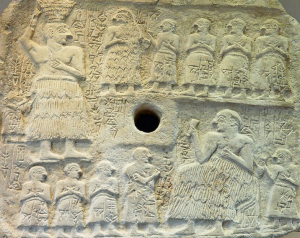
The relief of Ur-Nanshe (late 26th c. BC), with
the oldest extant reference to Dilmun yet
discovered (see the second paragraph below).
Photo by Marie-Lan Nguyen.
The reference is harder, for a slightly mystifying reason. There isn’t one. That is, there isn’t a word-for-word quotation—and expecting that, as opposed to a mere allusion, may be the answer. In other words, we created a problem that didn’t exist by asking what Christ was “quoting” when he wasn’t! This appears to be a paraphrase of something from the prophets, maybe even from multiple prophets. (A similar issue pops up about Matthew 27:9-10.) Ezekiel 47 is a possible allusion; there, the prophet describes a stream of water flowing out of the restored Temple of his vision and becoming a deep river that flows eastward “to the sea.” An even likelier referent, since this chapter mentions Sukkot explicitly in v. 16, is Zechariah 14. Zechariah is one of the most apocalyptic of the prophets, as much so as Ezekiel or the latter half of Daniel, and chapter 14 describes God intervening in Israel with a series of vivid images. He stands on Mount Olivet and causes the mountain to split in two, and his luminosity overwhelms the old cycle of day and night. Notably, v. 8 says that “living waters shall go out from Jerusalem; half of them toward the former sea, and half of them toward the hinder sea”—that is, both westward and eastward.
The sea to the west is the Mediterranean. That to the east, in both Ezekiel and Zechariah, might be the Dead Sea; however, I think it’s possible it actually refers to the Persian Gulf. Whichever of the two is meant, they both lead to the same place, i.e. the Indian Ocean. The Dead Sea of course does not flow into the Indian Ocean, but it still leads that way.7
The Persian Gulf has its own global importance now, but in the Ancient Near East—especially back in the Bronze Age, which was fabled antiquity even by the time Ezekiel was being composed—it was a place of considerable cultural and literary significance. Its coastline used to be quite different, even within the last few thousand years. Some modern commentators speculatively link the primordial Sumerian goddess Tiamat with the Persian Gulf. Be that as it may, the remains of some of the most ancient cities of Sumer now lie drowned beneath its waters; the land of Dilmun—a prosperous center of the copper trade, located somewhere between Mesopotamia and pre-Indo-Aryan India, but now known only from references in early Sumerian tablets—may have been located in what is now Bahrain. Some ruins there could plausibly belong to it; or, most or all of it may also lie underneath the inflow of the sea. But the point is, if the Persian Gulf is what these references mean by “the sea” to the east, it’s as romantic an allusion as the Mediterranean itself. We’re being given a picture of a triumphant messianic age in which the fresh water that flows from the fountain of the restored Temple encircles the world.
d. David … Bethlehem/Dawid … Beyt Lechem | Δαυὶδ … Βηθλέεμ [Dauid … Bēthleem]: My translation features my best attempts at readable transliterations of the Aramaic forms. The original Hebrew words were דּוֹד [Doudh], “Beloved,” and בֵּית לֶחֶם [Bêyth Lechem], “House of Bread.”
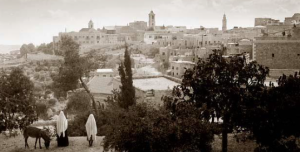
Bethlehem on Christmas Day in 1898
(photographer unknown).
Incidentally, it’s possible that David was not a personal but a regnal name. David’s confrontation with Goliath of Gath is his first claim to fame, yet II Samuel 21:19 attributes Goliath’s death to one “Elhanan the son of Jaare-oregim, the Bethlehemite.” This is rather puzzling, and has been for many centuries: the discrepancy was noticed at least since the first century, and probably far longer. At least two solutions are possible:
- David and Elhanan are the same person.
- The text of II Samuel 21 is corrupt.
I’m not normally big on textual-corruption explanations—I don’t consider them theologically impossible; they just strike me as terribly lazy (which ancient scribes were not)—but here, it may have some merit. The book of Samuel’s statement is almost repeated in I Chronicles 20:5, but there the text narrowly veers aside, making Elhanan the slayer of Goliath’s brother, a certain Lahmi, “whose spear staff was like a weaver’s beam.” Jaare-oregim is probably a clue: Chronicles makes Elhanan’s father’s name Yair (the older form of what in the New Testament becomes Jairus), and אֹרְגִים [‘or’ghym] means “weavers.” (The name Lahmi is proposed to be a textual corruption as well, derived perhaps from the second element of the adjacent word Bethlehem.) An Elhanan is listed among David’s band of warriors in II Samuel 23 and I Chronicles 11; however, that Elhanan’s father’s name is given as Dodo, so this may or may not be the same Elhanan.
On the other hand, we have the Targum Jonathan. A targum is a translation of part of the Hebrew Bible into Aramaic; these were plentiful during the Zugothic and Tannaitic periods of Judaism (though they were for the most part not written down until the latter), roughly from the mid-second century BC to the early third CE. The Targum Jonathan, which contains the Nevi’im,8 dates from around the time of Jesus. It takes the opposite interpretation, making Elhanan and David one and the same. This might strike modern readers as a stretch, but it really isn’t. Several figures in Israelite history bear multiple names—Abram/Abraham, Sarai/Sarah, Jacob/Israel, Gideon/Jerubbaal, Hadassah/Esther, Daniel/Belteshazzar—and the custom is not unknown in other places (Rome and Japan are both examples). In particular, regnal names are fairly common in monarchies, and a monarch’s personal name frequently differs from his regnal name, which is frequently taken in honor of some predecessor; sometimes there is even a rule, official or unofficial, that the monarch must take a different name on his accession, as with the papacy.9 This would seem to imply that Jesse, for whatever reason, also had more than one name—specifically, the name Yair. I don’t know of anything that would make this implausible, but in strict fairness, I also don’t know of any evidence specifically corroborating it.
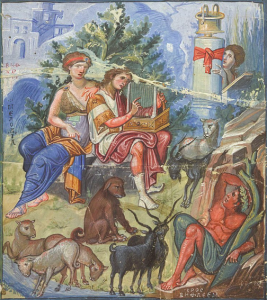
David Composing the Psalms (10th c.),
from the Paris Psalter.
e. accursed/damned | ἐπάρατοί [eparatoi]: This is a bizarrely harsh statement, and even one that’s specially ill-suited to the celebration of Sukkot. Today, there is a rabbinic interpretation10 of the four plants used for the festival that runs as follows:
- The citron tree bears fruit with a pleasant taste and has a pleasant scent, and thus symbolizes those who are both learned in the Torah and full of practical good works.
- The date palm bears fruit, but has no scent, and thus symbolizes those who study Torah but are not notable for good works.
- The myrtle, which has a pleasing scent but whose berries were not eaten by the Israelites, symbolizes those who observe the commandments but do not devote themselves to studying Torah.
- Finally, the willow has neither fruit nor scent: it stands for those with neither good works nor scholarship in the Law.
The idea, according to this interpretation, is that every Hebrew should, at different times or in different respects, be able to describe themselves as coming before God in all four ways—as one rich in both contemplative and active virtues, as one rich in contemplation with few good works of the active life, as one rich in action but poor in contemplation, and as one who has nothing and brings nothing. I don’t know exactly how far back this particular interpretation goes, but even if it wasn’t current in the first century, the clear (if implicit) lesson of Sukkot‘s four species, highlighted in this post’s introductory text, is that everyone is necessary and everyone is interdependent.
There was, it’s true, a difference between the “People of the Land” (the עַם הָאָרֶץ [3am hâ’âretz]) and the Jews who had returned from the Exile in Babylon and were punctilious about observing the Law. This comes up in the books of Ezra and Nehemiah, and this “People of the Land” group is not reducible to the Samaritans alone. See, the Babylonian Exile was probably not a deportation of the populace in general. The aristocratic and scribal classes of Judah were taken into exile by the Babylonians, these being the classes recognized as capable of providing leadership (in whatever sense—military, cultural, or political): commoners were almost certainly ignored. So the class divide between the Pryshaya and “this people” was not purely arbitrary, or purely economic or classist. The former had a background of religious education and practice in their families that commoners likely didn’t
Tel Megiddo, an archæological site in the
Jezreel Valley in northern Israel. Photo by
Carole Raddato (2014), used via
a CC BY-SA 2.0 license (source).
… but even so, going from that to “this crowd, which do not know the Law, are damned” is a bit much! The term ἐπάρατοί is derived from the verb καταράομαι [kataraomai], which is based on an intensified form of a word meaning “to curse”; according to Strong’s, this was not a word used for mere disfavor, but was used to indicate being cut off from God’s covenant, hence my translation. And anyway, if (if) they didn’t know the Law, whose fault was that? The Jewish Encyclopedia of 1906, in its article on the Pharisees, relates the following:
The Sadducees, jealously guarding the privileges and prerogatives established since the days of Solomon … insisted upon the literal observance of the Law; the Pharisees, on the other hand, claimed prophetic or Mosaic authority for their interpretation … With reference to Ex. 19:6, they maintained that “God gave all the people the heritage, the kingdom, the priesthood, and the holiness” (cf. II Macc. 2:17). As a matter of fact, the idea of the priestly sanctity of the whole people of Israel in many directions found its expression in the Mosaic law; as, for instance, when the precepts concerning unclean meat, intended originally for the priests only, were extended to the whole people; … The very institution of the synagogue for common worship and instruction was a Pharisaic declaration of the principle that the Torah is “the inheritance of the congregation of Jacob.” In establishing schools and synagogues everywhere and enjoining each father to see that his son was instructed in the Law, the Pharisees made the Torah a power for the education of the Jewish people all over the world …11
So on the one hand, if indeed this crowd which knoweth not the Law are accursed, then it sounds like that’s at least presumptively the fault of the Pryshaya themselves for failing to teach well. But hang on a minute. Dothn’t this crowd know the Law? They’re arguing over the Biblical qualifications of the Messiah with what sounds very like a confidence and fluidity born of long practice. That implies on the contrary that the synagogues and schools were doing quite a good job! To me, it seems at least possible that the author of John has here recorded a snobbish quip from one of the shallower sorts of Prysha (whom works like the Mishnah and the Pirqey ‘Avoth recognize and, like Yeshua, warn against), who perhaps dropped this without thinking it out enough to realize that it was either self-defeating or a discredit to his own side.
A page from a copy of a motet (13th or 14th c.),
Alle Psallite Cum Luya, an elaboration of
the Alleluia.
f. Nicodemus, who had gone to him before, and who was one of them, said to them, “Does our law judge a man without first giving him a hearing and learning what he does?” They replied, “Are you from Galilee too? Search and you will see that no prophet is to rise from Galilee.”/Nikodemos says to them (who came to him before), being one of them: “Our Law does not judge a person except it first hears from him and knows what he does, [surely]?” But they told him in response, “Are you not from the Galilee too? Investigate and see that no prophet arises from the Galilee.” | λέγει Νικόδημος πρὸς αὐτούς, ὁ ἐλθὼν πρὸς αὐτὸν πρότερον, εἷς ὢν ἐξ αὐτῶν· Μὴ ὁ νόμος ἡμῶν κρίνει τὸν ἄνθρωπον ἐὰν μὴ ἀκούσῃ πρῶτον παρ’ αὐτοῦ καὶ γνῷ τί ποιεῖ; ἀπεκρίθησαν καὶ εἶπαν αὐτῷ· Μὴ καὶ σὺ ἐκ τῆς Γαλιλαίας εἶ; ἐραύνησον καὶ ἴδε ὅτι ἐκ τῆς Γαλιλαίας προφήτης οὐκ ἐγείρεται. [legei Nikodēmos pros autous, ho elthōn pros auton proteron, heis ōn ex autōn: Mē ho nomos hēmōn krinei ton anthrōpon ean mē akousē prōton par’ autou kai gnō ti poiei? apekrithēsan kai eipan autō: Mē kai sü ek tēs Galilaias ei? eraunēson kai ide hoti ek tēs Galilaias profētēs ouk egeiretai]: This exchange is, first of all, very funny, and I want to pause briefly on that quality. Humor is to be found all over the New Testament, but is especially richly present in the Gospels; and it is widely, routinely ignored in both study and discussion of them. As far back as I can recall, I’ve been baffled by this. Do people not see the jokes? Do they not think they’re funny? (Humor is notoriously subjective, but I think trying to maintain that the Incarnate Logos can’t tell a good joke may be the single instance of a subjective opinion which is factually wrong.) Do they think “being funny” is in some way incompatible with the subject matter of the Bible?—which, if that’s the objection, it’s one of the worst and stupidest approaches to Scripture I’ve ever heard.
Now, I want to clarify something. There are people who will take “one of the worst I’ve ever heard” as a joke: i.e., a thing I said to try and make people laugh. It is.
However. There are a very large number of people who think they agreed with that last sentence, yet who take those same words differently. Specifically, when they say “joke,” they take it to mean a thing I DON’T SINCERELY MEAN but still said, merely to try and make people laugh. This is absolutely not that.
The inane phrase “I was only joking”—as though truth and degree of humor bore any relationship to each other at all—is partly to blame here; perhaps also the plain fact that it’s difficult to make a good joke, and most of us are therefore apt to seize and tell any jokes at all that come to us even if we don’t think they’re true, or to fall back on nonsensical humor, or both. In any case, the joke amounts almost to an irrealis mood in English through mere force of association, but the association is worth guarding our minds against; it warps our idea of truth.12 Chesterton got it the right way around, in Heretics I think: “Funny is the opposite of not funny, and of nothing else.” I will therefore repeat myself, hoping to drive the point home. The notion that being funny is somehow an inherently irreverent or profane13 quality, or that it is otherwise unworthy of Scripture, is a bad, foolish way to see the Bible. There is no contradiction between making a person smile or laugh and telling them the truth. Why on earth would there be?
View of the Kidron Valley from the Old City
of Jerusalem. Photo taken in 2007
by Mark A. Wilson.
Alright, I’ve explained not what the but what a joke is, so let’s now get back down to the joke! As mentioned above, chapter 7 ramps up the “cross-examination” element of the grand trial motif that suffuses this Gospel; both here in our text and surrounding it, we have much back and forth, many views of Yeshua vying with each other, a sense of voices overlapping one another in argument. Immediately after what sounds like a shockingly uncalled-for remark about the crowd at large, Nikodemos reënters the narrative.
Readers may recall that Nikodemos’ departure from the narrative left him in an ambiguous relationship to Yeshua. We don’t necessarily know what to expect from him—though, considering the setbacks the Lord has been having throughout this chapter and the two before it, we’re primed to expect the worst.
Yet what he does is break in to point out that this cross-examination is not being conducted fairly. Curiously, he advances no specific mitzva in support of his question, not even a weirdly-chosen one like St. Paul’s in I Cor. 9:9; his appeal is to omit something the Torah omits, so to speak—perhaps this is an echo of 5:39 and 45-47. Once again we have a foreshadowing of similar events, in this case irregular proceedings and a deliberate exclusion of sympathizers from the trials related in John 18 and in the parallel accounts in Matthew 26, Mark 14, and Luke 22. These trials were held at night, which was not usual—and John clarifies that there were in fact two: one conducted by the previous high priest, Chanan ben Set (a name Hellenized as Annas), and one by the regnant high priest, Yousef ben Qayafah (Caiaphas). Given it was reportedly the middle of the night, the idea that the entire seventy-one person Sanhedrin was summoned, and assembled, is rather unlikely in the first place. Furthermore, we know from the Gospels and the book of Acts that the proto-Church had sympathizers sitting on the Sanhedrin from the start; they probably weren’t wanted at this sort of proceeding. I think it’s accordingly a safe conjecture that a reduced Sanhedrin of twenty-three—which was a recognized “lower court,” but was supposed to be restricted from issuing verdicts on capital cases—was invited to these trials. Perhaps they held two trials of Christ instead of one to satisfy themselves that, even if they were cutting corners procedurally, they were “still being fair.”
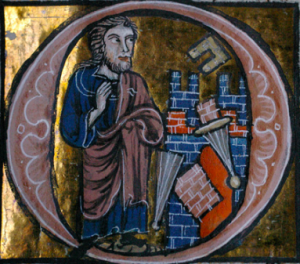
Illuminated capital (c. 1220) showing the
prophet Nahum witnessing Nineveh’s
destruction, from a Bible preserved in the
National Library of Portugal.
The prompt and comparatively lame riposte of the other Pryshaya to Nikodemos is also funny, unintentionally. Prophets, up to and including those whose writings formed part of the Tanakh, did indeed hail from the Galilee; in fact, though now lost, the tribe of Issachar were reputed to be specially intelligent about the Torah, and their ancestral lands lay in the Galilee. Hilariously, Yeshua’s own “HQ” was set up in a town named after one of the Galilean prophets: K’far-Nachum, or “Capernaum,” means “village of Nahum”!
g. — | — [—]: This note is not about what’s here, but what’s been left out, which your Bible might contain: specifically, the verses enumerated as John 7:53-8:11. I’ve written about this text before, and gone into why it is almost certainly not properly part of John, but of Luke, most likely belonging at the end of chapter 21. For the most part, my thoughts have not changed (though I must unsay what I there said parenthetically in textual note f: John also features third-person imperatives, and right here in chapter 7, no less, so that doesn’t tell us anything after all). To be clear, I do intend to translate this, but I will be doing so, a little audaciously, in what I take to be its proper place.
Footnotes
1Sheba, or Saba, was a polity in what is now Yemen and Saudi Arabia. It is thought to have been founded some time before 700 BC (some estimates place it as much as a few centuries earlier), and it lasted as an independent state until roughly 275 CE. Its cultural legacy was claimed by the Kingdom of Aksum (or Axum), also known as the Aksumite Empire, the ancient predecessor to the modern Ethiopian state; it was in Aksum that the distinctive Ethiopian Jewish populace known as Beta Israel (Ge’ez for “the House of Israel”) formed, which shares certain peculiarities of tradition with the Orthodox Tewahedo Church2 native to Ethiopia and Eritrea.
2The word Tewahedo (also Ge’ez) means “unified”; it indicates this Church’s belief in a non-Chalcedonian Christology known as Miaphysitism. Rather than defining Christ as having two natures, one divine and one human, Miaphysites describe him as having a single divine-human nature. This view descends from the theological school of ancient Alexandria, and was contested by the theological school of Antioch, which maintained a Dyophysite or “two-natures” Christology. (Rome, Alexandria, and Antioch were all considered in some sense heirs of St. Peter, Rome and Antioch through direct foundation by him and Alexandria through foundation by his protégé St. Mark.) Miaphysite and Dyophysite traditions alike speak of Christ’s deity and humanity being “without confusion, without change, without division, without separation,” as the unity of Christ is described in 451’s Definition of Chalcedon, which was a victory for the Antiochene school—and at the same time, Dyophysite and Miaphysite both call the Blessed Virgin Θεοτόκος [Theotokos] or “Mother of God,” a title declared dogmatic at Ephesus in 431, a triumph for Alexandria. Their Miaphysite doctrine aligns the Orthodox Tewahedo Church with what are usually called the Oriental Orthodox Churches: besides the Ethiopic branch, Oriental Orthodoxy consists in the Coptic Orthodox Church of Egypt, the Armenian Apostolic Church, and a few other bodies located chiefly in India, Iraq, and Syria; the head of the Coptic Church, like the Bishop of Rome, also uses the title “Pope.” Ecumenical talks among Catholicism, Eastern Orthodoxy, and the Miaphysite Churches are recurring, and, while full reunion has not thus far been achieved, there seems to be a broad consensus at least that the difference between the Miaphysite and Chalcedonian views lies solely in terminology, which greatly simplifies the conversation.
3I.e., the Antioch corresponding to the modern city of Antakya, Turkey. The other Antioch of the New Testament, which was located in the region of Pisidia in southwestern Anatolia, was devastated in the early eighth century during the Byzantine-Umayyad wars, and had probably ceased to exist by the twelfth. (There is a town nearby today, but it has no continuity with Pisidian Antioch.)
4Holidays observed as a single day within the Holy Land are traditionally observed as two by Jews outside the Holy Land. This custom originated due to a small doubt about the correct calculation of the Hebrew calendar, and has remained in place since. For this reason, outside of Israel, Shemini Atzeret and Simchat Torah are observed on the two successive days following Sukkot instead of on the same day.
5The notion of doing this would never have occurred to me independently; the Sacra Pagina commentary (details are in my bibliography) raised the issue, and after some reflection I preferred the alternative text.
6This line comes in He Came Down From Heaven, near the end of Chapter II, “The Myth of the Alteration in Knowledge.” I’ve lent out or given away my copy, but fortunately Faded Page has an online version of the text. The book is about the Incarnation: it sets forth the thesis—a minority school of thought in Latin Christianity, but perfectly orthodox, associated (if memory serves) with the Franciscan tradition of Scholastic theology—that the Incarnation was “always Plan A” on God’s part, so to speak. This contrasts with the interpretation that the Incarnation was sort of “introduced as Plan B” to remedy the Fall of Man.
7I mean, technically it wouldn’t anyway, it’d flow into the Red Sea and from there to the Indian Ocean, but it doesn’t flow into the Red Sea in the first place.) However, if you follow the Wadi Aravah—geographically, a continuation of the Jordan Valley that runs all the way to the Red Sea; the course of the Jordan and the shores of the Red Sea are both shaped mainly by the Dead Sea Transform—along its natural course, the wadi would take you from Dead to Red, suggesting where its natural outlet would be if its water level exceeded the depth of its basin’s lip.
8For any who are wondering why this single verse isn’t linked in the King James: the reason all the others are is merely that it’s my sentimental favorite; unfortunately, it’s also translated from the weakest of the great manuscript families, and in John 9:4, it has a reading (“I” instead of “we”) that reflects this. So I opted for the RSV, that being the other version I regularly use.
9This is the title of the second section of the Hebrew Bible. The name means, and is usually translated, “prophets,” but its reach is a little different from the Christian idea of the prophetic books: it includes the books of Joshua, Judges, Samuel, and Kings, and excludes Lamentations, Daniel, and Baruch (Baruch is not part of the Hebrew Bible, while Lamentations and Daniel are, but belong among the Kethuvim or “Writings”).
10The last Bishop of Rome to use his birth name was Marcellus II, who reigned for less than a month in 1555. The custom of using regnal names did not actually begin until the sixth century, when a priest of the Diocese of Rome was elected to the papacy who was named Mercury. He felt it inappropriate for a pope to have the name of a pagan deity, so he took the name John in honor of his immediate predecessor, and thus became Pope John II. John is the most popular of all papal names, with twenty-one pontiffs (miscounting due to erroneous records made the last pope to bear this name “John XXIII”). Gregory and Benedict are in second and third place, with sixteen and fifteen each (Benedict is another victim of miscounting), and as of the reigning pontiff’s accession, Leo is tied with Clement for fourth, at fourteen apiece. There is no taboo against coining new papal names, although there was a long lapse in the practice. The most recent addition was of course by Pope Francis in 2013, and the next most recent was by Pope John Paul I in 1978; before those two, the third most recent novel name was that of Pope Lando, who reigned in 913-914.
11My thanks to Chabad-Lubavitch for posting this explanation at chabad.org, in one of their short articles discussing Sukkot. It is there attributed to the Lubavitcher Rebbe, i.e. the late and much-beloved R. Menachem Mendel Schneerson, who passed in 1994; this might or might not mean that it is a modern interpretation of the etrog and lulav—I don’t know what sources the Rebbe may have been drawing on. (Chabad-Lubavitch are an interesting group in their own right, but I’ve gotta cut this off somewhere!)
12This article (which can be found here in the online, freely-available version of the Jewish Encyclopedia) was composed by R. Kaufmann Kohler (1843-1926), a prominent German-Jewish rabbi of Reform Judaism, who immigrated to the US in 1869 and held a series of eminent pastoral posts in Detroit, Chicago, and New York City. I’ve simplified the text slightly, mainly by removing most of the long strings of references to Mishnaic or Talmudic authorities, as most Gentile readers won’t know what books are being referred to, nor have the background to understand the books in question even if they do (at any rate I don’t understand most of anything I’ve read in the Mishnah!); the italics for emphasis are in all cases mine here.
13Incidentally, there is a particular kind of nerd rage that this crucial distinction (between the true/false and funny/not funny polarities) sheds light on. While you’ll find some, not many people are so immature or insecure as to be wholly unable to enjoy ribbing—i.e., superficially rude or stupid humor on subjects they care deeply about, differentiated from mere hostile sniping by coming from people we trust to respect the subject in a way that’s hard to articulate but easy enough to spot. (This makes the “right to rib” an obvious mark of intimacy: one ironic further result is that some socially artless people, who get an impression of this phenomenon but don’t fully grasp the mechanics, draw the mistaken conclusion that a rude or insulting affect, to people in general, is a form of charm.) However, I think many of us have had the following experience: A is making a joke (whether to ourselves or to someone else but in our hearing), meant to be of the ribbing type, on a topic we know well; despite the fact that we are proficient in the art, this particular joke annoys us—but why? Well, it might just be a sore spot or some issue of personal ego on our part. But I think it’s often because certain jokes about whatever subject are only funny to people who are fundamentally misinformed about that subject; these are the jokes that, even when told with an intent to harmlessly rib, will only irritate the well-informed (because they usually exemplify and often perpetuate bad information Weirdly, this isn’t because jokes need to convey much, or any, correct information about their topic; on the contrary, a widespread misunderstanding about its topic can be the very thing that makes a stupid joke funny—as long as the misunderstanding is the butt of the joke and not a premise of the joke.
14When I say profane here, I’m using it in a now-archaic sense that denoted things which, while not evil, were still held to be ritually improper within and alien to fanes—i.e., sacred precincts like churches and chapels. (Weapons are a great example of objects which are not evil of themselves but which normally are profane.) Accordingly, it would be proper to set these things aside when entering a fane, and one typically enters any building from the front; these “innocent but un-templar” things would therefore remain prō fānum, “before the fane.” The word has taken on harsher meanings because even on its older and milder definition, to profane a holy place is to treat it like something one could leave out in the street.










 Ad-Free & Subscriber Log-In