

In the new film “Midwinter Break,” directed by Polly Findlay, Lesley Manville and Ciarán Hinds portray Stella and Gerry, a longtime married couple who come to terms with challenges in their relationship while on holiday in Amsterdam. Stella, who longs for something deeply spiritual, has emotionally run aground with frustrations with Gerry, who has his own struggles with addiction and hurt while also dismissing her faith.
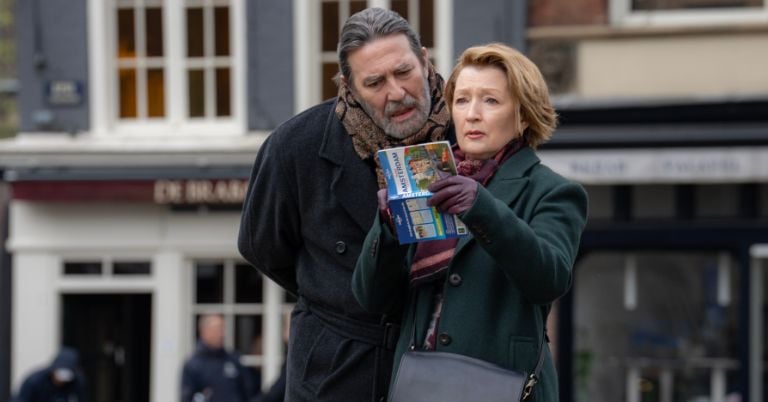
Recently, Findlay and Hinds spoke with DeWayne Hamby of Reel Faith about the film and its themes of human longing and spirituality.
Polly, this was your first feature film after a lifetime of theater work. So, tell me a little bit about what you take away from it, and how this compared to what you’ve done in the past?
Polly Findlay: Well, Ciarán and I have spoken about this before, but I feel I was very lucky in having this as my debut feature. It felt like the ideal gateway from theater, in that it is a film very much about the acting and about the performance. We were really aware going in that the quality of the film was going to live or die on whether or not we gave these two fantastic actors the space and the time to do the thing they do so brilliantly. In some respects, that felt familiar from theater, because a big part of the challenge was creating a set that was reactive and responsive and genuinely engaged and interested in what Lesley and Ciarán were doing. In some ways, that felt like home territory.
Ciarán, you have been in everything from “Road to Perdition” and “Game of Thrones” to Harry Potter. Where does Gerry of “Midwinter Break” land in all these roles? You’ve had some very eccentric, very dramatic characters, and this is a pretty understated role. So, what do you take away from Gerry and what were your thoughts going into it?
Ciarán Hinds: I think we were very fortunate in this day and age to have two days with Polly just reading the piece. It was difficult to actually get to know each other, to get to know who our characters might be, for those characters to get to know each other, for Gerry and Stella. Polly was there to probe us, to ask ourselves and each other questions about the relationship we were going to portray. It gave Lesley and me the license to really be free with each other. Therefore, it wasn’t about what we wanted from the scene, but trying to play the scene as truthfully as possible—whether that meant being emotionally honest or hiding emotions. That was a movable feast, in a way, and we just had to play right in the moment. Almost every scene we did was guided by Polly, and it was a great experience for me. It really meant a lot to me, actually, to be able to play like this, because it’s very rare one gets that kind of opportunity to be so personal and so connected in the search for truth and honesty.
Polly, I write about things from a spiritual aspect most of the time. She’s really struggling in her faith. She’s struggling to rectify her relationship considering deeply held things that she believes, and she feels he takes them lightly or mocks them. How difficult was that to portray with them?
Polly Findlay: Well, I think it’s one of the things that I remember loving in the book. The book is such a wonderful piece of writing, and I felt there were certain phrases and sentences from the book that I wanted the feeling of to live under the film. One that I remember is that Stella, in the book—she’s an old English teacher—says she loves old English because of the language’s ability to move in a blink to the mystical. That sense of moving in a blink to the mystical was a thing that Lesley and I talked about a lot. She is somebody who is constantly seeing a miracle. She’s somebody that spots miracles in places. So that scene where they see the horses, or even just in a little way that scene when we’re in the museum, and there’s that crowd of children looking at the picture, and they’re also striking in their white coats. There are these little things that we found all the way through that felt like they had that sense of daily miracle in them. Of course, that’s what a marriage is as well—there’s that sense—and I think that is what happens at the end: there is a decision to have faith in each other, to find a moment of change and trust, and to take a leap into what feels like the unknown, which is an amazing thing to do at that stage in a relationship. So, for me, the religion of the film was less about anything that felt like dogma, and more about that character having a super sensitivity. One of the other sentences was Bernard talks about pollen sensitizing your nose to sneezing, so that you have the pollen in your nose. There’s a sense of: Oh, I’m just about like that. You feel super sensitive. They’re both in this place of super sensitivity over the course of this weekend—liveness to the world—and the spirituality of the film is in that sense of being alive to the world and each other, I think, as much as anything else.
Her spirituality could be substituted with any kind of strong held belief that she has, that he doesn’t necessarily subscribe to, or that he may make light of. Ciarán, I felt like you really played your role very sympathetically. I felt for Gerry, even among the issues that he had, the challenges that he had. I did not want her to give up on him and I love the resolution of them coming together. Talk a little bit about just that stage of life when a man basically has to assess, “What’s going wrong and what’s going right, and what do I need to do to change it?”
Ciarán Hinds: It’s interesting. From my perspective, when you play it, but from the outside, he’s quite a needy person, quietly, very needy. He’s almost like a child; he has a deep-seated fear of being abandoned. The only person that he’s been really connected with his entire life is his childhood sweetheart. He has lost his faith; she has not, and he doesn’t want to take her faith away from her. But at the same time, there are some things that he can just let be. That’s where the friction comes from. I think at the end, he wants to be honest with himself and honest with her, and that is the problem when resentment and frustration come into a relationship about two people living together some 45 years and they’re not on the same path. But there is a way that they can hold each other along the path, and I think that’s what he’s aiming for. Towards the end, when he does say, “I love you more than anything,” he still can’t admit to the fact that he believes it was more science than religion that saved our child—the fact that the bullet didn’t bear, that it missed and went through. When he says, “I hate myself when I drink. I hate myself more when I’m not drinking.” He’s honest in his appraisal of himself. He’s ashamed of himself. He loves this woman so deeply, and he needs her so much that he’s a bit of a mess, but he will try and hold her up. That’s all. It’s so human. It’s so human.
“Midwinter Break,” directed by Polly Findlay and starring Lesley Manville and Ciarán Hinds, released February 20 from Focus Features.












 Ad-Free & Subscriber Log-In