

Here’s a quick look at one of my favorite examples of what I mean when I talk about the Bible as being a collection of arguments. I don’t mean arguments about the Bible, but arguments within it — arguments between the various biblical writers and editors and redactors.
Perhaps the biggest and most frequently occurring argument within the Bible is the one about exclusion vs. inclusion. Did God choose Abram to bestow upon him an exceptional privilege, or to commission him for an exceptional mission? Are the people of God those who are distinct from everybody else, or is it their job to invite and to demonstrate to the entire world that everybody is the people of God?
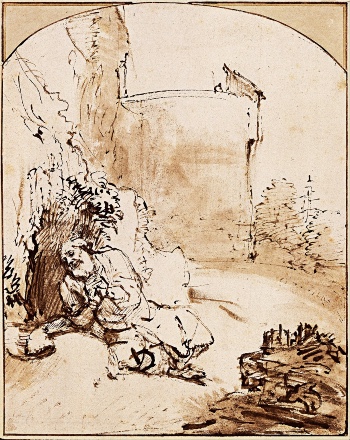
The anthology of anthologies that we call the Bible includes voices advocating for both sides of this argument. It gives us scores of exclusionist arguments and just as many inclusionist arguments. I usually describe this running biblical argument as the fight between Team Jonah and Team Everybody.
That tells you which side I side with, since the book of Jonah is itself a vicious polemic written against Team Jonah, arguing that the exclusionist understanding of the people of God is not merely mistaken, but foolish and spiteful and self-destructive. (And suggesting, in the view of the author of Jonah, that the biblical writers on the other side of this argument are pretty much just a bunch of miserable jerks.)
The book of Acts also sides with the author of the book of Jonah, but it’s not so much a polemic against Team Jonah as it is a start-to-finish argument on behalf of Team Everybody. Where the author of Jonah is landing punches, the author of Acts is giving out hugs, because if Everybody Means Everybody, then Everybody even includes the Jonah types who think it doesn’t.
And Acts is not subtle about this. It starts with Jesus’s final commission to his followers, commanding them to invite in and include Everybody “in Jerusalem, and in all Judea and Samaria, and to the ends of the earth.” Then comes Pentecost — the proclamation of Good News for Everybody that’s miraculously heard in every language of the world.
Despite that one-two punch of the Great Commission and Pentecost, these first Christians of the not-yet-church struggle to get on board with Team Everybody. This is a major theme — almost a running gag — throughout the first half of the book. But by chapter 15 of Acts, they finally — somewhat belatedly and somewhat begrudgingly — all agree to get with the program. This happens at what we call the Council of Jerusalem, where James gets the final word and affirms the church’s allegiance with Team Everybody.
James does so by quoting from the book of Amos. “The words of the prophets are in agreement with this,” he says, and then he recites from Amos 9:12: “that the rest of mankind may seek the Lord, even all the Gentiles who bear my name.”
Here’s where this gets very interesting, and why this is such a good example of what I mean by the ongoing internal argument within the Bible between exclusion and inclusion, between Team Jonah and Team Everybody. Because that passage from Amos that James quotes sure sounds like a clear statement of inclusion. What is the duty of God’s people? It is to ensure “that the rest of humanity may seek the Lord, even all the Gentiles.” Even the great city of Ninevah and all the heathen sailors.
But if you’re reading James there as he recites from Amos in Acts 15:17, you’ll see a little footnote in your English translation of the Bible. When you look down to the bottom of the page, it will give you the citation, Amos 9:12. And then, if you turn in that same Bible you’re holding to Amos 9:12, you’ll read something very different from what James read. You’ll read, instead, this: “so that they may possess the remnant of Edom and all the nations.”
That doesn’t sound like Team Everybody at all. That sounds like something you’d say at a pep rally for Team Jonah. What does it mean to be God’s people? It means we get to possess the lands of Edom — we’re preferred over our cousins, “and all the nations.” It means we’re special and blessed above everybody else. Suck on that, Ninevah!
So what’s going on here?
It’s a little complicated, and that complication is hinted at by the footnote in Acts 15 in the NIV, which says, “Amos 9:11,12 (see Septuagint).” James may have been reading from the Greek translation of Amos found in the Septuagint instead of from the Hebrew Masoretic Text version of that book that was used for the “Old Testament” in our English Bibles.
But I’ll try here to avoid getting into the weeds of LXX and MT and all that. I’m not any kind of expert in ancient languages and I’m not writing here for experts in ancient languages.
The fascinating, basic gist of the issue here is that the oldest written versions of the book of Amos were in a form of Hebrew that didn’t have punctuation, or upper and lower cases. Or written vowels.
What that means, among other things, is that one word in Amos 9:12 was just written “DM.” The reader might decide to plug in one set of vowels and have that read as “Edom” — meaning the descendants of Esau and the land east of Israel where the people of Edom lived. Or the reader might also, just as legitimately, opt to plug in another set of vowels and thus read the word as “adam” — meaning humanity, humankind as a whole.
Something similar is also true of the rest of that passage, where the conflicting readings of “seek” versus “possess” are both available as legitimate options for what the text may intend. (Plenty of articles on this by actual scholars if you’re up for that, but I’m not gonna get into the details here, because I’m only half sure that I even half-understand discussions about “pronominal suffixes” and whatnot.)
The bottom line is that in our English Bibles, Acts 15 quotes Amos 9 and our version of Amos 9 doesn’t say what Acts says it says. And in the simplest terms, this conflict between those passages may be due to Jesus’s brother reading from a different translation of Amos than the one used for our Bibles. The one James had plugged in one set of vowels — DM as “adam,” while our version of Amos is based on a different translation that plugged in different vowels — DM as “Edom.”
That’s possible and maybe even likely. But I like to imagine the scene there at the Council of Jerusalem with James opening up an older scroll of Amos, one with the ancient writing that included no indication as to which vowels belonged there.
Things are tense. Barnabas and Paul have just made their plea for Team Everybody, “telling about the signs and wonders God [was doing] among the Gentiles.” Philip isn’t there to make this case with them because he’s probably off somewhere baptizing yet another queer Black guy or Samaritan sorcerer or some such. Team Everybody finally has Peter on their side, thanks to Cornelius & Co., but people like Cornelius don’t have a say in this Council, since the whole point of the gathering is to decide whether or not they can or will be included.
And now their fate seems to rest in the hands of James who has, so far, been less than receptive to the radical inclusivity of Philip and Barnabas and Paul. Their fate and my fate, too, since what’s being decided here is whether or not people like me are allowed to be part of Everybody — whether or not even people like me can be included as God’s people.
James turns to Amos chapter 9 and this is what it says, in all caps, with no vowels: DM.
And now James has a choice to make.
This is what we find, too, when we turn to “the Bible.” It affords and accommodates different and opposite meanings, depending on how we choose to read it. We can choose to view it as a text assuring us that we are the special ones who will get to “possess” every last remnant of the lands and legacies of “Edom” and of all the excluded whose birthright we have taken for our own.
Or we can choose to read it as a text that calls us to call in “the rest of humanity,” so that Everybody may seek the Lord.
James chose wisely. He cast the deciding vote for Team Everybody.
I happen to think he chose correctly. But then, like Cornelius and his household, and like Simon of Samaria, and like the Ethiopian eunuch and his queen, I am not a disinterested party here.










 Ad-Free & Subscriber Log-In