

• This Politico headline could’ve worked harder on the R.E.M. reference — “How the Rapture Explains the Rupture Over Israel on the Right” — but Joshua Zeitz’s piece is a pretty decent overview.
 Zeitz argues that Christian Zionism is waning in America because Rapture Christianity (“dispensational premillennialism,” i.e., Left Behind-ism) is fading among younger white evangelicals. He doesn’t suggest a simple answer for why that is, but suggests that the complicated arcana of “Bible prophecy” schemes is harder to sustain with younger people who are less strict about church attendance: “Dispensationalism is a theology of charts, timelines and interlocking prooftexts. It flourishes when people are motivated to practice theology — and when religious institutions train them to do it.”
That’s true enough — mastering the arbitrary skipping around between proof-texts that Rapture folklore demands really requires twice-on-Sunday and Wednesday-night church attendance. Otherwise you’ll just keep reading all of those “prophetic” passages in context, never realizing how you were supposed to dissect and reassemble them into the basis for all of those elaborate charts and timelines. Unless you’re reading all of Scofield’s footnotes, you’ll never just pick up a Bible, read it for yourself, and come up with anything like that ornate, convoluted system.
But premillennial pessimism in general is also waning because it’s being replaced by more triumphalist, “dominionist” eschatologies. And also, I would guess, because watching the icons of Rapture Christianity die of extreme old age after decades of them saying “It could happen this very night” with it never happening has probably made their prophecies seem less convincing. (We’re also now on the far side of the turn of the century, so our calendar seems to be counting up more than counting down.)
And, beyond the scope of Zeitz’s capable summary of all of this, I think there’s also more to the appeal of “Christian Zionism” than just premillennial-dispensationalist mythology and the spell-casting invocation of Genesis 12:3 by people like Mike Huckabee and John Hagee. I suspect another element in their blanket support for the state of Israel is that it represents for them an alternative to pluralistic liberal democracy, a model they would like to see duplicated here. (Tad Delay’s much denser discussion of white evangelical “Christian Zionism and the US political imaginary” touches on this somewhat, but with more Jacques Lacan and such in the mix.)
• I’ve noted here previously that religion reporters shouldn’t feel compelled to call Samuel Rodriguez every single time they need to quote someone representing a “Hispanic evangelical perspective.” And that they surely shouldn’t be calling him as much as they do so he can provide THE “Hispanic evangelical perspective” even if that’s what he’s always insisting he provides. I’ve heard grumbling about this before, about how annoying it is to many of those he claims to represent that they’re always being sidelined and silenced in favor of this transparent climber and spotlight-chaser.
And now it seems the people he’s shoved out of the way so he could hog the microphone are starting to shove back: “Over 100 Latino Christian leaders say Trump adviser Samuel Rodriguez’s reach is misrepresented.”
More than 100 Latino Christians leaders signed a statement saying the Rev. Samuel Rodriguez, an evangelical adviser to President Donald Trump and a go-to voice for Hispanic evangelical perspectives, and news media have exaggerated the size of Rodriguez’s reach as president of the National Hispanic Christian Leadership Conference.
In the statement released [last month], the signers said they were prompted to speak out because of the damage the Trump administration’s immigration policies have done to Latino communities. …
Several signers of the letter, titled “We are not a monolith, we are a multitude,” said that while Rodriguez represents some Latino evangelicals, he should not be the sole public representative.
“It’s not just a misrepresentation but how that misrepresentation is impacting the communities we serve,” said the Rev. Gabriel Salguero, president of the National Latino Evangelical Coalition and a letter signer. “Our people are hurting, and our people are not going to stand for apologists for this kind of immigration action.”
Building on years of simmering frustration with Rodriguez among some Latino evangelicals …
Rodriguez is one of those “leaders” whose “leadership” has always been based on how many pictures he could manage to score of himself standing next to Donald Trump. And now, well, there are lots and lots and lots of pictures of him and Trump, grinning like besties. Sowing, reaping, etc.
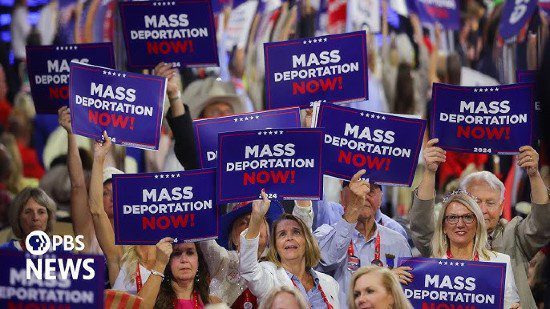
• For some context on why those “years of simmering frustration with Rodriguez” have finally bubbled over, check out Ethan Fauré’s piece, “New Project 2025-Inspired Playbook Urges Trump to Double Down on Mass Deportation.”
Last week the Mass Deportation Coalition (MDC) — a collection of national and state-level groups and individuals of varying influence, all aligned with the MAGAmovement — published a “Playbook” of 21 recommendations for the Trump administration to pursue a “whole-of-government” effort expanding its draconian immigration enforcement operations. “With little over a year of this administration completed,” the document urges, “the time for the first phase of deportations, ‘the worst first,’ should come to an end and advance to phase two: a mass deportation program.”
In 2024, Rodriguez was able to sell that “first phase of deportations, ‘the worst first,'” to some Latino evangelicals as a form of respectability politics that he seems to think will provide them (or at least him) with honorary whiteness. By now it’s clear that this was always just a first step, intended to pave the way for “Phase two: a mass-deportation program,” in which no one, not even Sammy Rodriguez himself, was safe.
The bargain he’s been selling is bogus. Support for the White People’s Party will never get them (or him) support from the White People’s Party.
• Here’s a story about American exceptionalism: “West Haven church ordered to pay $397K says it never knew about lawsuit.”
That newspaper report covers the litigation and the stakes for the local church. Somebody tripped on the sidewalk by its parsonage and broke a hip. That person — or their insurer — sued the church, but nobody at the church seems to have known about that, so they never showed up in court and the judge ruled against them. So on the on hand, this is a story about legal procedures and personal-injury cases and all that.
But it’s really a story about the American health care system, which is unique because when somebody breaks a hip here in America, it’s gonna cost hundreds of thousands of dollars and multiple entities — competing insurers, health care conglomerates, individuals, local businesses or local churches — are going to wind up fighting in court over who has to pay. That’s the story behind this story. All of it — the financial desperation of the person with the injury, the financial desperation of the local church — is a function of American-style health care.
It isn’t this way everywhere and it doesn’t have to be this way.













 Ad-Free & Subscriber Log-In