

The now-defunct British duo Slow Club learned from Charles Brown in writing the lovely, wistful Christmas song that proved their biggest hit. That song, “Christmas TV,” is now a part of the “contemporary” Christmas music streaming at work. Its catchy, happy-sad refrain of “Just come on home, just come on home, home, home” reminds me a little of Brown’s “Please Come Home for Christmas.” It also reminds me a little of all the “Stomp, Clap, Hey” pop-folk that became a trend a few years later
Mainly, though, what “Christmas TV” makes me think of is seeing Chevy Chase getting gunned down like Moe Green in the big baptism scene in The Godfather.
Let me explain, for those who don’t remember watching the second season of Chuck back in 2009. That season ended with the wedding of Chuck’s sister, Ellie, and her longtime doctor boyfriend, Devon (aka “Captain Awesome”). Their church wedding is interrupted, and ruined, thanks to the intervention of that season’s main villain, played by Chase. He gets arrested and Chuck arranges a beautiful beach wedding for Ellie and Awesome and it unfolds as a big montage that tips its hat to that scene from The Godfather, interspersing scenes of the happy couple and scenes in which Chase is murdered by an agent of the following season’s even worse main villain.
Hearing the song from that scene made me go watch it again. It’s still a lot of fun. It includes almost all the familiar faces from the show — the secret agents from Chuck’s secret life and the screwballs and screw-ups from his day job in retail.*
But it’s not Chuck’s wedding, it’s Ellie and Awesome’s big day and so the scene is also full of unfamiliar faces, with lots of their friends and colleagues from the hospital where they both work. Other than Chuck and his girlfriend/spy/handler Sarah, we viewers don’t recognize anybody from the wedding party. Who are these people?
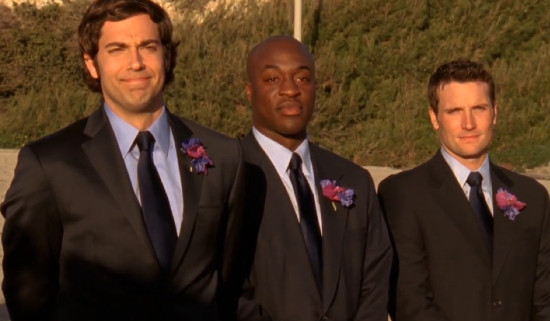
The other groomsmen and bridesmaids in the scene — Ellie and Awesome’s dearest friends — are all doctors from a TV hospital, so we see an ethnically diverse bunch of young, implausibly good-looking people.
The headline cast for Chuck was mostly white, but the background diversity at Ellie’s wedding (sometimes very background) wasn’t new for the show. Right off the bat, in the pilot episode, when Ellie throws a birthday party for her brother to introduce him to the kind of responsible women she hopes will force him to grow up, we see that Ellie and Awesome’s friends from the hospital are a diverse (and implausibly attractive) bunch.
These occasional reminders that Ellie Bartowski has Black friends is the kind of thing often criticized as tokenism — a form of bare-minimum representation performed in lieu of actual equality or inclusivity. And even such minimal, tangential inclusion is also often criticized as “woke” — the current term for what was, back during the early 2000s run of the show, still sneered at as “political correctness.”
Those opposite criticisms are sometimes presented as two sides of a “culture war” raging between liberals and conservatives.
But that’s not entirely what’s going on here. This isn’t about any current “culture war” so much as it is about one that was already fought — and won, decisively — ages ago. This has to do with the morality of white supremacy, which was the subject of more than merely a culture war. What’s now described as the “conservative” side of that war lost, and the totality and enormity of that loss accounts for their lingering bitterness over the sight of Black characters in a wedding party in the background of a TV show.
Those background characters are, in fact, tokens — symbols rather than characters. They are Black because Ellie and Awesome are white, and thus they are ambiguous and suspect characters — their character is suspect and ambiguous. We do not know if they are Good Guys or Bad Guys in this story and the age-old shorthand way of indicating which they are is to show us that these white characters have Black friends.
That sounds like the worst kind of white-liberal-guilt nonsense, and it often is that. It’s often sloppy and slapdash and reductive. It resembles the defensive move employed by every white person just after or just before they say or do something that seems kind of racist, where they loudly insist that others mustn’t ever accuse them of being such because they “have Black friends.” That move resembles this because it is an imitation of this — an attempt to establish oneself as a “Good Guy” by imitating the way we’ve all seen and read dozens of stories establishing that, even long before television. American stories have been doing this for generations. The quickest way to establish the virtue of a white character in an American story is to show that character’s friendly relationship with a Black person.
This isn’t some post-Civil Rights Movement phenomenon or relic of the 1960s. It’s a shorthand language that storytellers and their audiences have understood since Rick and Sam or Huck and Jim.
Is this often dismissive or condescending or tokenistic or problematic in countless other ways? Yes. Yes it is. It often centers and foregrounds white characters while reducing Black characters to subhuman symbols and accessories who serve only to support them. And it caters to white people’s desperate desire to be granted an unearned atonement, to be given a Get Out of History Free card, to be exempted from hegemony, and to be acknowledged as One Of The Good Ones. None of that is great.
Somebody with more time and learning and insight than me could write volumes about all the problems with this hoary trope of the Black friend as a signal of the white character’s virtue. (And plenty of such people have written such volumes.) There are very many and very large problems with this device. It’s problematic in many of the same ways that corporate “DEI” programs are problematic. And it can convey or involve the same smug shallowness that undermines those efforts.
But I’m not writing here either to critique this device or to defend it. My point here is simply that it persists because it works — because it effectively communicates that This White Character Is Good (or, at least, that This White Character Is Not All Bad).
And it communicates this effectively even to those angrily denouncing it as “woke” or “P.C.” This is part of what makes them so angry.
They catch those brief, fleeting glimpses of Ellie’s diverse bridesmaids flitting through the background with no speaking parts and they both understand and accept the shorthand message that this signals. They accept that this underscores that the white character in question is not a hateful person or an exclusive person or someone clinging to imagined hierarchies in which she is entitled to superiority. And they accept this as valid evidence that this character is, in short, good. They understand that this weird American signaling works and why it works and that it works even for them, and that infuriates them because it reminds them that they have chosen and continue to choose to be on the villainous side of this long-ago settled cultural question.
Even the loudest and most adamantly anti-DEI MAGAnauts — people as far right as Adam Baldwin — who witness a character making even the slightest demonstration of the virtues of diversity, equality, and inclusion will perceive those virtues as virtuous. This is, to them, intolerable. It makes them mad and drives them mad because they perceive it as a personal attack. If a fictional character who has made choices that I refuse to make is thereby portrayed and perceived as good (even by me), then I am being portrayed and perceived as bad (even by me).
And we can’t even try to calm them down by reassuring them that, no, no, no — this is just a TV show … it doesn’t really mean anything and it has nothing to do with you. Because we know that they know it does mean something and that that something has everything to do with them.
They understand the situtation, so I’m not sure what we can say to them other than something much like “Just come on home, just come on home home home.”
* Speaking of day jobs in retail … December is a fundraising month here at the blog because, well, because we need it to be. A lot. (Sorry, thank you.) So here again is my PayPal link. And here again is my Venmo: @George-Clark-61. Thanks again.










 Ad-Free & Subscriber Log-In