

Warren Throckmorton shares a couple of excerpts from Keri Ladner’s new book American Dominion: The Rise and Radicalization of a New Christendom.
Ladner’s book includes this fantastic tidbit of real history that seems too on-the-nose to be real. She writes about the moment Donald Trump first engaged with the white evangelical voting bloc, when he was invited to speak at the Faith and Freedom Coalition conference:
He had his introduction to the world of political evangelicalism in 2011, when he came on stage to the lyrics, “Money, money, money, money.”
The lyric here is actually “Money, money, money, money. … [beat, beat] … Money.”
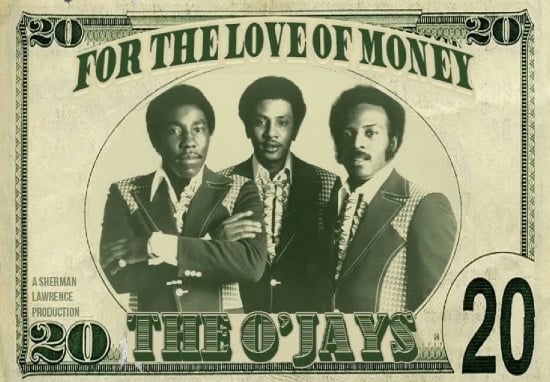
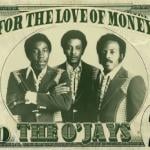
I suppose conference organizers were thinking about how Trump was famous for being a mega-rich “businessman,” and so they were looking for walk-on music to hype up the audience that would underscore that identity. But the O’Jays’ “For the Love of Money” doesn’t celebrate wealth. It indicts it.
That song is basically a sermon on 1 Timothy 6:9-10 set to a killer funky riff.
1 Timothy 6 is the famous “root of all evil” passage: “Those who want to get rich fall into temptation and a trap and into many foolish and harmful desires that plunge people into ruin and destruction. For the love of money is a root of all kinds of evil.”
The preceding verses, also describing the sort of people who “want to get rich” and pursue “many foolish and harmful desires,” also seems to fit:
They are conceited and understand nothing. They have an unhealthy interest in controversies and quarrels about words that result in envy, strife, malicious talk, evil suspicions and constant friction between people of corrupt mind, who have been robbed of the truth and who think that godliness is a means to financial gain.
I think those two inspired texts — the one from 1 Timothy and the one from the O’Jays — offer clearer insight into, and a more accurate description of, the two white Christian leaders profiled in these excerpts from Ladner’s book.
The first excerpt is about Ralph Reed, the head of that Faith and Freedom Coalition who invited Trump to speak there, advising him to “get to know evangelicals,” whose support he would need to succeed in any Republican primary election. Ladner’s short history of Reed’s work and political strategy at the Christian Coalition glosses over why it was forced to later change its name to “Faith and Freedom.”
“Christian Coalition had faced a series of scandals, beginning in the late 1990s,” Ladner writes, “but Reed brushed these off and eventually rebranded his movement as the Faith and Freedom Coalition.”
These were not sex scandals. They all involved the Almighty dollar. That mean, mean green.
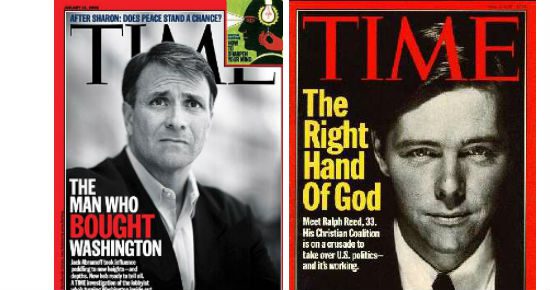
Ladner portrays Reed here as a conservative Christian activist primarily involved in the work of getting other conservative Christian activists elected to school boards nationwide. But at the time he was pitching Donald Trump on the necessity of winning over white evangelical voters he was primarily a freelance lobbyist and political operative coming off of years of involvement in Jack Ambramoff’s fraud, extortion, and money-laundering schemes.
The only reason Reed was not in prison in 2011 is that Abramoff found him so skin-crawlingly creepy that he was kept apart from the inner-workings of the scam. Abramoff would get hired as a lobbyist for tribes seeking to open new casinos. He’d then hire Reed to rally white Christians to oppose those same casinos, allowing him to go back to the tribes explaining that this opposition meant he’d need millions more from them to overcome this new opposition. Reed got paid from both sides — collecting his share of Abramoff’s racket plus whatever he could fundraise from the Christian rubes against the casinos that he and his boss, Abramoff, were ensuring would eventually be built and expanded.
That’s the basic gist. It got way more convoluted — Abramoff was a talented white-collar criminal — pitting various tribes and non-tribal casino interests against one another and laundering income from all of them through a host of shady fake companies. But Ralph Reed’s role in this con was explicitly and only that: a role in a con.
Reed was and is a con artist. He is also a key figure in the rise of white/Christian nationalism and someone Ladner rightly includes as such in this history of its rise — particularly given what Ladner shows to be Reed’s direct role in shaping its emerging form by introducing white evangelicals to their soon-to-be champion Donald Trump.
But in this excerpt, Ladner portrays Reed as a true believer who is committed to this Christian nationalist agenda due to his genuine Christian faith and his genuine conservative political ideology, I do not doubt that Reed is also, among other things, inclined to prefer Christian hegemony and right-wing politics. But his personal history proves that these are not his paramount concern. When he was faced with the choice between those things and making millions of dollars from casino profits, he chose the millions of dollars.
“Let’s say it plain: Ralph Reed is a fraud,” Alex Gibney wrote as the first sentence of his 2010 Atlantic article on “The Deceptions of Ralph Reed.” It does not help our understanding of “The Rise and Radicalization of a New Christendom” to refuse to acknowledge that plain truth or to pretend that Reed is something other than a fraud.
The second excerpt from Ladner’s book involves Sean Feucht, the MAGA-evangelical “worship leader” famous for defying public health restrictions during a pandemic and for desperately needing some Pantene and a trim.
Feucht comes from the charismatic/Pentecostal wing of white evangelicalism — a culture that is full of both cynical grifters and zealous true believes. I don’t have enough of a handle on Feucht to know which one of those he is, but Ladner paints him as the latter — as a mission-trip kid who snapped during Covid and began channeling all of that religious zeal into right-wing white/Christian nationalism.
That may be part of Feucht’s story and part of what we need to understand about him. But I do not think it is the whole story, or an adequate representation of what we need to understand about him.
See, for example, some of the jaw-dropping details of this AP report from last fall: “Worship leader Sean Feucht mismanaged millions in ministry funds, former associates say.”
The word “mismanaged” there presumes that these “ministry funds” were collected for the purpose of Feucht’s white/Christian nationalist “ministry,” but if we instead recognize that these funds — tens of millions of dollars — were collected for the personal benefit and enrichment of Sean Feucht, then I’d say he managed them pretty well.
His publicity stunts against pandemic measures were very lucrative: “Revenue to Feucht’s ministry also skyrocketed, jumping from $243,000 in 2019 to $5 million in 2020 — the last year his ministry filed a Form 990 with the IRS.”
And that money didn’t get reinvested in his “ministry.” It was invested in real estate:
Property records posted online by the concerned former associates show Sean Feucht Ministries has purchased nearly $7 million in property since 2020. The properties include two parsonages in Washington, D.C., and San Juan Capistrano, California, a 40-acre hunting property with a cabin in Creston-Bigfork, Montana, and 458 acres in Real County, a scenic region known as the “Swiss Alps of Texas.”
The property records also show Feucht and his wife personally own $4.5 million in real estate. That includes seven rental properties in Pennsylvania and a house in Redding, California, that were purchased between 2009 and 2023; a condo in the oceanside community of Dana Point, California, that they bought in April; and a Big Fork, Montana, property about 15 minutes from the ministry’s hunting ground.
I’m thinking back to all of the struggling Christian ministries I’ve worked with and supported over the years. None of them owned a hunting ground. Maybe that was our problem.
Feucht, like Reed, sure seems to be someone who thinks that godliness is a means to financial gain. It certainly has been for both of them. Perhaps that’s why they are also, as 1 Timothy 6 says, “conceited and understand nothing,” and why “They have an unhealthy interest in controversies and quarrels about words that result in envy, strife, malicious talk, evil suspicions and constant friction.”
Whatever else we may need to know about the leaders and the agenda of those promoting “a New Christendom,” the most essential advice may be what the O’Jays told us back in 1973. Don’t let money fool you. It’ll only try to rule you.









 Ad-Free & Subscriber Log-In