

• “Where, exactly, this is all heading remains to be seen,” this Religion News profile of 22-year-old online “evangelist” Bryce Crawford says. But, frankly, “where, exactly, this is all heading” seems obvious and inevitable:
Crawford has become one of the most popular evangelical voices of his generation. He has a combined total of 7 million followers on TikTok and Instagram and a hefty YouTube catalog of sermons and street-preaching videos. His podcast, which sits at third on Spotify’s Religion and Spirituality charts, has hosted influential and contentious figures, including far-right pundit Tucker Carlson and 89-year-old prosperity gospel televangelist Kenneth Copeland. Crawford has also, of late, aligned himself with MAGA platforms such as Turning Point USA. …
At a moment when Generation Z’s religiosity is hotly debated, Crawford is clearly resonating. But whether his virality is driving a real movement — and where, exactly, this is all heading — remains to be seen.
Crawford is an evangelist in the same way that Mr. Beast is a philanthropist.
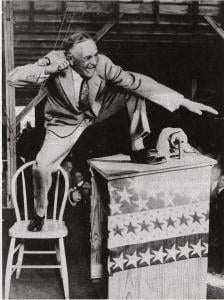
The high-profile interviews mentioned here tell us “where this is heading” — toward some cross between Tucker Carlson and Kenneth Copeland. Picture Nick Fuentes with a fleet of Jesus jets. That ain’t “revival.” That is not compatible with any credible meaning of “revival.”
I mean, like, the Second Klan was a nominally Christian organization that swelled to some 5 million members in the 1920s (back when the total population of the country was only about 120 million or so). That was “viral” and it had the sign of the cross, but I wouldn’t describe it as “revival.”
And also too, I realize that I am about to turn 58 and I am therefore irremediably out-of-touch with Kids These Days, but are Tucker Carlson (57) and Kenneth Copeland (89) really Gen-Z icons?
And isn’t the whole confrontational man-on-the-street shove-a-mic-in-a-stranger’s-face style of “street preaching” a little past it’s sell-by date at this point? If this kid is trying to bring that 2010s shtick back into vogue, I suppose that’d be a “revival,” but in a different sense of the word.
Anyway, I am not deeply familiar with this YouTuber/street-preacher’s body of work, but YouTubers and street-preachers should be presumed guilty until proven innocent.
• Two American teenagers attacked a mosque in San Diego last month, killing three people. The two men were white-supremacists and Neo-Nazis who attacked an Islamic house of worship because they hated Jewish people and because they hated women.
Some people think “intersectionality” is a new idea that has only existed since they personally first heard the term “woke.” But tyrants and Nazis and white-supremacists have always been intersectional. “That train is never late.”
• Doktor Zoom points us to this 2023 AP story on the sleazy, always-be-grifting corruption of Texas Attorney General Ken Paxton:
David Maxwell, the attorney general’s former head of law enforcement and one of eight deputies who reported him to the FBI, told investigators that Paxton once bought a $600 sports coat from a hotel store while at a conference and billed it to the event’s organizer. According to transcripts, Maxwell also said Paxton asked for specialty license plates available to state officials but never paid the nominal fee to pick them up.
”He was all about money,” said Maxwell, who is also a former Texas Ranger, the state’s elite law enforcement division. “He always had his hand out.”
Other former staff point to an even smaller gift.
Around Christmas for years, Texas grocery giant H-E-B sent a coconut-dusted cake to the attorney general’s office, which staff shared.
That changed after Paxton was elected, according to three former employees of his executive office who spoke on condition of anonymity out of fear of retaliation.
One said Paxton once told staff not to touch the cake because it was for his birthday, which is on Dec. 23. Another said Paxton once had the cake brought to a Tex-Mex restaurant for a staff lunch but never served it. The third recalled watching Paxton and an aide walk out of the office carrying the cake box.
There are a lot of corrupt politicians, but Paxton really takes the cake.
• Philip Jenkins looks at “lost Gospel” forgeries in pop culture. “In no way would I recommend The Word,” he writes of Irving Wallace’s 1972 best-seller, “except to those with an archaeological interest in 1970s pop culture.”
That’s why I read that book. I found it in on the $1 table of a used-book store years ago, back when my bookstore friends were lamenting the popularity of The Da Vinci Code, so I read it to see how an earlier generation of hack handled similar material. I suppose I enjoyed it more than Jenkins did. It succeeded for a bit in making me want to know what would happen next and then ultimately disappointed when I found out what happened next.
It seems like this premise — a forgery of “lost scriptures” intended to destroy or to revive religion — should be fodder for an entertaining, and potentially thoughtful, thriller. But alas, none of the pop-culture works Jenkins finds lives up to the promise of that premise. Umberto Eco probably could’ve pulled it off, but Irving Wallace sure didn’t.








 Ad-Free & Subscriber Log-In