


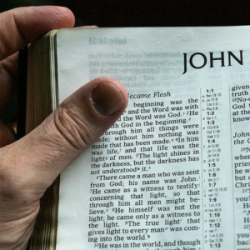
Lastly this week, I want to address the Johannine community’s transition away from an adversarial relationship with certain sects of the Pharisees to the Gospel of John’s universal use of the phrase “the Jews.” The phrase “the Jews” in the Gospel of John, including here in John 9, has a long and troubling history of antisemitic misuse, even though such readings distort the text’s original context and intent.
Welcome Readers! Please subscribe to Social Jesus Here.
This is Part 3 of the series Justice Lessons From Being Expelled
(Read this series from its beginning here.)
It is vitally important when we read the gospel of John to interpret John’s usage of “the Jews” (Greek “hoi Ioudaioi”) not as a blanket reference to the Jewish people as a whole. (Here we are encountering the seeds that led to the Holocaust.) Rather, we should interpret John as pointing to specific Judean authorities (particularly Temple leaders in complicity with Rome) who are portrayed as opposing Jesus. Tragically, later readers collapsed this narrow, contextual meaning into a totalizing indictment of all Jews, fueling centuries of Christian antisemitism.
The Gospel of John emerged from a late first-century Jewish context shaped by conflict within Judaism itself. Jesus, his disciples, and the Gospel’s author were all Jewish. Their sharp language reflects intra-Jewish debate following the destruction of the Jerusalem Temple (70 CE), when different Jewish groups struggled over identity and authority. John’s community, likely marginalized and expelled from some synagogues, articulated its pain through polemic. What was originally a family argument was later weaponized by Christians as an accusation against an entire people.
When removed from its historical setting, then, John’s language was used to justify social exclusion, violence, and theological contempt. Church leaders and preachers repeatedly cited John’s references to “the Jews” to portray Judaism as willfully blinkered or malicious, and that culture culminated in deadly consequences from medieval pogroms to modern racial antisemitism. Such readings contradict both the ethical vision of Jesus found in the Synoptic Gospels and the historical reality that Christianity itself emerged from Judaism. Jesus, remember, was never a Christian. Jesus was a Jewish man in the first century speaking from the Hebrew prophetic wisdom he had gained from his own tradition.
Responsible interpretation today requires rejecting any reading that essentializes or demonizes Jewish people. Interpreters must clarify that John critiques specific power structures, not an ethnicity or religion. For communities committed to justice, this work is not optional. Naming and resisting antisemitic interpretations of scripture is part of repairing the harm Christians have committed against Jewish communities. It means honoring historical truth and practicing a faith that refuses to scapegoat marginalized communities.
This week’s reading presents to us a story of standing up to the status quo and the risks involved in standing with the marginalized when doing so contradicts religious and political institutions. This kind of action is not abstract sentiment. It is costly. It demands we move from private belief to public solidarity, to love our world and those who are being harmed, even when that harm is supported by religiosity. Following the Jesus of our story this week also calls us to confront systems that crush life and stand where solidarity and harm mitigation is risky. Our story calls us to step out of our comfort zones and redirect our loyalties, resist injustice, and commit to transformative action alongside the marginalized, for the flourishing and thriving of all as we work to shape our world into a just, compassionate, just home for everyone.
Begin each day being inspired toward love, compassion, justice and action. Free.
Sign up at HERE.












 Ad-Free & Subscriber Log-In