

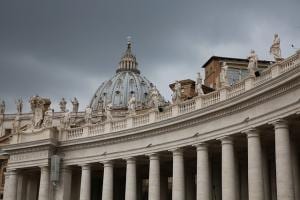
I am reading “Magnifica Humanitas: On Safeguarding The Human Person In The Time Of Artificial Intelligence,” Pope Leo XIV’s first encyclical.
It’s very good. I am reading extremely slowly because I have other deadlines this week, but I hope to talk to you about it in a few days. Just now, I only want to react to the way people are REACTING to “Magnifica Humanitas.” This post is not about the encyclical, only the dialogue.
EVERYONE has an opinion on “Magnificat Humanitas.” Purely secular commentators are commenting on this instead of secular news. I’m watching all kinds of atheist and agnostic accounts on social media tweeting out their favorite paragraphs from the encyclical. People who left the Church and don’t have fond memories of most Catholic things are remarking that they can’t believe they’re suddenly in perfect agreement with the Pope. Leo seems to have really opened up a door. All kinds of human beings who are generally unwilling to hear what the Church has to say, are suddenly listening. That fascinates me.
For quite awhile, it seemed that the Church didn’t want to talk to anyone who didn’t already like the Church.
Fans of Pope John Paul the Second and Pope Benedict XVI would go around saying “the Church will become small” as if that was a good thing. They were proud of how hard it is to be Catholic and how much non-Catholics didn’t like them.
When someone, for whatever reason, couldn’t stand it anymore and left the Church to become an Episcopalian or anything else, the devout would say “good riddance, they never really believed anyway.” And I’m sure many still do. The people who left the Church, meanwhile, didn’t look back. Those who were never Catholic in the first place and only thought of the Catholic Church as old fashioned and stodgy kept dismissing the Church as old fashioned and stodgy. Stodgy Catholics wore the secular world’s dismissal as a badge of honor. That was the Catholic culture I was raised in and the culture I found here in Steubenville. That was the attitude I was used to from non-Catholics.
But somehow, in a small way under Pope Francis and much more under Pope Leo, I’ve felt a change happening. The Church seems to be trying to talk to the secular world in a way they can understand and want to listen to. And the secular world seems to be listening. Leo is respected and liked by all kinds of people from all faiths, and by people of no faith at all. They want to listen to what he has to say, and he wants to talk to them. That’s remarkable to me.
The only people who don’t seem to want to listen, are the people who never want to listen to anything because they’re sure they’re already right.
Raymond Arroyo doesn’t like the encyclical because it doesn’t mention sin often enough. In an interview with Robert Royal, the editor of “The Catholic Thing,” the two griped that “sin is also mentioned three times in this document… how is this a Church document?” as if all papal encyclical was supposed to do was to scold people for their sins over and over again. It’s already been pointed out that other encyclicals like Pius X’s “Lacrimabili Statu” and Pius XII’s “Meminisse Iuvat” don’t mention sin at all. But I get the impression that Arroyo and his ilk don’t think anything is Catholic enough unless it’s lecturing other people on their sins, so that they can watch and feel superior.
And then of course we have Eric Sammons, the editor-in-chief of the aptly named Crisis magazine. I’m not surprised he objects to anything written by Pope Leo. For some reason, Sammons thought it would be fun to run an encyclical on AI through an AI, Claude, for analysis:
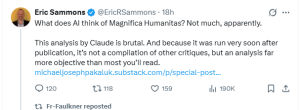
This is funny to me, because LLM’s like Claude are designed to be sycophantic. They’re supposed to try to ingratiate themselves to their users. They are programmed to spit out an answer that the user wants to hear, which will make the user feel good about him or herself. Sammons ran “Magnifica Humanitas” through Claude and got an analysis that he liked. My friend Mike Lewis of “Where Peter Is” also ran the encyclical through Claude for analysis. Mike is of a very different theological and political bent than Eric. So Claude, predictably enough, gave Mike a totally different analysis of the document. That’s what AIs do. They are as reliable as reading tea leaves because they try to tell people what makes them feel good.
So it seems to me that people who need the Gospel preached to them, are suddenly listening to the Church, thanks to Pope Leo. And people who assume they already know the Gospel are the only ones who don’t like it.
That seems to be exactly the way the Church is supposed to work.
I’m very happy and excited to see what happens next.
And I’ll have more on “Magnifica Humanitas” very soon!
Mary Pezzulo is the author of Meditations on the Way of the Cross, The Sorrows and Joys of Mary, and Stumbling into Grace: How We Meet God in Tiny Works of Mercy.










 Ad-Free & Subscriber Log-In