

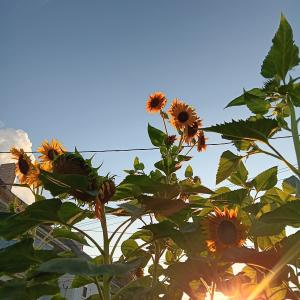
I’m calling the sunflowers “The LaBelle Special.”
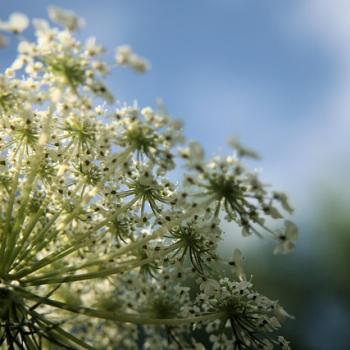
Sunflowers are a flower that cross pollenates with ridiculous ease. If you want to keep only one breed of sunflower and store the seeds for next year, you have to grow it a very long way off from any other breed, and I don’t have a large backyard. In 2023 I planted three different breeds of heirloom sunflower: lemon queens with a myriad of small yellow blossoms, Red Velvet with dark burgundy blossoms, and Mammoths with a single colossal flower. I left them standing in the garden to dry out, in fall, after the petals had dropped off. I had great fun getting to know the birds of LaBelle, who picked at the dead sunflowers and dropped seeds here and there. In the spring of 2024, I had sunflower seedlings growing wild all over the garden. They grew into a strange multi-headed hybrid flower, too big to be a Lemon Queen, with streaks of red in the center of large yellow blossoms. In 2025, I had so many sunflowers that I had to transplant some to the front yard. This year, I posted in the LaBelle neighborhood Buy Nothing group, inviting people to come to my yard with pots and buckets and dig up a sunflower seedling of their own. They’ve done their best to clean me out. But every time I come to check on the garden, there are more sunflower seedlings cropping up where I meant to plant something else. They are my own flower, Mary Pezzulo’s LaBelle Special Sunflower, a flower the birds made for me.
I wish someone had told me, back when I was hiding from my abusive stalking neighbor who beheaded my sunflowers and destroyed my garden, that one day I’d have a yard full of sunflowers to share with the whole town.
I took so long puttering in the garden that I lost track of the time. I was almost late to pick up Adrienne from school, and I had to teach the after school art class very shortly after. I ran upstairs to my room to peel out of my gardening clothes and put on nicer things. There was hardly space to walk around in my room, because I’m keeping the tomato seedlings there until all chance of frost is over. They were in the sunny window, on top of that bookcase I found last summer. I am starting to use that bookcase. I’m learning how to read for pleasure again. It’s taken a very long time. I’ve been reading Jane Austen: a few chapters a night, trying to imagine what it would be like to be the Landed Gentry. I don’t think I’d be good at it.
The only other flat surface in my room is taken up by that ridiculous Barbie Dreamhouse that was Adrienne’s favorite toy.
I was so devastated when she announced she didn’t want it cluttering up her room anymore because she was too old for toys. I felt as if my life was over. I’d spent hours and hours acting out the fantasies Adrienne made up in her dollhouse paracosm, and suddenly the fantasies had gone silent. She didn’t even want to talk about her made up world anymore. She asked me to throw it out, but I stuck it on top of my bureau instead. But then one day, a year or so ago, Adrienne got out the old dollhouse furniture and the G. I. Joe action figures and decorated the house for me, just like old times. She started talking about the games we played again. We talk about her characters often. I’ve asked her to make the stories we crafted into a madcap children’s picture book someday.
I wish someone had told me, back when Adrienne first outgrew her toys, that a day would come when she thought fondly of all the childhood fantasies instead of being embarrassed by them. That children go through a brief phase of having no time for play, and then they mature into learning to be whimsical again. We have so much fun together now: if anything, more fun than when she was little.
Somehow, I got out the door in time to pick Adrienne up. She often wants to come help me teach my class, but today she wanted to go home for a nap. I dropped her off and floored it downtown to the church outreach, where there was barely time to set up for my art class.
I had already taught one group that week about drawing with chalk pastels. They sat quietly like little angels, drawing pastel flowers and forest scenes, joking with me that pastel was great fun because it was just as messy as paint. I had them all pose with their chalk-smeared hands held out for the camera to show the pastor, as well as having them pose holding up their colorful pastel drawings.
I thought it would be just as easy with this class, since they’re the same age group. But this class was stir crazy.
They were too excited to go outside in the warm sun and play; they had no interest in sitting still to learn a new artform. They squabbled over which page to leave the art books open to, so the could copy pictures. One little girl turned her pastel paper over to draw on the back, and ended up smearing black chalk on the whole table. Another little girl took six pieces of paper so that she could chalk “Six Seven” on each of them and nothing else. Chalk pastels spilled all over the floor and rolled to the corners. Finally, a boy came upstairs from the kitchen, where another volunteer had been teaching a cooking class. He showed the students the cookie he’d decorated with blue sugar and candy eyes.
Next thing I knew, all ten of my students stampeded out of the classroom to the kitchen, to get a cookie.
“No running indoors!” I shouted to the thin air, but they were already gone.
I started to clean up the mess.
As the dust settled, one little boy quietly stepped into the classroom.
“Can I have markers?” he asked.
I got him a box of washable markers from the supply closet.
“I want a picture of SpongeBob,” he said, pointing to my phone.
I google image searched “SpongeBob” and set the phone down next to him.
The boy carefully sketched out a rectangle with noodly arms and legs. He drew in the eyes and khaki shorts. And then he carefully colored in his composition as if he was a trained cartoonist. Every time I looked over his shoulder, he’d added something impressive to the vignette: SpongeBob’s pineapple house, the gray house of Squidward the squid next door. We chatted as he worked. He loved drawing cartoon characters best of all, he said. He didn’t like painting very much. Chalk pastel was all right. But markers were his very favorite medium.
By the time the other children came back with their cookies to get their bookbags and board the bus, the boy had made a beautiful composition. He left the classroom, beaming with pride, to show his parents what he’d done.
I wish somebody had told me that chaos isn’t a bad thing, not in itself. You make plans, good or bad plans, and life begins to happen anyway, and for awhile it hurts so terribly you wish you’d never been born. Then, one day, you’re in your forties, and you have a yard full of ragged sunflowers instead of a lawn. You don’t live in a nice suburban neighborhood, but you’ve made peace with your neighbors in LaBelle. You don’t have the six or seven homeschooled children you planned on having, but you have a remarkable child who has near perfect grades and sings in the public school choir and decorates the house with action figures, and you’re best friends. You can’t teach the class you meant to teach, but you can teach and learn from another artist. You can’t win, but you also don’t have to.
Life is dreadfully complicated, but I don’t hate it like I used to.
I went home to LaBelle, feeling happy.
I think I’m going to be all right.
Mary Pezzulo is the author of Meditations on the Way of the Cross, The Sorrows and Joys of Mary, and Stumbling into Grace: How We Meet God in Tiny Works of Mercy.










 Ad-Free & Subscriber Log-In