


What do you call a Catholic theologian who defends Veritatis Splendor, raises concerns about sacramental ambiguity, and urges fidelity to the Church’s perennial moral teachings?
According to Mike Lewis at Where Peter Is, you call him a heretic.
In his recent article, Lewis celebrates the firing of Ralph Martin, Ed Peters, and Eduardo Echeverria—three scholars who spent decades defending Catholic orthodoxy. Their crime? Expressing concern that recent papal documents like Amoris Laetitia (AL) and Fiducia Supplicans (FS) risk confusing the faithful.
But the real scandal isn’t their concern—it’s the selective outrage of those who label it dissent. While progressive theologians who deny moral doctrine receive tenure and synodal influence, faithful Catholics get purged.
Lewis exhibits a venomous double standard—one so blatantly obvious it demands correction and historical context regarding theological dissent in the Church.
Lewis’s Case
Moreover, Lewis accuses these men of violating Lumen Gentium 25 and Canon 752. Yet he provides no direct quotes proving doctrinal rejection or formal dissent. Instead, he bombards readers with inflammatory accusations.
Examples include:
- “These former professors have advanced a widespread anti-Catholic ideology.”
- “This ideology is heretical.”
- “This false orthodoxy… is a form of fundamentalism.”
- “They have campaigned for this warped ecclesiology against the pope for years.”
Did these men publicly reject Church teaching? No.
At most, Martin, Peters, and Echeverria questioned the consequences of ambiguous language in AL and FS—particularly about Communion for irregular unions, blessings for same-sex couples, and the death penalty. They never published a letter of dissent. They simply asked Pope Francis for clarification.
For this, Lewis brands them heretical and anti-Catholic.
Who else belongs to this supposed “anti-Catholic” club?
This mindset has become the mainstream view promoted by media outlets like EWTN, NC Register, The Pillar, Ignatius Press, Crisis, One Peter Five, The Remnant, LifeSite News, First Things, the Catholic Herald—virtually all of ‘conservative Catholicism’ in the English-speaking world. Bishops like Burke, Chaput, Schneider, Strickland, Sample, Paprocki, and so on adhere to and promote this ideology.
What—no mention of The Latin Right? I’m offended. And Mike, raising concern about ambiguity isn’t dissent. It’s fidelity.
The Washington Statement and Humanae Vitae
In 1968, over 600 theologians (led by Fr. Charles Curran of Catholic University of America) signed the Washington Statement in public dissent from Humanae Vitae, Pope Paul VI’s encyclical on artificial contraception. This marked a clear and coordinated rejection of binding moral doctrine.
They didn’t seek clarification. They promoted dissent.
Their statement said:
It is common teaching in the Church that Catholics may dissent from authoritative, non-infallible teachings of the magisterium when sufficient reasons for so doing exist… We conclude that spouses may responsibly decide, according to their conscience, that artificial contraception in some circumstances is permissible.
What were the consequences for this brazen, public dissent? Practically none.
There were no mass terminations. No censures. These theologians continued to teach and publish as usual. Curran remained at CUA until 1986. Other signers—Richard McCormick, Richard McBrien, Bernard Häring—remained highly influential.
So, let’s be clear: theologians who openly denied Church teaching on contraception faced no consequences. Meanwhile, those who affirm Church teaching (but express concern over ambiguous disciplinary documents) get fired or branded dissidents.
Lewis, McElroy, and the German Synodal Way
Some may argue the events of 1968 don’t reflect Mike Lewis’s approach. But Lewis shows a consistent pattern: conservative voices get condemned while progressive ones receive cover.
Take Lewis’s article on Cardinal McElroy’s move to Washington, D.C. He praises McElroy as “one of the most articulate and courageous defenders of Pope Francis’s vision.”
But Lewis never mentions McElroy’s dissenting views on Communion for sexually active Catholics in irregular unions—views widely criticized by bishops and theologians. He omits any mention of doctrinal concern.
Unlike his treatment of Martin, Peters, and Echeverria, Lewis cites no Lumen Gentium 25, no Canon 752, and no “religious submission of intellect and will.”
Next, consider his article on the German Synodal Way. German bishops have openly defied Vatican instructions—proposing structural reforms, blessing same-sex unions, and even calling for female ordination.
Lewis’s tone? Mild. Detached. He writes:
- “Germany’s synodal reformers are moving ahead… despite a clear order from the Vatican not to.”
- “We are watching an institutional standoff.”
- “The Synodal Way’s advocates… insist they are acting in communion with the Church.”
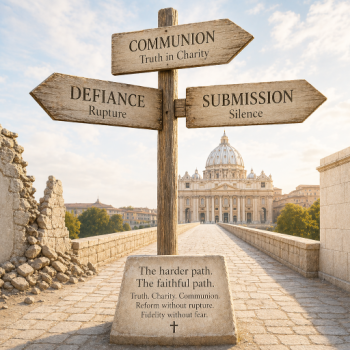
So, when conservative theologians express loyalty to doctrine, Lewis calls them heretics. When German bishops promote doctrinal rupture, he calls it a “standoff.”
Apparently, the only unforgivable sin is questioning a progressive interpretation of papal authority—not proposing schism in the name of reform.
Final Thoughts: What’s Really Going On?
To recap: Lewis accuses three respected theologians (Martin, Peters, and Echeverria) of heresy for asking for clarity. He lumps them in with bishops, publishers, and writers who also defend Church doctrine and question ambiguity.
Meanwhile, he offers cover to actual dissenters: bishops promoting same-sex blessings, and cardinals who argue against Eucharistic discipline. He praises Cardinal McElroy while vilifying men who affirm the Catechism.
This isn’t theological policing. It’s ideological targeting.
Lewis’s article is a hit piece—a textbook case of double standards. He uses inflammatory language against conservatives, while treating progressive dissenters with deference.
So let this article stand as a correction. If questioning ambiguity is heresy, then so was Vatican II. And if fidelity to truth is now grounds for termination, the problem isn’t the theologians—it’s the gatekeepers.
Thank you!
If you liked this article, please leave your comments below. I am very interested in your opinion on this topic.
Read The Latin Right’s other writing here.
Please visit my Facebook page and IM your questions (and follow my page) or topics for articles you would like covered.












 Ad-Free & Subscriber Log-In